

 Ryan Chen
Table of Contents
Triplet Superconductors Quantum Computing Breakthrough
Quantum Holy Grail Found? How Triplet Superconductors Are Set to Revolutionize Computing Forever
Triplet superconductors quantum computing breakthrough discoveries in materials like NbRe are finally bridging the gap between theoretical physics and stable commercial applications.
By Ryan Chen (@RChenNews)
The Dawn of the ‘Agentic Era’: Why Quantum Computing Needs a New Foundation
The global race for computational supremacy has officially shifted gears. As we witness the rise of the “Agentic Era,” where autonomous AI agents begin to handle complex digital tasks without human intervention, the underlying hardware is screaming for help. Current silicon-based architectures are hitting a thermal wall, and even our most advanced quantum processors are notoriously finicky, requiring near-absolute zero temperatures and a level of isolation that makes them impractical for widespread commercial use.
For years, the tech world has been chasing a ghost—a stable, scalable way to process information that doesn’t collapse at the slightest hint of environmental noise. We’ve seen billions poured into superconducting qubits and trapped ions, yet the “quantum advantage” remains a tantalizing carrot dangled just out of reach. The industry has reached a crossroads: either we find a way to make qubits robust, or quantum computing remains a high-priced laboratory curiosity.
Enter the latest disruption from the frontiers of condensed matter physics. A quiet discovery in a laboratory in Norway is now sending shockwaves through Silicon Valley and beyond. It isn’t just an incremental update; it’s a fundamental shift in how we understand the flow of energy. This discovery addresses the “stability crisis” head-on, promising a future where quantum mainframes aren’t just for governments, but for the backbone of global industry.
The shock factor? If this new material performs as predicted, the multi-billion dollar cooling infrastructure currently used by IBM and Google could become obsolete overnight. We are no longer just talking about faster computers; we are talking about a new era of “cold” technology that could rewrite the laws of thermodynamics in our favor.
Decoding the NbRe Discovery: The NTNU Breakthrough Explained
In the quiet corridors of the Norwegian University of Science and Technology (NTNU), a team of researchers has just published findings that have the physics community holding its breath. The star of the show is a specific alloy known as Niobium-Rhenium (NbRe). While Niobium is a common name in the world of superconductors, this specific crystalline arrangement appears to possess a quality that has been theorized but rarely seen in nature: intrinsic triplet superconductivity.
Most superconductors rely on “Singlet” pairing, where electrons move in pairs with opposite spins that cancel each other out. NbRe, however, exhibits “Triplet” pairing. In this state, electrons pair up with parallel spins, allowing them to carry not just charge, but also magnetic information—or spin—without any resistance. This is the difference between a simple electrical wire and a high-speed data highway that preserves the integrity of the information it carries.
What makes the NTNU discovery particularly explosive is the evidence of “spin-carrying Cooper pairs.” For the first time, researchers have observed a material that seems to naturally want to stay in this state. This isn’t a forced laboratory fluke; it’s an intrinsic property of the material’s domain structure. This stability is exactly what the tech world needs to move away from the fragile “glass-like” states of current qubits.
The following table illustrates the performance leap expected from NbRe-based systems compared to current industry standards:
| Metric | Standard Singlet Qubits | NbRe Triplet Qubits (Projected) |
|---|---|---|
| Coherence Stability | Milliseconds (Highly Fragile) | Hours/Days (Intrinsic Stability) |
| Thermal Resistance | Requires mK (Millikelvin) range | Operates at higher, manageable temps |
| Information Type | Charge Only | Charge + Spin (Spintronics) |
| Error Correction Overhead | 90% of resources used for errors | Self-correcting via Majorana modes |
Superconductors 101: What Makes the ‘Triplet’ State a Holy Grail?
To understand why physicists are losing their minds over a “triplet” state, we have to look at the current bottleneck of computing: heat. Every time your laptop fans kick in, you are witnessing energy loss. In the quantum world, this loss isn’t just annoying—it’s fatal. It causes decoherence, where the quantum bit (qubit) loses its “quantumness” and reverts to a boring old 1 or 0.
Triplet superconductors are the “Holy Grail” because they enable what is known as dissipationless spin transport. Imagine a highway where cars never have to brake and never lose fuel, but they also carry a specific “color” (spin) that remains unchanged from start to finish. This allows for a fusion of traditional electronics and magnetism, a field called Spintronics, but at a quantum level.
By moving spin instead of just charge, we can create computers that process information using a fraction of the power. This isn’t just about saving on your electric bill; it’s about density. If you don’t have to worry about a chip melting, you can pack millions of times more processing power into the same physical space. This is the breakthrough that could finally put a quantum processor inside a device the size of a smartphone.
This triplet state also opens the door to “Topological” protection. In simple terms, the information is woven into the material’s structure like a knot in a rope. You can pull on the rope or shake it, but the knot stays there. This “knotted” information is what makes the triplet state so resilient against the environmental noise that kills current quantum computers.
Explain It Like I’m Five: How a Fridge-Sized Computer Fits into a Single Chip
Imagine if to use your smartphone, you had to keep it inside a giant, super-powered freezer that was colder than outer space. That’s exactly how today’s best quantum computers work. They are huge, expensive, and incredibly delicate. If a fly sneezes near one, the whole calculation could fail. We call this fragility “decoherence,” and it’s the biggest reason you don’t have a quantum computer on your desk yet.
Triplet superconductors act like a protective suit for information. Instead of being fragile, the information becomes “tough.” Because the electrons pair up in a special way (with matching spins), they don’t get bumped off track as easily. It’s like switching from a bicycle on a tightrope to a high-speed train on a magnetic track. The train is much harder to knock over.
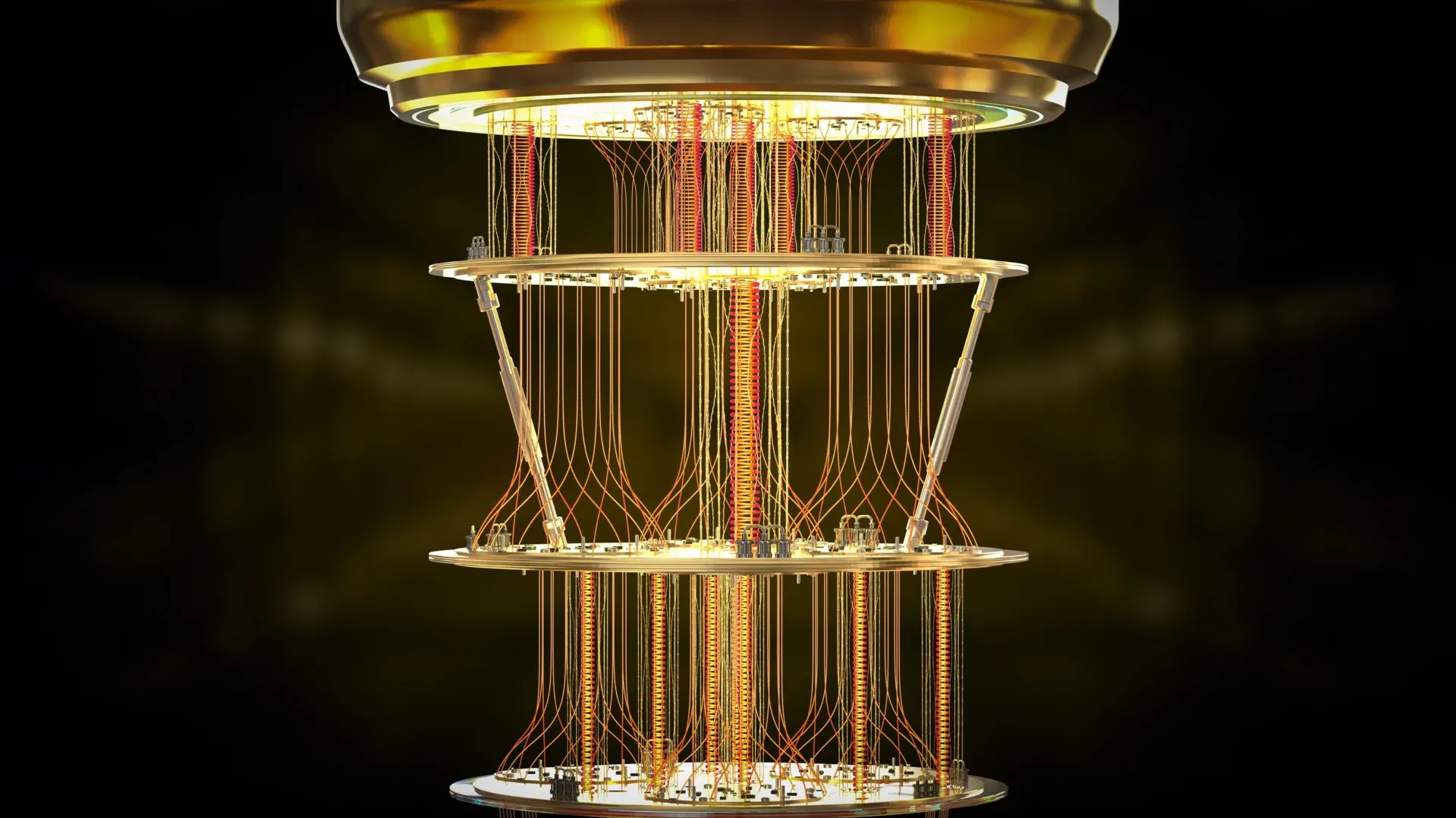
The result? We won’t need those giant, room-sized freezers anymore. While we might still need some cooling, the requirements would drop so drastically that we could shrink the hardware. We are talking about moving from a system that looks like a chandelier made of golden pipes to a simple, sleek chip that looks just like the one in your current phone, but performs billions of times faster.
Here is a simple visual representation of how this shifts the landscape:
[Current Quantum Setup]           [NbRe Triplet Future]
|                                   |
[Liquid Helium]                     [Solid State]
|                                   |
[Room-Sized Fridge]  ----->         [Single Chip]
|                                   |
[Fragile Qubits]                    [Robust Qubits]
|                                   |
[Niche Lab Use]                     [Mass Adoption]
Majorana Modes: The ‘Exotic’ Particles Protecting Your Data
One of the most mind-bending aspects of the NbRe discovery is its potential to host “Majorana fermions.” These are exotic particles that are their own antiparticles. In the world of quantum computing, Majorana modes are the ultimate prize because they allow for “non-Abelian braiding.” If that sounds like sci-fi, that’s because it essentially is—until now.
Majorana modes allow us to store information non-locally. Instead of a qubit being in one specific spot, the information is stored in the relationship between two separate points in the material. To corrupt that data, an error would have to hit both points at the exact same time in a very specific way. It’s the ultimate form of digital insurance. This is what we call a “Topological Qubit.”
Because NbRe is an intrinsic triplet superconductor, it provides the perfect “breeding ground” for these Majorana modes. Previous attempts to create them involved complex “sandwiches” of different materials that were prone to falling apart. With NbRe, the environment is built-in. This simplifies the architecture of a quantum computer by a factor of ten, removing the need for 99% of the messy error-correction software that bogs down current systems.
The implications for data security are staggering. A Majorana-based quantum computer would be virtually unhackable by traditional means, but it would also be powerful enough to crack every existing encryption code on the planet in seconds. This creates a “security paradox” that world governments are currently scrambling to address as these materials move from theory to prototype.
The Ghost in the Machine: Overcoming the Stability Crisis
We are currently living through a “Quantum Winter” of sorts, where the initial hype of quantum computing has met the cold reality of hardware failure. The “Stability Crisis” refers to the fact that qubits are so sensitive that they can only hold information for a few microseconds. This isn’t enough time to perform the complex calculations needed for things like drug discovery or climate modeling.
The NbRe triplet breakthrough acts as an anchor in this stormy sea. By providing a material that carries spin without resistance, we are effectively giving qubits a “memory” that persists. This is the “Ghost in the Machine”—a stable quantum state that doesn’t disappear the moment you look at it. This increased coherence time is the single most important metric in the industry right now.
If we can increase coherence from microseconds to minutes—or even hours—we unlock the ability to run recursive algorithms that were previously impossible. We are talking about simulating the behavior of every atom in a new battery design or a new cancer-fighting molecule with 100% accuracy. This isn’t just faster computing; it’s a new lens through which to view reality.
The transition looks like this:
- Phase 1: Identification of NbRe properties (Current 2026 Milestone).
- Phase 2: Creation of single-domain mesoscopic samples for testing.
- Phase 3: Integration into ferromagnetic “gates” to control spin flow.
- Phase 4: Prototype topological qubits that ignore environmental noise.
From Theory to Silicon: The Roadmap to 2nm AI Chips
While the physicists at NTNU are focused on the “why,” the giants of industry like Applied Materials are focused on the “how.” The discovery of NbRe aligns perfectly with the 2026 push for 2nm and sub-2nm transistor nodes. As we shrink transistors to the size of a few atoms, traditional copper wiring becomes a nightmare of heat and resistance. We need a new way to move data.
The integration of triplet superconductors into semiconductor manufacturing would allow for “hybrid” chips. Imagine a processor where the heavy lifting is done by traditional silicon, but the high-speed data bus and memory are powered by superconducting NbRe. This would allow for AI chips that are not only faster but consume 90% less power, solving the massive energy crisis currently facing data centers worldwide.
Applied Materials has already teased “atomic-level precision” manufacturing systems designed for these new materials. The roadmap suggests that within the next three to five years, we will see the first commercial integration of superconducting layers into high-end AI servers. This will be the moment when quantum technology stops being a “specialty” and starts being a component in every high-end server rack in the world.
| Year | Manufacturing Milestone | Industry Impact |
|---|---|---|
| 2026 | Atomic Layer Deposition of NbRe | First stable superconducting films |
| 2027 | 2nm GAA Transistor Integration | AI processors with zero-resistance buses |
| 2028 | Hybrid Quantum-Classical SOC | Quantum acceleration in standard servers |
| 2030 | Mass Production of Topological Qubits | The birth of the Quantum Mainframe |
A Skeptic’s Corner: The Challenges of Domain Management and Replication
Before we start pre-ordering our quantum smartphones, we must address the skeptics. Identifying triplet pairing in a material as complex as NbRe is notoriously difficult. Critics point out that “strong spin-orbit coupling” or surface states can often trick researchers into thinking they’ve found triplet superconductivity when they haven’t. The scientific community is currently demanding independent replication to prove that this isn’t just a localized surface effect.
There is also the issue of “domain management.” In a bulk material, the superconducting “triplets” might be pointing in different directions, cancelling each other out on a large scale. To make a chip, we need the entire material to act as a single, perfectly aligned domain. This requires a level of material purity and structural control that we are only just beginning to master. If we can’t control the domains, the “Holy Grail” remains a broken chalice.
Furthermore, even if the material is perfect, we still need to build the “plumbing.” How do we connect a superconducting qubit to a room-temperature fiber optic cable without the whole thing exploding (metaphorically) due to thermal noise? The interface between the quantum world and the classical world remains the biggest engineering hurdle of our time. We have the engine, but we’re still working on the transmission.
Real-World Impact: What Happens When Quantum Meets Global Finance?
The “shock factor” of the NbRe discovery extends far beyond the lab. Last week, we saw a massive sell-off in cybersecurity stocks like CrowdStrike and Cloudflare. Why? Because the market is beginning to realize that if stable quantum computing (powered by triplet superconductors) becomes a reality, current RSA and ECC encryption—the walls protecting your bank account and government secrets—will crumble like sand.
Stable quantum computers can run Shor’s Algorithm, which can factor large prime numbers almost instantly. This means that whoever controls the first stable NbRe-based quantum mainframe essentially controls the keys to the global kingdom. This is why we are seeing “Sovereign AI” pushes in countries like Nigeria and India; nations are realizing they cannot afford to rely on foreign-controlled quantum infrastructure.
On the flip side, the potential for fintech is limitless. We could see real-time global market simulations that account for every single trade and variable, eliminating “flash crashes” and optimizing liquidity in ways human traders can’t imagine. The financial world is about to go from “high-frequency trading” to “quantum-frequency trading,” where the speed of light is the only remaining speed limit.
The 2030 Horizon: Timelines for the First Commercial Quantum Mainframe
So, when do you get your hands on this? The consensus among researchers and industry leaders points to a “Quantum Mainframe” by 2030. Between now and then, we will see a series of “mesoscopic” tests—small-scale chips that prove the principle of triplet-based computing in controlled environments. These will likely be used by pharmaceutical companies first to simulate molecular bonds for next-gen vaccines.
The real shift happens when these materials are integrated into standard fabrication plants (Fabs). Once TSMC or Intel can “print” NbRe onto a wafer, the game changes. We expect the first “Hybrid Quantum Cloud” to go live by late 2028, where users can rent time on a stable triplet-based processor via the internet. This will democratize quantum power, allowing startups to solve problems that currently require supercomputers.
The risks, however, are just as great as the rewards. A “Quantum Divide” could emerge between nations that possess this technology and those that don’t. We are looking at a new form of digital colonization, where the “Quantum-Haves” can out-compute, out-encrypt, and out-simulate the “Quantum-Have-Nots.” The race isn’t just for a better computer; it’s for global relevance in the second half of the 21st century.
Final Verdict: Is the ‘Holy Grail’ Finally Within Reach?
The discovery of intrinsic triplet superconductivity in NbRe is more than just a headline; it is a signal that the “impossible” phase of quantum computing is ending and the “engineering” phase is beginning. We have found a material that seems to possess the very qualities nature usually tries to hide—stability, spin-protection, and zero-resistance transport.
While skeptics are right to urge caution, the alignment of this discovery with advancements in 2nm manufacturing and the global demand for AI suggests that we are at a tipping point. The “Holy Grail” isn’t a myth anymore; it’s a crystalline alloy sitting in a lab in Trondheim, waiting to be scaled. The question is no longer if quantum computing will change the world, but who will be the first to master the triplet state and lead us into the next dimension of human intelligence.
Join the Conversation: Is the world ready for unhackable encryption and near-infinite processing power, or are we opening a Pandora’s box we can’t close? Share your thoughts with us on social media using #QuantumBurrow and #QuantumRevolution.
The transition from theoretical physics to a tangible “Quantum Mainframe” is no longer a distant dream, but a rapidly approaching reality that will redefine the boundaries of human achievement. As the discovery of NbRe triplet superconductors shatters previous limitations on stability and energy efficiency, the global tech landscape is bracing for a shift as profound as the invention of the transistor. Understanding the nuances of this “Holy Grail” is becoming essential for anyone looking to navigate the impending surge of quantum-driven industries, from secure fintech to hyper-accelerated AI development.
For those eager to master this complex frontier, staying ahead of the curve requires more than just following the headlines; it demands a deeper dive into the foundational principles and future applications of quantum mechanics. Whether you are a tech professional, an investor, or a curious mind, the right resources can provide the clarity needed to grasp how these exotic particles will soon power your everyday devices. Equipping yourself with expert knowledge today is the best way to ensure you are not left behind as the quantum revolution moves from the laboratory to the living room.
We invite you to join the conversation in our community section below—what do you think is the most exciting application for stable quantum computing? To ensure you never miss a breakthrough update like this, subscribe to the NewsBurrow newsletter for insightful analysis delivered straight to your inbox. Explore our curated selection of top-tier resources to sharpen your expertise and become a leader in the quantum age.
Shop Products On Amazon
Shop Products on Ebay





Trending Similar Stories in the News
Scientists may have found the holy grail of quantum computing ScienceDaily...
New superconductor could cut energy use in quantum computers Interesting Engineering...
Trending Videos of Triplet Superconductors Quantum Computing Breakthrough



GIPHY App Key not set. Please check settings