

 Emily Carter
Table of Contents
Gaza Board Of Peace
Trump Unveils $17B Gaza Peace Plan: Inside the New ‘Board of Peace’ and the $10B U.S. Pledge
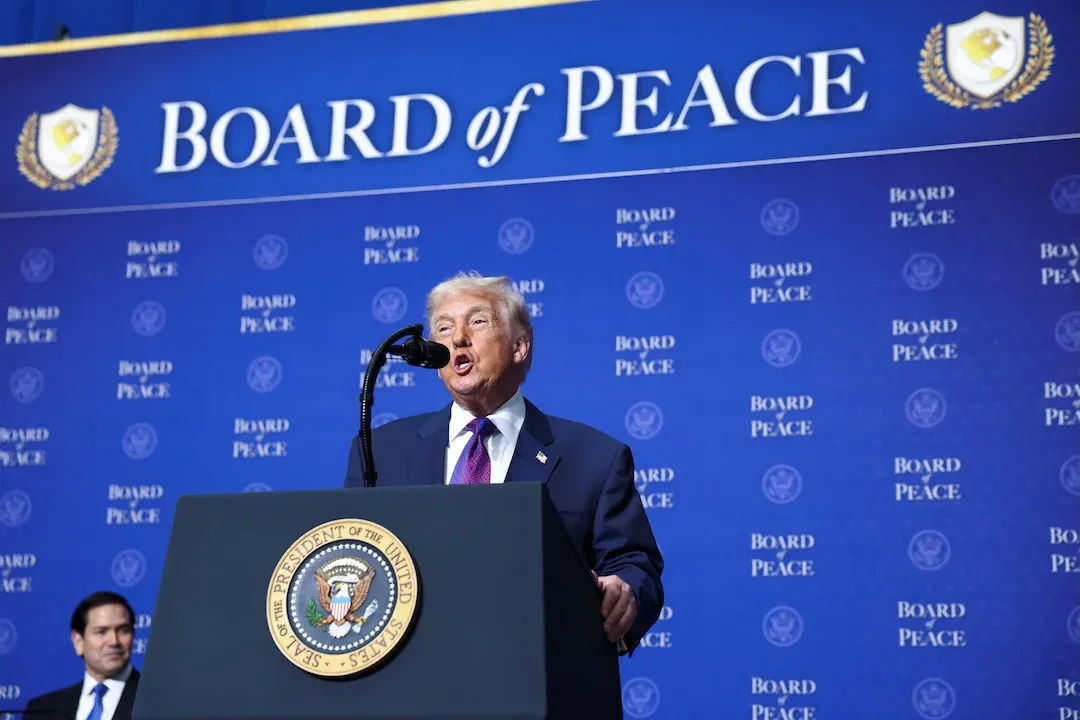
Gaza Board of Peace members convened in Washington today as President Trump announced a massive $10 billion U.S. commitment to the rebuilding of the war-torn enclave.
Trump Unveils $17B Gaza Peace Plan: Inside the New ‘Board of Peace’ and the $10B U.S. Pledge
By Emily Carter | @ECarterUpdates | February 19, 2026
The Washington Summit: A $17 Billion Paradigm Shift in Gaza
In a move that has sent shockwaves through the halls of the United Nations, President Donald Trump today convened the inaugural meeting of the “Board of Peace” (BoP) at the U.S. Institute of Peace in Washington, D.C. The summit, attended by envoys from over 45 nations, was the stage for a staggering announcement: a $17 billion combined pledge for the reconstruction of the Gaza Strip. The United States has committed a lion’s share of $10 billion, effectively cementing a new era of American-led diplomacy that operates outside traditional multilateral channels.
The atmosphere in the room was electric, a blend of corporate efficiency and high-stakes geopolitics. Trump, acting as the self-designated “Chairman for Life” of the Board, framed the initiative not just as a humanitarian mission, but as a strategic business-led stabilization project. “The old ways of the UN didn’t work. They institutionalized crisis,” Trump declared to a gallery of world leaders and billionaire CEOs. “We are bringing the art of the deal to the science of peace.”
Allies from the Gulf and Central Asia quickly followed the U.S. lead, adding another $7 billion to the coffers. The speed of the fundraising has stunned observers who are used to the years-long “donor fatigue” typically associated with Palestinian aid. This isn’t just a charity fund; it is a rapid-response capital injection intended to transform one of the world’s most volatile territories into a functional, if highly managed, economic zone.
As the session closed, the “Board of Peace” logo—a globe significantly highlighting the Western Hemisphere while omitting large swaths of Europe and Asia—flickered on the screens behind the podium. It served as a potent symbol of the administration’s intention to rewrite the rules of international governance, prioritizing a “coalition of the willing” over the veto-heavy bureaucracy of New York and Geneva.
Anatomy of the ‘Board of Peace’: Trump’s New Global Diplomatic Engine
The “Board of Peace” is not your grandfather’s international organization. Established formally in January 2026, the BoP operates under a charter that grants extraordinary authority to its Chairman. Unlike the rotating presidencies of the UN Security Council, Trump holds sole authority to nominate his successor and exclusively authorize which countries are invited to join. This centralized command structure is designed to facilitate “nimble” decision-making, a sharp contrast to the stagnation often seen in traditional bodies.
Beneath the Chairman, the BoP is divided into distinct tiers: the Board proper (comprising national leaders), an Executive Board focused on diplomacy and investment, and a specific Gaza Executive Board. The latter is led by Nikolay Mladenov, the High Representative for Gaza, who is tasked with the monumental job of coordinating with Israeli and Palestinian technocratic bodies on the ground. Notably, the BoP charter prohibits “reservations,” meaning members must agree to the entire 20-point peace plan without exception.
The structure reflects a corporate hierarchy. Policy analysts have noted that the BoP operates more like a multinational corporation than a diplomatic forum. Decisions move from the top down, and participation is an all-or-nothing proposition. This has created a “pay-to-play” dynamic that has attracted wealthy Gulf states and Central Asian nations while alienating some G7 partners who worry about the erosion of multilateral legitimacy.
| Role | Name | Background/Note |
|---|---|---|
| Chairman for Life | Donald J. Trump | U.S. President; Sole authority over charter and membership |
| High Representative for Gaza | Nikolay Mladenov | Former UN Special Coordinator; Directs the Gaza Executive Board |
| Executive Board Member | Jared Kushner | Architect of the “New Gaza” Master Plan |
| Executive Board Member | Marc Rowan | CEO of Apollo Global Management; Focused on capital mobilization |
| Executive Board Member | Tony Blair | Former UK PM; Senior diplomatic advisor |
The Billionaires’ Peace: Why ‘Private-Public Diplomacy’ is Replacing the UN
For the NewsBurrow audience, the most controversial aspect of the BoP is the integration of “private-public diplomacy.” By bringing figures like Marc Rowan, the billionaire CEO of Apollo Global Management, into the inner sanctum of diplomatic decision-making, the administration is treating Gaza’s reconstruction as a massive real estate and venture capital opportunity. The goal is to move away from “perpetual dependency” on aid and toward a model of “investment attraction.”
This approach has caused a significant rift with the European Union. Critics argue that placing the fate of two million Palestinians in the hands of private equity moguls turns the territory into a “sovereignty-free zone.” However, supporters point to the $1.5 billion already allocated for vocational training and the $3 billion investment fund for business districts as proof that the profit motive can achieve what humanitarian appeals could not: jobs and stability.
The friction with the UN is deliberate. The BoP charter explicitly laments that traditional approaches “institutionalize crisis.” By creating a parallel structure that controls the purse strings of the world’s most powerful donors, the BoP effectively sidelines the UN Relief and Works Agency (UNRWA) and other agencies. This isn’t just about Gaza; it’s a pilot program for a new world order where the “nimble” few dictate terms to the “stagnant” many.
The “shock factor” here cannot be overstated: the world is witnessing the privatization of peace. If the BoP succeeds in Gaza, the model is expected to be exported to other conflict zones, such as Ukraine or the Sahel. We are entering an era where a seat at the peace table is determined by the size of your portfolio rather than the weight of your vote in the General Assembly.
Boots on the Ground: The Mandate of the International Stabilization Force (ISF)
Security is the bedrock of the 20-point plan, and today the BoP officially activated the International Stabilization Force (ISF). Led by a U.S. two-star general, the force will eventually consist of 32,000 personnel. Crucially, the boots on the ground will not be American or Israeli. Trump announced that five countries—Indonesia, Morocco, Albania, Kazakhstan, and Kosovo—have committed troops to serve in this multinational force.
The ISF’s mandate is “peace enforcement” rather than traditional “peacekeeping.” Their primary mission is to enforce the demilitarization of the Strip, verify the decommissioning of weapons, and protect reconstruction sites. This force is intended to act as a buffer, allowing the Israeli Defense Forces (IDF) to withdraw while ensuring that no armed faction—specifically Hamas—can regain control of the territory’s infrastructure.
Training for the ISF is already underway in Egypt and Jordan, with a focus on urban policing and counter-insurgency. The strategy is to integrate these international troops with a new, vetted Palestinian police force. Recruitment for this local force began today, with over 2,000 applicants already being processed. The goal is a professional, non-factional security apparatus that answers to the technocratic committee rather than any political party.
Stabilization Force Deployment Timeline (Projected)Deployment Level (%)
100 |                                  __________
80 |                       __________/
60 |            __________/
40 | __________/
20 |/
0 +------------------------------------------------
Feb 2026   May 2026   Aug 2026   Nov 2026   Feb 2027
Demilitarization and the ‘Rafah First’ Strategy
The reconstruction won’t happen all at once. The Board of Peace has adopted a “Rafah First” strategy, focusing the first phase of investment on the southern border city. Since the Rafah crossing was partially reopened earlier this month, it has become the primary artery for both humanitarian aid and the entry of “Board-sanctioned” personnel. The logic is simple: demonstrate success in one district to prove the model’s viability.
However, this success is contingent on a hardline requirement: the full demilitarization of Hamas. The Board has made it clear that funds will be released in tranches, tied strictly to security milestones. If weapons are found in a newly built district, the funding for that quadrant stops immediately. This “carrot and stick” approach puts the onus on the local population and remaining militant groups to choose between reconstruction and resistance.
The security perimeter around Rafah is currently the most heavily monitored 25 square kilometers on earth. Integrated with AI-driven surveillance and “Board-vetted” checkpoints, the city is serving as a pilot for what the rest of the “New Gaza” will look like. It is an inhabitable but sanitized enclave, where every sack of cement is tracked via blockchain to ensure it isn’t diverted for military use.
The “Rafah First” approach has its detractors, who argue that it creates a “tale of two Gazas.” While the south begins to resemble a construction site for a modern city, the north remains a landscape of rubble. The administration’s response is pragmatic: you cannot build where you cannot secure. Until the northern factions lay down their arms, the cranes will stay in the south.
The Technocratic Transition: Who is the National Committee for the Administration of Gaza?
While Trump and the billionaires handle the high-level strategy, the day-to-day management of Gaza is falling to the National Committee for the Administration of Gaza (NCAG). Led by Dr. Ali Shaath, a Palestinian civil engineer with a PhD from Queen’s University Belfast, the NCAG is a 15-member body of technocrats. Shaath is a figure of administration rather than politics, bringing decades of experience in infrastructure and planning to the role.
The NCAG is intentionally depoliticized. It excludes members from Hamas and the dominant faction of the Palestinian Authority, Fatah. This “clean slate” approach is meant to win the trust of international investors who are wary of the corruption and factionalism that have plagued previous aid efforts. Based in Egypt for now, the committee is preparing to move its headquarters into Gaza as security conditions stabilize.
Shaath’s immediate priority is the restoration of core public services—water, electricity, and healthcare. The challenge is immense, with an estimated 61 million tonnes of rubble needing to be cleared. The committee is working with the World Bank to design transparent procurement systems, ensuring that every dollar of the $17 billion pledge is accounted for. This is “governance as a service,” a model where the administration is judged purely on its ability to deliver infrastructure.
Critics, however, warn that a government without a political mandate is a government without a soul. They argue that by vetting the NCAG through Israel and the U.S., the Board is creating a “Vichy-style” administration that lacks domestic legitimacy. Whether Shaath’s numbers and program designs can overcome the deep-seated political aspirations of the Palestinian people remains the project’s biggest “X factor.
Resource Diplomacy: The $70 Billion Rebuilding Challenge
Despite the fanfare surrounding the $17 billion pledge, the reality of the numbers is sobering. Most experts estimate the “post-war Gaza reconstruction cost” to be upwards of $70 billion. This leaves a massive $53 billion gap that the Board of Peace hopes to fill through private investment and future fundraisers. Japan has already committed to hosting a major “fundraiser of fundraisers” later this year to bridge this deficit.
The “Resource Diplomacy” at play here is a complex web of logistics and economics. The Board is negotiating with Israel to ease restrictions on “dual-use” materials, such as steel and concrete, which are essential for rebuilding but were previously banned due to security concerns. The BoP’s solution is a closed-loop supply chain where materials are delivered directly to BoP-certified contractors and monitored by the ISF.
This is where the “Business Insights” of the BoP leadership come into play. By treating Gaza as a “Special Economic Zone,” they hope to attract multinational corporations to build data centers and advanced manufacturing facilities. The vision is to create 500,000 jobs by 2035, turning a population that has been largely dependent on aid into a workforce for the “New Gaza” economy.
- Immediate Relief: $2 billion for housing, healthcare, and water (UN OCHA).
- Infrastructure: $5 billion for power grids, sewage, and transport.
- Economic Stimulus: $3 billion investment fund for business districts and microgrants.
- Security: $4 billion for the ISF and Palestinian police training.
- Human Capital: $1.5 billion for vocational training and education.
Regional Power Players: The Roles of Egypt, Jordan, and the Gulf States
The Board of Peace would not exist without the “cautious embrace” of regional power players. Egypt and Jordan have taken the lead on the security front, acting as the primary trainers for the new Palestinian police force. Their involvement provides the mission with much-needed regional legitimacy, even as they navigate the domestic political risks of being seen as “security subcontractors” for a Trump-led initiative.
The Gulf states—the UAE, Kuwait, Qatar, and Saudi Arabia—are the financial backbone of the project. The UAE and Kuwait have each pledged $1.2 billion, while Saudi Arabia has announced its own parallel aid package for the Palestinian Authority. For these nations, the BoP is a way to stabilize their northern neighbor and prevent the “spillover” of conflict that could threaten their own “Vision 2030” style economic projects.
However, the coordination is not without friction. Qatar and Turkey, both members of the Board, have been vocal critics of Israeli conduct during the war. Their participation in a body chaired by Trump and featuring Israeli representatives is a masterclass in pragmatic diplomacy. They recognize that remaining outside the Board would mean having no say in the future of the Palestinian territories.
The absence of other G7 nations—France, Germany, and the UK—is notable. These countries have expressed support for the peace plan but have declined to join the Board of Peace, citing concerns over its “international guardianship” model and its potential to undermine the UN. This creates a fascinating geopolitical divide: a U.S.-Arab-Central Asian alliance building the “New Gaza,” while Europe watches from the sidelines with a mix of hope and trepidation.
Kushner’s ‘Catastrophic Success’: The Economic Vision for a New Gaza
Jared Kushner’s “New Gaza” master plan, unveiled earlier this year in Davos, is the intellectual blueprint for the Board’s work. Kushner’s vision involves a radical reimagining of the enclave’s geography. Instead of traditional neighborhoods and refugee camps, the plan envisions four district-like “quadrants” separated by large green zones, industrial areas, and sports facilities. It is Gaza reimagined as a modern Gulf city—think Dubai on the Mediterranean.
The plan includes high-tech infrastructure that Gaza has never seen: a new airport, a deep-water port, and a freight rail line with a logistics corridor. Kushner describes this as a “Riviera” style development, complete with luxury apartments by the sea. The goal is “full employment,” with the industrial zones slated to house data centers and advanced manufacturing plants that will employ hundreds of thousands of Palestinians.
Critics call this “catastrophic success”—a plan that succeeds in economic terms by erasing the cultural and historical fabric of the territory. The proposal razes northern cities like Beit Lahia and Jabalia, replacing them with agricultural zones. One resident, whose home was demolished for a BoP park, told reporters, “We only want one thing: leave us to rebuild. We don’t want your luxury apartments; we want our homes.”
But the Board is betting that economic opportunity will ultimately trump historical grievance. By creating a “sanitized” environment where business can thrive, they hope to attract the kind of global capital that has traditionally stayed away from the region. It is a gamble on the transformative power of the dollar, led by a team of men who believe every conflict is essentially a failed business negotiation.
Sovereignty or ‘Recolonization’? The Critics and the Skeptics
The “shock factor” of the Board of Peace has sparked a fierce global conversation. Is this a revolutionary path to peace or a 21st-century form of “recolonization”? Groups like DAWN (Democracy for the Arab World Now) have been scathing, arguing that the Board treats Palestinians as “subjects to be managed rather than citizens with rights.” The fact that the Board contains no Palestinian representatives while Israel holds a seat is a primary point of contention.
European leaders, while supporting the ceasefire, are wary of the BoP’s mandate. France’s Foreign Minister recently stated, “Yes to the peace plan, no to an organization that replaces the UN.” There is a deep fear that by creating parallel structures, the Trump administration is normalizing a world where multilateral legitimacy is replaced by raw financial and military power. This isn’t just a critique of the Gaza plan; it’s a critique of the “Trumpian” approach to world order.
On the ground, Hamas has labeled the Board “international guardianship.” While they have expressed a willingness to cede governance to the technocratic committee (NCAG), they remain vehemently opposed to the Board itself. This creates a dangerous paradox: the very people the Board aims to “stabilize” are the ones most likely to view it as an occupying force. If the BoP cannot secure local “buy-in,” the $17 billion investment could be lost in a new cycle of violence.
The Board’s supporters counter that the “multilateral” approach has failed for 75 years. They argue that the BoP provides the “nimble” and “effective” antidote to a system that has fostered perpetual dependency. In their view, sovereignty is a luxury that Gaza cannot currently afford; stability and economic survival must come first. This debate—between the “idealists” of the UN and the “realists” of the BoP—will define the next decade of international relations.
The Risk Assessment: Will the Ceasefire Hold?
As the Board of Peace begins its work, the most pressing question remains: will the ceasefire hold? The October 2025 framework is fragile. While the return of the final hostage was a major milestone that triggered the reopening of the Rafah crossing, the underlying tensions remain. Any move toward “de-facto annexation” in the West Bank or a failure to disarm the remaining militant cells in Gaza City could shatter the peace.
The Board faces its first major test in the next 60 days. The goal is to deploy 5,000 “vetted” Palestinian police officers to work alongside the ISF. If this deployment is met with resistance from the local population or sabotage by spoilers on either side, the BoP’s credibility will be severely diminished. The “Board” has the money and the troops, but it does not yet have the trust of the people on the ground.
There is also the risk of political change in the donor countries. While Trump’s mandate as “Chairman for Life” is intended to provide continuity, the domestic politics of the U.S. and its Gulf allies remain unpredictable. A shift in the American electorate or a change in leadership in Riyadh or Abu Dhabi could lead to a sudden withdrawal of support, leaving the Board—and Gaza—in a precarious position.
Finally, there is the risk of “Two Gazas”—a southern “Riviera” and a northern “Wasteland.” If the Board cannot bridge the geographic and economic divide within the Strip itself, it may inadvertently create the conditions for future conflict. The roadmap to 2027 is clear on paper, but the reality of Gaza has a way of defying even the most well-funded plans.
Looking Toward 2027: The Roadmap to Final Status
The Board of Peace is not intended to be permanent. Its current mandate expires in 2027, by which time it hopes to have completed the primary reconstruction phase and handed over control to a “reformed” Palestinian Authority. The roadmap includes strict milestones for verified security, functional governance, and economic GDP growth. If these targets are met, the BoP envisions a “pathway to self-determination and statehood” for the Palestinian people.
But the “Final Status” remains a conditional prospect. The Trump plan treats statehood as a reward for performance rather than an inherent right. This is the ultimate “art of the deal”: the Palestinians get a state, but only after they have proven they can be a stable, demilitarized, and economically viable neighbor. It is a radical reimagining of the “two-state solution,” one built on the foundations of the Abraham Accords and the logic of the marketplace.
As we watch the cranes rise over Rafah and the ISF patrols the streets, the world is witnessing a high-stakes experiment in international governance. Can a board of billionaires and generals solve a problem that has baffled diplomats for generations? Or is the Board of Peace merely a gilded cage for a people who still yearn for true independence?
We want to hear from you. Is the Board of Peace the “nimble” solution the world needs, or is it a dangerous precedent that undermines the rule of law? Join the conversation on NewsBurrow and share your perspective on the future of Gaza and the “New Gaza” Master Plan. The world is watching, and the stakes couldn’t be higher.
To truly grasp the magnitude of the “Board of Peace” and its radical departure from traditional diplomacy, one must look back at the centuries of complex narratives that have shaped this region. While the $17 billion pledge aims to build a modern “Riviera” on the Mediterranean, the success of such an ambitious project depends heavily on navigating the deep-seated cultural and historical currents of the Levant. Understanding the past is not just an academic exercise; it is the essential blueprint for anyone trying to predict whether this new era of private-public diplomacy can truly break the cycle of conflict.
The current shift toward “Resource Diplomacy” and technocratic governance is a bold experiment that challenges decades of established geopolitical thought. For those following these developments on NewsBurrow, having a curated library of foundational knowledge offers a clearer lens through which to view today’s headlines. We have gathered a selection of definitive resources that provide the essential context needed to understand the historical stakes involved in this unprecedented $17 billion reconstruction effort.
We invite you to dive deeper into these perspectives and join the conversation in our comments section—how do you think history will judge this corporate-led peace plan? Make sure to subscribe to the NewsBurrow newsletter for exclusive, on-the-ground reporting and analytical deep dives delivered straight to your inbox. Explore our recommended reading list below to arm yourself with the insights that define the future of the Middle East.
Shop Products On Amazon
Shop Products on Ebay


![Latest Middle East That Anyone Can Understand [Hardcover]](https://i.ebayimg.com/images/g/kugAAeSw-BZpvgeZ/s-l640.jpg "Trump Unveils $17B Gaza Peace Plan: Inside The New 'Board Of Peace' And The $10B U.s. Pledge 14")



Trending Similar Stories in the News
Live Updates: Trump Says U.S. Will Commit $10 Billion to Board of Peace for Gaza Redevelopment The New York Times...
Trump indicates Iran decision within days and says Board of Peace will be ‘looking over’ UN CNN...
Trending Videos of Gaza Board Of Peace



GIPHY App Key not set. Please check settings