

 Emily Carter
Table of Contents
Trump Ice Minnesota Protests
Standoff in Minneapolis: Trump’s ICE Surge Sparks Deadly Conflict and Jurisdictional War
Trump ICE Minnesota protests have reached a boiling point as local leaders and federal authorities clash over a fatal shooting and the surge of thousands of agents into the Twin Cities.
By Emily Carter (@ECarterUpdates)
Published: January 23, 2026
The Twin Cities Under Siege: Operation Metro Surge Explodes
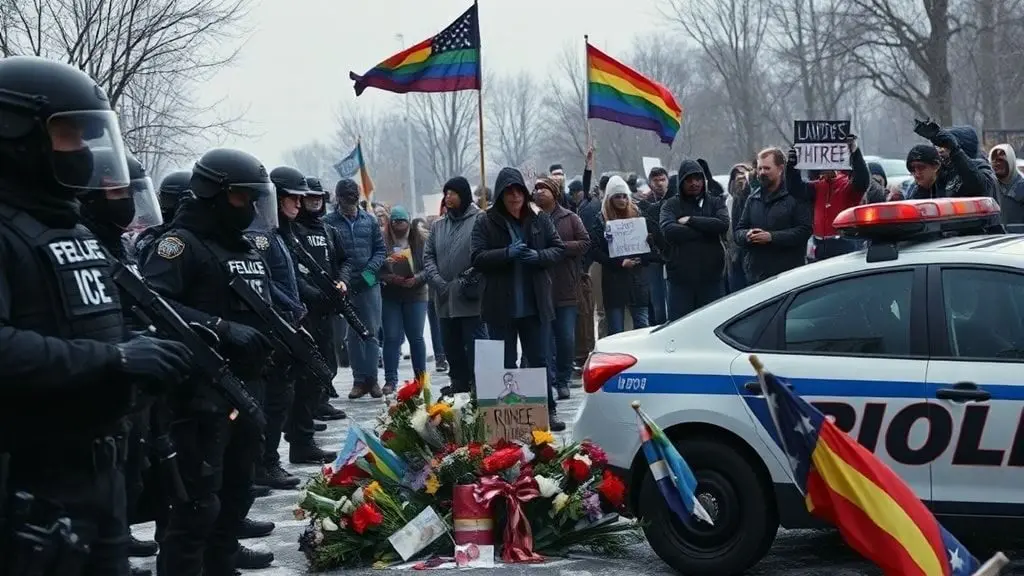
The air in Minneapolis and St. Paul has grown heavy with a scent that many had hoped would never return to these streets: a mixture of winter exhaust and the sharp, metallic tang of tactical gear. Under the banner of Operation Metro Surge, the Trump administration has effectively turned the Twin Cities into a theater of domestic war. What began in December 2025 as a purported crackdown on Somali-run child care fraud has mutated into a full-scale federal occupation, with 2,000 ICE agents—exceeding the combined strength of the local police forces—swarming residential neighborhoods.
Witnesses describe a city on edge. Masked agents in unmarked SUVs roam the Lake Street corridor, once a vibrant hub of immigrant entrepreneurship, now a ghost town of shuttered doors and pride flags. The NewsBurrow Press Team has confirmed that since the surge began, over 3,000 arrests have been made statewide. But these aren’t just statistics; they are neighbors being snatched from porches and children being taken from school districts, including four recently reported in Columbia Heights. The psychological toll is immense, with St. Paul Police Chief Axel Henry admitting that residents are literally terrified to step outside.
The political friction has reached a white-hot intensity. As federal authorities claim they are “upholding the law,” local leaders argue that this is a retaliatory invasion aimed at a “blue” state that has long defied the administration’s rhetoric. Below is a snapshot of the current troop disparity causing friction on the ground:
| Agency / Group | Estimated Personnel in Twin Cities | Primary Allegiance |
|---|---|---|
| Federal Agents (ICE/CBP) | ~2,000 | U.S. Department of Homeland Security |
| Minneapolis & St. Paul Police (Combined) | ~1,350 | Local Municipalities |
| National Guard (On Standby) | 1,500 | State of Minnesota |
The Flashpoint: 90 Seconds on Portland Avenue
Every war has a catalyst, and for the Minneapolis standoff, it is the name Renee Nicole Good. On January 7, 2026, the 37-year-old poet and mother of three was driving her Honda Pilot near her south Minneapolis home when she encountered a team of federal agents. Within ninety seconds, the street became a crime scene. Agent Jonathan Ross fired three rounds through Good’s windshield and side window, killing her instantly. The administration was quick to label Good a “domestic terrorist” who attempted to ram officers, a narrative that sparked immediate and visceral outrage across the nation.
However, the NewsBurrow Network has analyzed surfacing video evidence that contradicts the official federal account. The footage shows Good’s vehicle turning away from Ross as she attempted to navigate the snowy street, not toward him. Her family, still in shock, describes a woman who was “gentle and kind,” a U.S. citizen with no history of activism, let alone terrorism. Her death has become a rallying cry, transforming quiet vigils into massive marches that have forced the closure of the city’s public schools.
The “shock factor” here isn’t just the death of a citizen; it’s the cold efficiency with which the state has moved to criminalize her memory. While her mother, Donna Ganger, weeps for a daughter who was “terrified,” federal prosecutors are reportedly pivot-investigating Good’s own family members. This aggressive posture has left many wondering: if a suburban mother isn’t safe from the “surge,” who is?
The Jurisdictional Wall: Why the BCA Was Shut Out
In a move that local legal experts are calling a “constitutional bridge to nowhere,” the U.S. Justice Department has effectively locked local investigators out of the Renee Good shooting probe. Normally, the Minnesota Bureau of Criminal Apprehension (BCA) would lead the investigation into an officer-involved shooting. In this case, federal authorities claimed “exclusive jurisdiction,” barring state agents from the scene and the evidence. This wall of silence has created a jurisdictional war between the city and the feds, with Mayor Jacob Frey calling the move a blatant attempt to hide the truth.
This exclusion isn’t just a procedural hiccup; it’s a deliberate dismantling of the check-and-balance system. The NewsBurrow Press Team has learned that the FBI is now the sole arbiter of the facts, a situation that Governor Tim Walz has denounced as a “partisan distraction.” By removing the BCA, the administration has ensured that any findings will be viewed through a lens of federal self-preservation rather than local accountability. The message is clear: in the Twin Cities, federal law now operates in a vacuum.
The local response has been one of defiance. City officials have begun tracking federal agent overtime and resource usage, preparing a massive bill to present to the DHS. They argue that if the federal government wants to occupy their streets, they should at least pay for the chaos they’ve invited. The friction between the Minneapolis Police Department and ICE has grown so palpable that some officers have reportedly refused to coordinate on non-violent warrants, citing a lack of trust in federal “cowboy” tactics.
Mayor vs. Mandate: Jacob Frey’s Battle for City Sovereignty
Mayor Jacob Frey is no stranger to crisis, but the “ICE Invasion” has pushed his administration to the brink. Frey has issued emergency executive orders prohibiting federal staging on city-owned property, effectively forcing ICE agents to use private parking lots like Target and Home Depot. He has been a vocal critic on national news, stating, “We won’t be afraid. We know the difference between right and wrong.” His stance has turned him into a primary target for the White House, with officials labeling him a “failed mayor” who is “encouraging terrorism.”
Frey’s battle for sovereignty is being fought in the courts as much as on the streets. He has joined Attorney General Keith Ellison in a federal lawsuit alleging that Operation Metro Surge violates the Tenth Amendment and the principle of equal sovereignty. The lawsuit argues that the surge is a retaliatory act designed to punish Minnesota for its voting record. For the residents of Minneapolis, Frey has become an unlikely shield, standing between them and a federal government that seems increasingly interested in “scoring partisan points” through militarized policing.
Critics, however, argue that Frey’s defiance is putting the city at further risk. Pro-administration voices suggest that by “obstructing” ICE, Frey is creating a sanctuary for violent criminals. This narrative is being pushed hard by Deputy Attorney General Todd Blanche, who recently promised to stop the “terrorism” of Walz and Frey “by whatever means necessary.” The rhetorical escalation suggests that the federal government is prepared to move past subpoenas and toward direct intervention.
The DOJ Strikes Back: Subpoenas and Criminal Obstruction Probes
The federal government isn’t just fighting with boots on the ground; it’s fighting with paper in the courts. In a move without modern precedent, the Department of Justice has issued grand jury subpoenas to Governor Tim Walz, Mayor Jacob Frey, and St. Paul’s newly elected Mayor Kaohly Her. The investigation centers on an alleged “conspiracy to impede” federal officers, a charge that carries significant weight and the potential for federal prison time. The DOJ is essentially accusing Minnesota’s top leaders of being criminal co-conspirators in the protests rocking the state.
These subpoenas demand every piece of internal communication regarding immigration policies, “doxxing” of agents, and any efforts to surveil federal activity. It is a massive fishing expedition designed to intimidate. As reported by NewsBurrow.com, Mayor Frey described the subpoenas as an “obvious attempt to intimidate local leaders for doing their jobs.” The shock factor here is the use of federal criminal law to target elected officials for their public policy positions and political speech.
The legal community is watching this case with bated breath. If the DOJ successfully prosecutes local leaders for “impeding” ICE through non-cooperation policies, it would fundamentally rewrite the relationship between states and the federal government. Below is an ASCII representation of the intensifying legal pressure on Minnesota’s leadership:
FEDERAL LEGAL PRESSURE INDEX (Jan 2026)

100 |          [Subpoenas Issued]
 80 |        [Criminal Probe]
 60 |      [DHS Lawsuit]
 40 |    [Public Criticism]
 20 |  [Policy Disagreement]
  0 +----------------------------
       Dec '25       Jan '26
Cities Church St. Paul: When Protests Cross the Sanctuary Threshold
On Sunday, January 18, the conflict took an even more personal turn. A group of anti-ICE protesters entered Cities Church in St. Paul during a morning worship service. Their target wasn’t just the pews, but a man named David Easterwood. Easterwood is a pastor at the church, but he holds another, more controversial title: Acting Field Director of the ICE St. Paul field office. Protesters chanted “ICE out” and “Justice for Renee Good,” bringing the visceral anger of the streets into the sanctity of the sanctuary.
The disruption has set off a firestorm of “religious freedom” debates. Assistant Attorney General Harmeet Dhillon labeled the protest “un-American and outrageous,” vowing to use the FACE Act—typically used to protect abortion clinics—to prosecute those who “desecrated” the house of worship. The irony is not lost on activists, who point out that ICE agents have been documented conducting arrests at churches, funerals, and hospitals across the Twin Cities. “To have someone serving as a pastor who oversees these barbaric agents is unfathomable,” said activist Nekima Levy Armstrong.
This incident highlights the deep fractures in the community. For the congregation at Cities Church, it was an act of “intimidation and threat” against children and families. For the protesters, it was a necessary confrontation of a man they see as a “wolf in sheep’s clothing.” The DOJ’s involvement ensures that this will not remain a local dispute but will instead become a national test case for where the right to protest ends and the right to worship begins.
The Ghost of the Insurrection Act
As the standoff deepens, the “nuclear option” of domestic law enforcement looms: the Insurrection Act. President Trump has publicly flirted with the idea of deploying active-duty troops to “quell the agitators” in Minneapolis. Currently, 1,500 soldiers sit on standby at the Pentagon, awaiting a command that would signal a total breakdown of local-federal relations. While Vice President JD Vance recently stated there are “no immediate plans” to invoke the Act, the mere fact that it is being discussed has sent shockwaves through the region.
The use of the Insurrection Act would allow the President to bypass the Posse Comitatus Act and use the U.S. military for domestic policing. This isn’t just a legal theory; it is a ghost that haunts the current protests. NewsBurrow Network reporters have noted that the 1,500 troops are specifically trained in urban crowd control, suggesting the administration is prepared for a “worst-case scenario” where local police and the National Guard lose control—or simply refuse to enforce federal mandates.
The “shock” here is the realization that the American heartland could see tanks on its streets for the first time in generations. Protesters, undeterred, have begun organizing “know your rights” workshops specifically focused on interacting with military personnel. The tension is so thick that even a minor scuffle at a protest could serve as the pretext for a full military intervention. The Twin Cities are not just a protest site; they are a laboratory for the limits of presidential power.
A Judicial Line in the Sand: Judge Menendez’s Injunction
Amid the chaos, the third branch of government has finally weighed in. U.S. District Judge Katherine Menendez issued a preliminary injunction that serves as a rare victory for protesters. The order bars immigration agents from arresting individuals peacefully demonstrating and prohibits the use of “nonlethal munitions”—such as pepper spray and flash-bang grenades—against observers and journalists. Menendez found that federal agents had been “overly aggressive,” particularly in vehicle pursuits that endangered public safety.
This judicial intervention is a direct rebuke of ICE’s “Metro Surge” tactics. The judge also explicitly noted that agents cannot stop people in cars simply for following federal vehicles—a tactic community members have used to alert neighbors of raids. It is a significant legal roadblock for an administration that prides itself on “unleashing” its agents. However, the DOJ has already filed an appeal, arguing that the injunction “legally frivolously” interferes with federal law enforcement during a time of heightened threat.
The injunction has provided a brief respite for organizers, but it remains a fragile shield. As the “economic blackout” and general strike planned for January 23 approach, the eyes of the nation are on Minnesota. Will the federal government respect the court’s boundaries, or will the “surge” overwhelm the rule of law? The standoff in Minneapolis is no longer just about immigration; it is about the soul of American democracy and whether the streets of a major city belong to its people or to the agents of a distant, angry administration.
What do you think? Is Operation Metro Surge a necessary law enforcement action or a dangerous overreach of federal power? Join the conversation in the comments below and share your perspective on the future of the Twin Cities. NewsBurrow Network wants to hear your voice.
The escalating volatility in Minneapolis serves as a stark reminder that the line between a peaceful afternoon and a high-stakes confrontation can vanish in seconds. As Operation Metro Surge brings a dense federal presence into residential zones, families and observers find themselves navigating an environment where chemical irritants and heavy-handed crowd control have become common hazards. In such a climate, the ability to maintain clear vision and respiratory safety is no longer a luxury for professionals; it is a fundamental requirement for anyone caught in the crossfire of civil unrest.
Understanding the specific threats—ranging from airborne tear gas to unpredictable projectiles—is the first step in ensuring personal security during these turbulent times. Reliable protective gear, once reserved for tactical units, now offers essential defense for journalists and residents who must remain aware and mobile under duress. Investing in high-quality respiratory protection can mean the difference between maintaining situational awareness and becoming incapacitated by the very measures intended to manage the crowd.
We invite you to join the conversation and share your thoughts on the evolving situation in the Twin Cities in the comments below. To stay informed on the latest developments and safety resources, subscribe to the NewsBurrow newsletter for exclusive updates delivered directly to your inbox. For those looking to bolster their own preparedness, we have curated a selection of professional-grade equipment below to help you stay protected and vigilant in any environment.
Shop Products On Amazon
Shop Products on Ebay
Trending Similar Stories in the News
Trending Videos of Trump Ice Minnesota Protests


GIPHY App Key not set. Please check settings