

 David Goldberg
Table of Contents
Buy Canadian Policy Investment
Canada’s Buy Canadian Policy: Historic $1.2B Investment in TTC to Secure Local Manufacturing Jobs
Buy Canadian Policy investment is revolutionizing federal procurement by mandating a 55% local content threshold to safeguard the domestic industrial base.
The ‘Canada First’ Pivot: Mark Carney Unveils a New Economic Identity
In a move that signals a seismic shift in North American trade dynamics, Prime Minister Mark Carney has officially transitioned Canada from a “best efforts” procurement model to a rigorous “Canada First” mandate. Following the debut of Budget 2025—a document the NewsBurrow Press Team has dubbed the ‘Sovereignty Blueprint’—the federal government is no longer just a regulator; it has become its own most powerful customer. This isn’t just about spending; it’s about a strategic refusal to remain vulnerable to the whims of foreign trade wars.
The policy, bolstered by nearly $186 million in fresh funding, targets the heart of Canadian industry. By prioritizing domestic materials in every federal contract valued over $25 million, Ottawa is effectively building a fortress around the national supply chain. Finance Minister François-Philippe Champagne was blunt during a recent briefing with the NewsBurrow Network, stating that every dollar spent by the government must now act as a shield for the Canadian worker. The message is clear: if you want a piece of the federal pie, your roots, your steel, and your labor must be Canadian.
This pivot comes at a “hinge moment” in history. With U.S. tariff threats looming like a permanent storm front, Carney’s administration is betting that internal self-reliance is the only antidote to global volatility. The “Buy Canadian” policy isn’t just a tagline; it’s a high-stakes survival strategy designed to ensure that the $70 billion in planned infrastructure spending over the next decade stays within our borders, fueling a domestic Renaissance rather than leaking into foreign markets.
For the average citizen, this represents a fundamental change in how their tax dollars are utilized. Instead of seeking the absolute lowest global bidder, the government is now mandated to value “Canadian added-value”—a metric that counts local jobs, intellectual property, and domestic research. It is a bold, some might say risky, departure from the neoliberal trade norms of the last thirty years, but in the halls of Parliament, the sentiment is unanimous: Canada is finally putting its own house in order.
Toronto’s $1.2 Billion windfall: A Decade of Transit Security
The first major domino to fall under this new policy is a staggering $1.2 billion investment into the Toronto Transit Commission (TTC). Spread over a ten-year horizon through the Canada Public Transit Fund (CPTF), this capital injection is designed to modernize the aging Line 2 (Bloor-Danforth) fleet. However, the true “shock factor” lies in the fine print of the deal. Unlike previous transit expansions, this funding is strictly contingent on a 55% Canadian content requirement—a threshold that has sent ripples through the international manufacturing community.
The NewsBurrow Press Team has confirmed that this $1.2 billion represents more than just new subway cars; it is a guaranteed order book for the next decade. By securing the Baseline Funding stream of the CPTF, Toronto is effectively insulated from the “budgetary gymnastics” often seen in municipal politics. The predictability of this cash flow allows for long-term planning that was previously impossible, ensuring that the wheels of Toronto’s transit system keep turning while the factories that build them stay open.
Below is a breakdown of the projected funding allocation for the TTC modernization project under the new mandate:
| Investment Component | Funding Amount | Primary Objective |
|---|---|---|
| Line 2 Subway Fleet Replacement | $950.9 Million | Procurement of 55 new six-car train sets |
| $249.1 Million | 15 additional trains for Yonge North/Scarborough | |
| Total Federal Investment | $1.2 Billion | 10-Year Guaranteed CPTF Baseline |
This investment is being matched dollar-for-dollar by the Government of Ontario, creating a multi-billion dollar pool of liquidity that is legally tethered to Canadian soil. For Toronto commuters, this means 55 state-of-the-art trains that are not only more reliable but are built with the specific rigors of the Canadian climate in mind. It is a victory for the rider and a fortress for the worker, proving that infrastructure and industry can be two sides of the same coin.
The 55% Threshold: Why the Content Mandate Matters
The “55% Rule” is the new gold standard for Canadian procurement. By mandating that over half of the value of every train, bolt, and circuit board be sourced domestically, the government has effectively killed the “assembly-only” loophole. In the past, foreign firms could ship nearly finished products to Canada, perform a few final tweaks, and slap on a “Made in Canada” sticker. Those days are over. The new policy demands that the raw materials—the steel from Hamilton and the aluminum from Quebec—be part of the DNA of the product.
Critics have argued that this could lead to higher costs, but Minister Joël Lightbound told NewsBurrow.com that the premium is a “sovereignty tax” worth paying. “Sometimes you have to pay more to ensure you still have an industry to buy from in five years,” Lightbound noted. The policy includes a 10% financial evaluation advantage for Canadian suppliers and requires a 25% “Canadian value-added” score in the bidding process. It is a tilted playing field, designed intentionally to favor those who invest in Canadian families.
To visualize the shift in procurement strategy, consider the following comparison of the old vs. new content requirements:
CONTENT EVOLUTION GRAPH (PROJECTED)Mandatory % |
60%      |                _________ [2026: 55% Mandate]
50%      |               |
40%      |               |
30%      |      | [Pre-2025: 25% Avg]
20%      |     |
10%      ||
0%      |_____________________________
2020    2022    2024    2026
This radical leap in domestic requirements ensures that the “multiplier effect” of every government dollar is maximized. When a subway car is built with Canadian steel, it supports the miner in Labrador, the refiner in Ontario, and the engineer in Quebec. It is a closed-loop economic system that seeks to decouple Canada from the volatility of global markets, creating a predictable, high-value ecosystem for industrial growth.
Thunder Bay’s Industrial Renaissance: Alstom’s Guaranteed Future
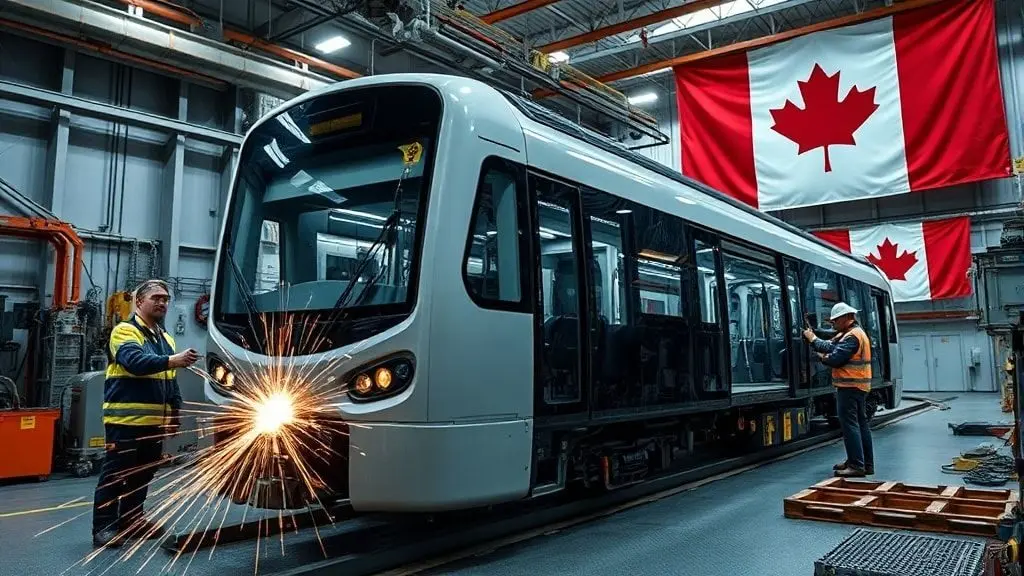
Nowhere is the impact of this policy more visible than in Thunder Bay, Ontario. The Alstom manufacturing plant—once facing a precarious future—is now the centerpiece of the national transit strategy. Under the sole-source agreement with the TTC, the Thunder Bay facility will handle the final assembly of the 70 new train sets. This isn’t just a “one-off” gig; it’s a decade of job security for over 1,000 workers and an additional 1,700 positions across the national supply chain.
The NewsBurrow Press Team recently spoke with local union representatives who described the atmosphere as “transformative.” Workers who were facing layoffs just eighteen months ago are now being recalled to help build the most advanced subway fleet in North America. The plant is transitioning from a state of survival to one of innovation, with plans to integrate new clean-tech manufacturing processes that align with Canada’s 2030 climate goals. Thunder Bay has reclaimed its title as the “Transit Capital of the North.”
The socio-economic impact on the region is profound:
- Direct Job Security: 900+ high-skilled manufacturing positions secured for 10 years.
- Supply Chain Growth: Over 1,700 indirect jobs supported in parts manufacturing and logistics.
- Regional Stability: An estimated $2.3 billion in total contract value circulating through Northern Ontario.
- Skill Retention: Prevents the “brain drain” of specialized transit engineers to the U.S. or Europe.
By using the “Buy Canadian” policy to anchor Alstom in Thunder Bay, the government has effectively saved a regional economy. This is the “shock factor” of the policy: it proves that government procurement can be a more effective regional development tool than any grant or tax incentive. It creates a “sink or swim together” bond between the federal government and the industrial heartland, ensuring that as Toronto grows, Northern Ontario thrives.
Defending the North: A Strategic Buffer Against Trade Volatility
The “Buy Canadian” policy is, at its core, a defensive maneuver. As the world enters an era of “Zombie USMCA” and protectionist rhetoric from Washington, Canada has realized that integration without safeguards is a liability. By becoming its own “best customer,” Canada is building a strategic buffer that ensures critical infrastructure projects—like Toronto’s subway expansion—cannot be derailed by foreign tariffs on steel or components. It is economic sovereignty in action.
Prime Minister Carney’s “elbows up” trade strategy is about more than just fighting back; it’s about building the capacity to walk away. If the U.S. market becomes too hostile, Canada must have the domestic capacity to build its own trains, its own homes, and its own energy grids. The $5 billion Strategic Response Fund, coupled with the “Buy Canadian” mandate, provides the liquidity and the demand needed for firms to retool and diversify away from a single-partner dependency.
The geopolitical stakes are high, as outlined in this summary of current trade risks:
| Trade Risk (2026) | Policy Counter-Measure | Expected Outcome |
|---|---|---|
| U.S. Section 232 Tariffs | Mandatory Canadian Steel/Aluminum | Decoupling from U.S. price spikes |
| Supply Chain Disruptions | 55% Domestic Content Rule | Shortened, reliable local supply loops |
| Economic Dependency Trap | “Buy Canadian” SME Program | Diversified industrial base |
This isn’t isolationism; it’s pragmatism. The NewsBurrow Network analysis suggests that by the end of 2026, Canada will have the most resilient procurement framework in the G7. By ensuring that the “big spends” are tethered to local production, Canada is insulating its GDP from the “collateral damage” of the U.S. political revolution. It is a bold gambit that says Canada is no longer content to be a branch plant; it is ready to be the headquarters.
SME Integration: How Small Businesses Win Big
While the $1.2 billion TTC deal grabs the headlines, the real “engine room” of the policy is the $79.9 million Small and Medium Business Procurement Program. This initiative is designed to break the monopoly that large multinationals have held over federal contracts. For the first time, a dedicated portion of federal procurement is being “carved out” specifically for Canadian SMEs. This ensures that the benefits of the “Buy Canadian” policy trickle down to the local machine shop and the tech startup.
This is a game-changer for competition. By simplifying the bidding process and providing liquidity through expanded BDC loans (up to $5 million), the government is encouraging a new generation of entrepreneurs to participate in nation-building. The policy isn’t just about big trains; it’s about the millions of small components that go into them. Every SME that wins a contract becomes a vital link in a more robust, more competitive national economy.
Key pillars of the SME support package include:
- Reduced Red Tape: Streamlined “one-window” bidding for contracts under $5 million.
- Evaluation Credits: A 10% price advantage for Canadian-owned small businesses.
- Direct Liquidity: Fast-tracked payments to ensure SMEs can manage the cash flow of large projects.
- Digital Connectivity: A new national jobs and training platform to match SME needs with skilled workers.
The NewsBurrow Press Team identifies this as the “quiet revolution.” If successful, this program will create a dense web of domestic suppliers that can eventually compete on the world stage. It’s about building muscles at home so we can win abroad. The goal is to turn the “Buy Canadian” mandate into a “Buy Canadian” culture, where being a local supplier is seen as a badge of quality and a strategic advantage.
The Road to 2036: Forging a Permanent Industrial Legacy
The $1.2 billion TTC investment is merely the opening act of a ten-year drama that will see $70 billion in public investment reshaped by the “Buy Canadian” lens. From the “Build Canada Homes” initiative to the newly formed “Defence Investment Agency,” every sector of the federal government is now pulling in the same direction. The vision for 2036 is a Canada that is more self-reliant, more industrial, and more unified in its economic purpose.
This is a pivotal moment for our national identity. We are moving away from being a “resource-only” economy and toward becoming an “advanced manufacturing” powerhouse. The trains built in Thunder Bay today will be the blueprint for the electric buses, modular homes, and defense systems of tomorrow. By using our own purchasing power as a catalyst, we are creating a permanent industrial legacy that will outlast any single political term or trade dispute.
As we move forward, the conversation must shift from “if we can afford this” to “how we can optimize this.” The “Buy Canadian” policy has laid the foundation; now, it is up to Canadian businesses to innovate and meet the challenge. The NewsBurrow Network invites our readers to join the discussion: Is this the dawn of a new Golden Age for Canadian manufacturing, or a risky pivot in an increasingly globalized world? Share your thoughts below and be a part of the story that is rebuilding Canada from the ground up.
About the Author: David Goldberg (@DGoldbergNews) is a veteran business analyst for NewsBurrow Network, specializing in economic policy and industrial trends. With over two decades of experience covering the intersection of government and the private sector, David brings a sharp, data-driven perspective to the most complex stories of our time.
The strategic move to anchor Canada’s infrastructure in domestic manufacturing is already fostering a new era of industrial pride across the country. As the “Buy Canadian” mandate shifts from policy to practice, citizens are increasingly looking for ways to reflect this national commitment in their daily lives. Beyond the massive subway cars and transit hubs, there is a growing market for high-quality, domestically produced goods that celebrate our shared transit heritage and industrial expertise.
Supporting local talent doesn’t end at the factory gates; it extends to the choices we make as consumers and commuters. Whether you are a transit enthusiast, a daily commuter, or someone who values the durability of Canadian-made equipment, there are numerous ways to invest back into the local economy. From specialized commuter gear designed for the rugged Canadian climate to unique collectibles that honor our iconic transit systems, choosing home-grown products helps sustain the very jobs highlighted in this historic investment.
We invite you to explore a curated selection of products that embody the spirit of Canadian innovation and craftsmanship. By choosing these items, you are directly contributing to the resilience of our national supply chain and supporting the workers who keep our country moving. Don’t forget to join the conversation in the comments below and subscribe to the NewsBurrow newsletter for the latest updates on Canada’s economic transformation and exclusive insights into local manufacturing excellence.


GIPHY App Key not set. Please check settings