

 David Goldberg
Table of Contents
Trump Tariff Global Trade War
Trump’s Tariff War 2026: Global Trade Collision and the Looming SCOTUS Ruling
Trump tariff global trade war fears have reached a fever pitch in early 2026 as the administration moves toward a sweeping ‘reciprocal’ regime that could redefine the cost of living for millions.
Lagos, Nigeria — The global economic order is standing on a precipice. As the first light of February 2026 hits the horizon, the world is no longer debating if a trade war is coming—it is calculating the wreckage. For the NewsBurrow News Network, the story of the hour isn’t just about policy; it’s about a seismic shift in how nations interact, driven by a relentless “America First” agenda that has set the United States on a collision course with its oldest allies and newest rivals alike.
The Constitutional Cliffhanger: SCOTUS and the IEEPA Legal Storm
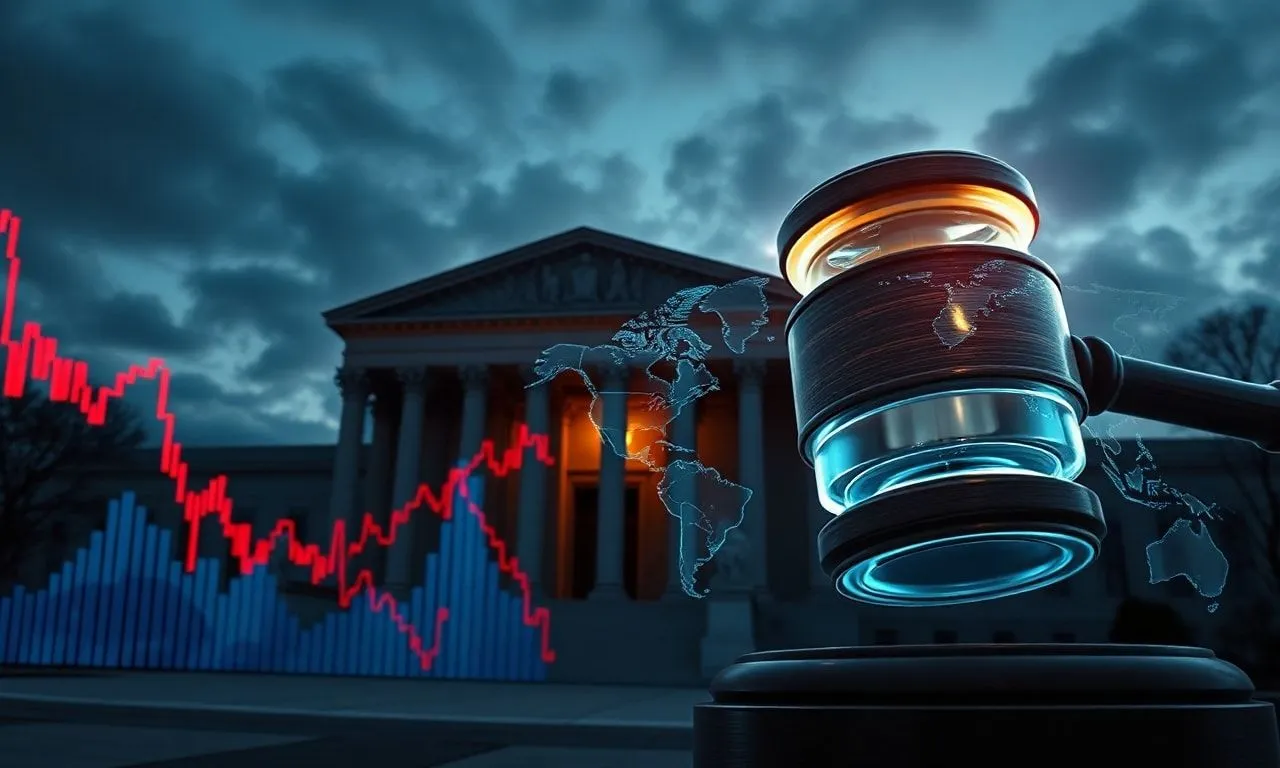
Inside the marble halls of the U.S. Supreme Court, a battle is raging that could strip the presidency of its most potent economic weapon. The consolidated cases of Learning Resources, Inc. v. Trump and Trump v. V.O.S. Selections, Inc. have moved beyond mere legal technicalities into a full-blown constitutional crisis. At the heart of the matter is the International Emergency Economic Powers Act (IEEPA), a 1977 statute that President Trump has wielded like a sledgehammer to bypass Congress and levy near-universal tariffs.
Constitutional scholars are sounding the alarm. Article I, Section 8 clearly grants Congress the power to “lay and collect Taxes, Duties, Imposts and Excises.” By declaring “large and persistent trade deficits” a national emergency, Trump has effectively seized the power of the purse. If the Court applies the “major questions” doctrine, we could see the invalidation of billions of dollars in duties, potentially forcing the Treasury to issue the largest refund in American history.
However, the White House legal team remains defiant, arguing that in a world of “unusual and extraordinary threats,” the Executive must have the agility to protect the national interest. This legal tug-of-war has left importers in a state of paralysis. Should they pay the duties and hope for a court-mandated rebate, or should they brace for a permanent new reality of “taxation by decree”? The shock factor here is real: a ruling against the President wouldn’t just stop the tariffs; it would fundamentally reset the balance of power in Washington for the next century.
Reciprocal Trade or National Emergency? Decoding ‘Liberation Day’ Tariffs
The administration calls it “Liberation Day”—the moment America finally “stopped being a piggy bank for the rest of the world.” Under Executive Order 14257, the U.S. has transitioned from a free-trade advocate to a “reciprocal trade” enforcer. The logic is simple and brutal: if a country charges 10% on American cars, the U.S. will match it, plus a baseline “national security” premium. This isn’t just a adjustment; it’s a total reimagining of global commerce.
The “National Emergency” declaration of April 2025 served as the launchpad for this strategy. By framing the trade deficit as an existential threat to sovereignty, the administration has cleared a path for a 10% baseline tariff on nearly all goods, with “Annex I” countries facing even steeper climb. Below is a breakdown of the current reciprocal disparities the administration is targeting:
| Trading Partner | Product Category | Foreign Tariff on U.S. | U.S. Reciprocal Tariff (2026) |
|---|---|---|---|
| India | Motorcycles | 100% | 100% |
| European Union | Automobiles | 10% | 15% (Base + 5%) |
| Brazil | Ethanol | 18% | 18% |
| Canada | Digital Services | Taxation > $500M | 25% (Targeted) |
This “eye-for-an-eye” strategy has left diplomats scrambling. While some nations, like El Salvador and Guatemala, have folded and signed “Agreements on Reciprocal Trade” (ART) to gain exemptions, major powers are digging in. The shock for the average consumer? The U.S. hasn’t seen an effective tariff rate this high since 1935.
Stagflation vs. Security: The Great Economic Debate of 2026
In the quiet offices of the Federal Reserve, the “Vibecession” has been replaced by something much more terrifying: Stagflation. As President Trump’s tariffs trickle down to the checkout counter, the Fed’s 2% inflation target feels like a relic of a bygone era. Economists at Yale Budget Lab and Goldman Sachs are now projecting that the current regime will add at least 1% to headline inflation through the first half of 2026.
The “Security” camp argues that these are short-term growing pains necessary to rebuild the American industrial base. They point to reshoring efforts and a “warrior ethos” in domestic manufacturing. But the “Stagflation” camp sees a different reality: a weakening labor market combined with rising prices. When the cost of lumber and steel goes up, the cost of housing follows, making the American Dream more expensive by the day.
Fed Chair Jerome Powell is caught in the crossfire. In mid-December, three voting members of the FOMC dissented—the most in seven years—highlighting a deep rift. Does the Fed cut rates to save the job market, or hold them high to fight tariff-induced inflation? It is a “no-win” scenario that has investors flocking to gold and the Japanese yen as the U.S. dollar begins to slide under the weight of trade uncertainty.
The $1,700 Household Hit: The Real Cost of ‘America First’
For the family in suburban Ohio or the small business in Lagos trying to source U.S. machinery, the numbers are starting to bite. The Yale Budget Lab projects that the average American household will see an annual cost increase of roughly $1,700 due to these tariffs. This isn’t a theoretical number; it’s a direct tax on the kitchen table.
The “Stockpile Buffer” that retailers built up in late 2025 is officially gone. As warehouses empty, the new tariff-adjusted prices are hitting the shelves. Here is how the costs are being distributed across the economy:
- Groceries: Beef and coffee have seen sharp spikes as supply chains reorganize.
- Construction: The combination of lumber tariffs and labor shortages from immigration crackdowns has made new home builds nearly 15% more expensive.
- Daily Essentials: From paper products to plastics, the 10% baseline tariff is a hidden surcharge on every transaction.
The irony is palpable: while the administration promises to “Make America Wealthy Again,” the immediate effect for the working class is a shrinking paycheck. The “K-shaped” inflation is widening the gap between the haves and the have-mores, with blue-state high earners benefiting from strange new tax withholding policies while low-income families struggle with the rising cost of eggs and gas.
The Fentanyl Tax: Border Friction and the Fragile USMCA
Perhaps the most dramatic turn in this trade war is the use of tariffs as a tool of border enforcement. In a move that stunned the North American trade bloc, President Trump threatened a 100% tariff on Canada if Prime Minister Mark Carney continued trade talks with China. Simultaneously, a 25% tariff on all Mexican and Canadian imports—excluding oil—was implemented to force cooperation on fentanyl smuggling and illegal migration.
This has turned the USMCA (United States-Mexico-Canada Agreement) into a piece of paper with more holes than a Swiss cheese. While 85% of trade remains nominally tariff-free due to exemptions, the “national security” loopholes are being exploited daily. The tension is highest at the Canadian border, where Carney has described the U.S. tactics as “unjustified” and has even hinted at the possibility of a “Middle Powers Initiative” to bypass Washington entirely.
The “Shock” here is the potential for annexation. In a series of social media posts that set the internet on fire, Trump suggested that Canada’s resistance might lead to a more “permanent” integration into the United States. While likely hyperbole, the mere mention of it has sent shockwaves through the Canadian parliament and global diplomatic circles.
The Silicon Squeeze: Semiconductors and the AI Tax
In the world of high technology, the tariffs have moved from the broad to the surgical. On January 15, 2026, the administration implemented a 25% duty on advanced computing chips—specifically targeting logic integrated circuits used in AI development. This “Silicon Squeeze” is part of a broader strategy to ensure that “untrusted vendors” are locked out of the U.S. digital backbone.
However, the policy is a double-edged sword. While it aims to reshore chip manufacturing, the U.S. currently only accounts for 12% of global capacity. This has created a massive bottleneck for American tech giants. Companies like NVIDIA and AMD are now paying a “25% fee” to the government just to sell high-end GPUs that were manufactured abroad.
The ripple effect has even hit the metals market. Fear of a “silver short squeeze” led to precautionary stockpiling, driving the precious metal to record highs as it remains a critical component in advanced chip fabrication. The administration is essentially using the tech sector as a laboratory for industrial policy, but the high cost of entry may slow down the very AI revolution it seeks to lead.
The Global Blowback: Middle Powers and the Death of Predictability
The world is not taking these hits lying down. A new “Middle Powers Initiative” led by Canada, the EU, and India is gaining momentum. Frustrated by the unpredictability of the U.S. dollar and trade policy, these nations are forming their own “Global Trade Organization” to keep the rules-based order alive without Washington’s participation.
The EU is currently weighing a staggering €93 billion tariff response to the U.S. measures. Meanwhile, India has pivoted to the UK and New Zealand after bilateral talks with the Trump administration collapsed. The result? A fragmented global market where the U.S. is increasingly an island of protectionism in a sea of new, independent trade pacts.
U.S. TRADE ISOLATION METER (2026)
[LOW] ------------------- [HIGH]
2022: ||| (Global Leader)
2024: |||||| (Tension rising)
2025: |||||||||| (Tariff War)
2026: |||||||||||||||| (Isolation)
As we navigate this “Trade Collision,” one thing is clear: the era of cheap, easy globalism is dead. Whether the Supreme Court intervenes or the “America First” engine keeps roaring, the 2026 international trade policy shifts have already reshaped our world.
What do you think? Is the “Stagflation vs. Security” trade-off worth it for the long-term strength of the nation, or are we witnessing the self-inflicted wounding of the American economy? Join the conversation on NewsBurrow and share your thoughts below.
Reported by David Goldberg (@DGoldbergNews), NewsBurrow Press Team.
As the 2026 trade landscape shifts toward a high-stakes “America First” strategy, U.S. manufacturers are grappling with a dual-edged sword. While the administration’s aggressive tariff wall aims to protect domestic interests, it has simultaneously triggered a significant surge in the cost of raw materials and industrial components. For facilities operating in heavy-duty sectors like metal fabrication, woodworking, and electronics assembly, these economic pressures are compounded by increasingly stringent workplace safety regulations. Maintaining a healthy, particle-free environment is no longer just a matter of compliance; it is a critical strategy for protecting high-cost equipment from corrosive dust and ensuring the productivity of a workforce already strained by rising living costs.
To navigate these turbulent waters, industry leaders are moving away from temporary fixes and toward resilient, long-term infrastructure. Advanced filtration technology has become a cornerstone of the modern factory floor, offering a way to mitigate the atmospheric hazards common in high-output manufacturing. By integrating high-efficiency systems that capture everything from volatile organic compounds to microscopic welding fumes, businesses can reduce downtime and avoid the “tariff-exhaustion” that comes with frequent equipment repairs and labor absenteeism. In an era where every cent of operational overhead counts, investing in the right environmental controls is one of the few ways to gain a competitive edge while shielding your bottom line from global trade volatility.
Stay ahead of these shifting market dynamics by exploring the latest solutions designed to keep your facility running at peak efficiency. We invite you to join the NewsBurrow community for ongoing analysis of how global policy impacts your local business—subscribe to our newsletter today and share your perspective on the 2026 economic reset in the comments below. Take the next step in securing your facility’s future by reviewing our top-rated industrial environmental solutions curated for the current economic climate.


GIPHY App Key not set. Please check settings