

 Ryan Chen
Table of Contents
Google Ai Turboquant Memory Chip Breakthrough
Google’s AI Breakthrough Crashes Memory Stocks: How TurboQuant is Disrupting Samsung and Micron
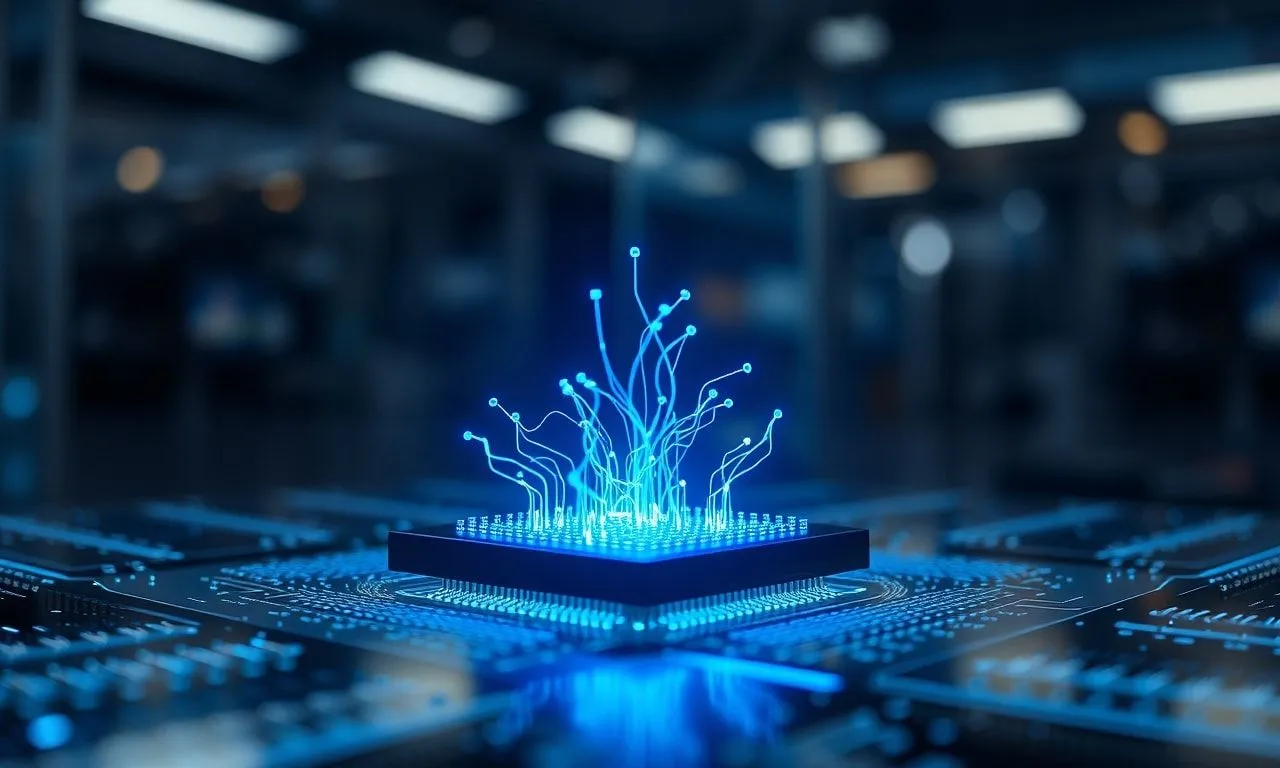
Google AI TurboQuant memory chip breakthrough is sending shockwaves through the global semiconductor market as it slashes memory requirements for massive AI models by up to six times.
The $100 Billion Aftershock: How Google’s Code Just Shattered the Silicon Status Quo
By Ryan Chen | @RChenNews | Technology and Innovation Correspondent
The Ghost in the Machine: A Paper That Cost Billions
On the morning of March 26, 2026, the global semiconductor market didn’t just dip; it suffered a structural heart attack. The culprit wasn’t a factory fire, a trade war, or a supply chain blockage. It was a research paper published by Google Research titled “TurboQuant.” While most of the world was sleeping, institutional investors were frantically calculating a new, terrifying reality: what happens to the world’s most profitable hardware boom when software suddenly becomes “too efficient”?
The immediate fallout was brutal. SK Hynix and Samsung, the undisputed kings of Korean high-bandwidth memory, saw their valuations crater by 6% and 5% respectively in a single session. Across the Pacific, the carnage continued as Micron and Western Digital hemorrhaged over 7% of their market cap. This wasn’t just profit-taking; it was a realization that the “scarcity” narrative driving these stocks for the last three years had been hacked by an algorithm.
At NewsBurrow, we’ve tracked the AI gold rush since its inception, but this marks a pivotal shift. We are moving from the era of “brute force hardware” to the era of “algorithmic elegance.” Google didn’t just build a better AI; they built a way to make the existing AI monsters run on a fraction of the fuel. For the companies selling the fuel, the implications are nothing short of catastrophic.
TurboQuant Demystified: The Lean Logic Slashing Memory Costs
To understand why investors are fleeing, you have to understand the sheer technical audacity of TurboQuant. Traditional Large Language Models (LLMs) are notorious memory hogs, requiring massive clusters of DRAM just to stay “awake.” TurboQuant changes the math by dramatically reducing the memory footprint of these models by up to six times. Imagine a freight truck suddenly being able to carry the same load using the fuel tank of a Vespa.
The breakthrough centers on quantization—the process of reducing the precision of the numbers an AI uses to think—without losing the quality of the output. While quantization isn’t new, Google’s implementation is surgical. It allows hardware like the Nvidia H100 to process complex requests at lightning speeds by eliminating the constant “traffic jam” of data moving between the processor and the memory chips.
This efficiency isn’t just a marginal gain; it’s a disruption. By making LLMs leaner, Google has effectively told the world that the frantic need to buy more and more DRAM chips might be over. If you can run six models on the hardware that used to run one, your future orders for Samsung and Micron chips are about to be slashed significantly.
The Efficiency Paradox: Why Better Tech is a Market Nightmare
We are currently witnessing the “Efficiency Paradox” in real-time. In a healthy economy, innovation usually breeds growth. However, in the high-stakes world of AI infrastructure, efficiency acts as a deflationary force on hardware demand. For the last 24 months, the investment thesis for companies like SK Hynix was simple: “AI is growing, so we must sell more memory.” TurboQuant has effectively decoupled that growth from hardware consumption.
The market’s reaction reflects a fear that we have reached “Peak DRAM.” If software can continue to optimize at this pace, the multi-billion dollar manufacturing expansions planned by chipmakers might result in a massive oversupply. The shock factor here is that the very companies using these chips (the AI labs) are the ones innovating to use them less.
Visualized: The Memory Demand Correction
Demand Index
^
10 |      * (Pre-TurboQuant Projection)
8 |     /
6 |    /  * (The "TurboQuant" Pivot)
4 |   /  /
2 |  /--* (Revised Demand 2026-2027)
0 +-------------------------------->
2024  2025  2026  2027 (Year)
Graph: The projected divergence between AI compute power and physical memory demand.
From DeepSeek to TurboQuant: The New Playbook of AI Disruption
Cloudflare CEO Matthew Prince recently noted on X that this is “Google’s DeepSeek moment.” He was referring to the Chinese AI firm DeepSeek, which previously caused a market tremor by proving they could train top-tier models for a fraction of the cost used by American rivals. Google has now taken that torch and applied it to “inference”—the part of AI that actually talks to users.
The industry is shifting its focus from training bigger models to making inference faster, cheaper, and more energy-efficient. TurboQuant isn’t just about saving money; it’s about “multi-tenant” usage. This means cloud providers can host more users on the same server, increasing their profit margins while simultaneously decreasing the number of chips they need to buy from third-party vendors.
This shift represents a “Software-Defined Hardware” era. We are no longer limited by what the silicon can do, but by how clever the code is. For investors, the takeaway is clear: the real power in the AI stack is migrating upward from the foundry to the research lab. The physical layer is becoming a commodity faster than anyone anticipated.
Market Bloodbath: Analyzing the Global Sell-Off Data
The numbers from the March 26 sell-off provide a grim look at how interconnected the global tech ecosystem has become. When Google sneezes in Mountain View, Seoul and Boise catch a terminal cold. The table below outlines the damage across the major players in the semiconductor space during the 24-hour window following the TurboQuant announcement.
| Company | Primary Region | Single Day Drop (%) | Market Value Lost (Est.) |
|---|---|---|---|
| SK Hynix | South Korea | -6.2% | $8.4 Billion |
| Samsung Electronics | South Korea | -4.8% | $15.2 Billion |
| Micron Technology | USA | -7.4% | $9.1 Billion |
| Western Digital | USA | -7.1% | $1.4 Billion |
While some analysts argue this is merely “profit-taking” after a year where Micron and SK Hynix gained over 300%, the volume of the sell-off suggests a deeper institutional exit. Money is moving out of the “storage” play and into “optimization” plays. The narrative of “endless memory demand” has been officially debunked by Google’s engineering team.
Nvidia H100: The Only Winner in a Leaner World?
Interestingly, while memory makers are suffering, the processors themselves—like Nvidia’s H100—might actually become more valuable. TurboQuant reduces the memory bottleneck, which has historically been the “choke point” for high-end GPUs. If a GPU is no longer waiting for data to arrive from the memory chip, it can spend more of its time actually calculating.
This means that the existing fleet of H100s just became significantly more powerful overnight without a single hardware upgrade. For the companies that already own these chips—Google, Meta, and Microsoft—this is a massive hidden dividend. They can now scale their services to millions more people without the capital expenditure of building new data centers.
However, this “free upgrade” is exactly what terrifies the memory chip manufacturers. If the current hardware is suddenly six times more efficient, the cycle for upgrading to the “next generation” of chips might be pushed back by years. We are looking at a potential “Dark Age” for hardware sales as software optimization catches up to the silicon.
The Real-Time Revolution: AI Inference for the Masses
Beyond the stock market drama, TurboQuant has a profound human impact. By reducing the memory cost of AI, Google is making it possible to run highly sophisticated “agentic” AI on smaller devices. We are moving away from massive, energy-sucking server farms and toward a world where your smartphone or laptop could host a “God-mode” AI locally.
This “democratization of inference” means that privacy and speed will improve. You won’t have to send your data to the cloud to get a smart response because the model will be lean enough to live in your pocket. This is the positive flip-side of the market crash: as hardware value deflates, consumer capability inflates.
However, this transition requires a radical rethinking of how we build devices. We may see a shift from devices with “more RAM” to devices with “better AI accelerators.” The focus is moving from quantity to quality, a shift that caught the traditional memory industry completely off guard.
Survival of the Smartest: Can Chipmakers Pivot in Time?
So, where do Samsung and Micron go from here? They cannot simply continue building bigger “buckets” for data if Google keeps figuring out how to pour the same amount of water into a thimble. The strategic pivot will likely involve moving closer to the logic. We may see “Processing-In-Memory” (PIM) become the new standard, where the memory chip itself does some of the AI thinking.
At NewsBurrow, we believe this is the start of a “Software-First” semiconductor cycle. The companies that will thrive are those that embrace this efficiency rather than fighting it. The era of selling “dumb” memory is dying; the era of “intelligent silicon” is beginning.
The Road to 2027: Will Hardware Ever Catch Up?
As we look toward the next year, the “Shock Factor” remains high. There are rumors that TurboQuant is only the first of several optimization breakthroughs Google has in the pipeline. If inference costs continue to drop at this exponential rate, the very foundation of tech valuations—currently built on the high cost of AI entry—will need to be rebuilt.
We invite our readers to join the conversation. Is this the end of the semiconductor supercycle, or just a temporary hurdle? Will you prefer a device that is more powerful, or one that is simply “smarter” at using what it has? The boundary between hardware and software has never been thinner, and the market is finally waking up to that reality.
One thing is certain: the era of “easy money” for memory makers is over. In the new world of TurboQuant, elegance is the new currency, and Google is currently the wealthiest player in the room. Stay tuned to NewsBurrow as we continue to track this high-stakes battle for the soul of the AI revolution.
The seismic shift caused by Google’s TurboQuant algorithm has fundamentally rewired the expectations for high-performance computing. While memory manufacturers navigate a turbulent market correction, the demand for raw processing power that can leverage this new efficiency is reaching a fever pitch. Systems capable of handling these optimized, lean AI models are no longer just a luxury for research labs; they have become the essential backbone for any enterprise looking to dominate the next phase of the digital revolution.
To truly capitalize on these algorithmic breakthroughs, having the right hardware is non-negotiable. Whether you are scaling a startup’s inference capabilities or upgrading a corporate data center to meet 2027 standards, the physical infrastructure must match the sophistication of the code. We have curated a selection of the industry’s most powerful deployment tools and hardware solutions designed to turn Google’s efficiency gains into your competitive advantage.
Explore our top-tier hardware recommendations below to ensure your tech stack remains ahead of the curve in this rapidly evolving landscape. We invite you to share your thoughts on the hardware-software divide in the comments section and subscribe to the NewsBurrow newsletter for exclusive daily insights into the innovations shaping our world. Don’t let your infrastructure become a bottleneck—discover the tools that power the future today.


GIPHY App Key not set. Please check settings