

 Ryan Chen
Table of Contents
Jwst Saturn Spin Mystery Solved
Solved: How JWST Finally Ended the 30-Year Mystery of Saturn’s Shifting Rotation
JWST Saturn spin mystery solved by uncovering how atmospheric winds and auroras create a deceptive radio signal that has puzzled scientists for decades.
The Heartbeat of a Giant: How Webb Finally Cracked Saturn’s 30-Year Rotation Code
By Ryan Chen | @RChenNews | Technology, Innovation, and the Final Frontier
A Cosmic Discrepancy: The Ghost in the Ringed Planet’s Gears
For three decades, Saturn has been the ultimate gaslighting artist of the solar system. While Earthly clocks tick away with predictable precision, the ringed jewel of our neighborhood seemed to be constantly changing its mind about how long its own day actually lasted. It wasn’t just a minor scientific footnote; it was a fundamental crisis in planetary physics that left researchers questioning if they understood the basics of gas giant dynamics at all.
The trouble began with the Voyager missions in the 1980s, which measured Saturn’s rotation based on radio emissions. Fast forward to the Cassini era in the early 2000s, and the planet appeared to have “slowed down” by a staggering six minutes. In the realm of celestial mechanics, a planet changing its spin rate that drastically in twenty years is practically impossible—it would require a cataclysmic shift in mass that simply wasn’t happening.
This discrepancy turned Saturn into a pariah of precision. Astronomers were forced to use “System III” and “System III (1984)” timeframes, essentially guessing which version of Saturn’s heartbeat was the real one. The mystery wasn’t just about a clock; it was about the invisible forces churning beneath those iconic golden clouds, mocking our best instruments from millions of miles away.
The “spin mystery” became the white whale for planetary scientists. If we couldn’t accurately measure the day length of a planet in our own backyard, how could we ever hope to characterize the thousands of exoplanets being discovered in the deep dark of the Milky Way? The stage was set for a hero with better “eyes”—and that hero arrived in the form of the James Webb Space Telescope (JWST).
The NIRSpec Breakthrough: Peering Through the Infrared Veil
While previous observers were essentially listening to the “noise” of the planet, the JWST decided to watch its temperature and chemistry instead. Utilizing the formidable Near-Infrared Spectrograph (NIRSpec), an international team led by Tom Stallard of Northumbria University embarked on an ambitious 10.7-hour marathon—a full Saturnian day—to watch the planet breathe in real-time.
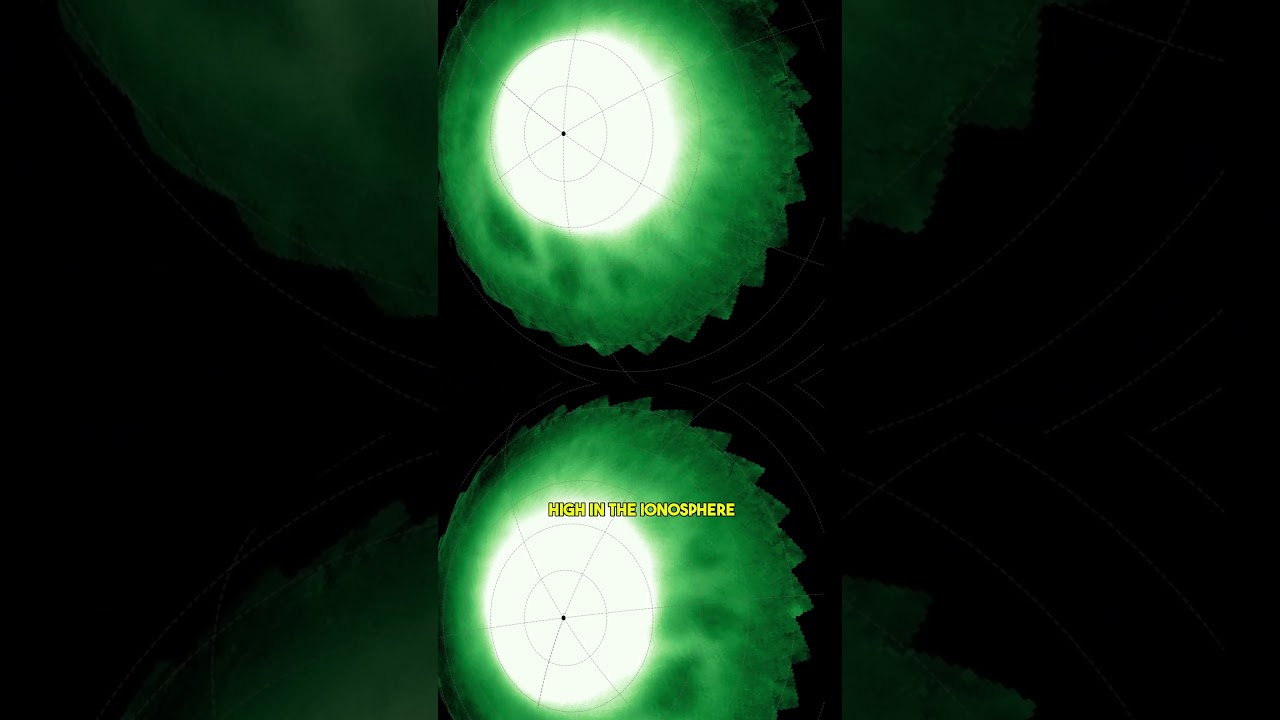
What they found was a chaotic, beautiful symphony of charged particles. By focusing on $H_3^+$ emissions—essentially the “glowing” ions in the upper atmosphere—Webb was able to map the ionosphere with a resolution that ground-based telescopes could only dream of. This wasn’t just a snapshot; it was a high-definition movie of the planet’s crown, where the aurora dances in a permanent display of electromagnetic fury.
The sensitivity of NIRSpec allowed researchers to see “dark beads” and complex sub-auroral structures that were previously invisible. These features didn’t move with the planet’s solid-body rotation; they drifted, shifted, and pulsed with a life of their own. This was the first hint that the “radio clock” we had been using for thirty years wasn’t tethered to the planet’s core at all, but was instead a byproduct of a massive atmospheric engine.
This discovery sent shockwaves through the community. It confirmed that the radio signals we thought were the “heartbeat” were actually just the “wind chimes” of the upper atmosphere. The JWST hadn’t just found a new data point; it had identified a fundamental flaw in how we perceive the rotation of gas giants across the universe.
The Planetary Heat Pump: Saturn’s Self-Sustaining Energy Loop
The “shock factor” of the JWST findings lies in the realization that Saturn is essentially a giant, self-powering weather machine. The research team identified what is being called a “Planetary Heat Pump.” The mechanism is as dramatic as it sounds: energy from the solar wind and magnetosphere slams into the poles, igniting the auroras. This energy doesn’t just create a light show; it dumps massive amounts of heat into the upper atmosphere.
This heat generates ferocious high-altitude winds. These winds, in turn, drag charged particles across magnetic field lines, creating a massive electrical circuit. This circuit then reinforces the aurora, creating a feedback loop that sustains these atmospheric “clocks” independent of the planet’s actual interior rotation. It’s a closed-loop system of power that effectively masks the true spin of the planet beneath a veil of electromagnetic interference.
To visualize the complexity of this vertical coupling, consider the following data comparison between what we *thought* was happening versus what JWST *confirmed*:
| Feature | Pre-JWST Assumption | JWST Discovery (The Reality) |
|---|---|---|
| Rotation Signal | Direct reflection of deep core spin. | Modulated by atmospheric electrical circuits. |
| Wind Dynamics | Passive response to solar heating. | Active “Heat Pump” driven by auroral energy. |
| Upper Atmosphere | Relatively uniform at high altitudes. | Complex “dark beads” and asymmetric star patterns. |
| Vertical Coupling | Isolated layers (Stratosphere vs Ionosphere). | Direct energy transfer from 500km deep to the edge of space. |
This mechanism explains why the rotation appeared to “change” over the decades. As Saturn moves through its 30-year orbit, its axial tilt changes how much solar energy hits the poles, effectively “tuning” the atmospheric radio clock to different frequencies. We weren’t watching the planet slow down; we were watching the seasons change on a global electrical circuit.
A Lopsided Star: The Bizarre Geometry of the North Pole
Perhaps the most “alien” discovery in the JWST data was the detection of a lopsided, star-shaped feature in the stratosphere, roughly 500 kilometers below the ionosphere. While Saturn is famous for its geometric “Hexagon” storm, this new feature adds a layer of complexity that defies standard meteorological models. The star appeared to have six arms, but only four were visible and active, creating a lopsided geometry that is completely unique in our solar system.
This “stratospheric star” sits directly beneath the auroral beads, suggesting that the energy from the “Heat Pump” is drilling down through the atmosphere. The vertical columns of energy are so powerful that they mold the very shape of the clouds and hazes deep below. It is a terrifying display of how much control the upper atmosphere exerts over the weather patterns we see from Earth.
The asymmetry of this star suggests that Saturn’s internal magnetic field might be more complex—and less aligned—than we ever dared to imagine. It challenges the “dynamo” models that explain how planets generate magnetic fields. If the field isn’t perfectly symmetrical, the energy injection from the sun becomes lopsided, leading to the bizarre “four-armed” star JWST captured.
Here is a conceptual representation of the energy intensity across the North Pole as captured by the NIRSpec’s infrared mapping:
[SATURN NORTH POLE INFRARED INTENSITY MAP]

High Intensity (Aurora) : ######################## (100%)
Medium Intensity (Beads): ################         (65%)
Low Intensity (Star Arm): ########                 (30%)
Deep Hexagon Base       : ####                     (15%)

Scale: Vertical energy coupling from Ionosphere to Stratosphere.
This data confirms that the “Spin Mystery” wasn’t just a math error; it was a symptom of a planet that is far more geologically and atmospherically “alive” than its cold, gas-giant exterior suggests. We are looking at a world that is effectively a giant, rotating plasma lab.
The ‘Then vs. Now’ Perspective: Re-writing the Voyager Legacy
To understand the magnitude of this solve, we have to look at the timeline of human frustration. The Voyager mission’s “System III” rotation period of 10 hours, 39 minutes, and 22 seconds was written into textbooks as gospel for twenty years. When Cassini arrived and found a different number, the scientific community entered a state of “controlled panic.” How could the most massive thing in the solar system, save for Jupiter and the Sun, just… change its momentum?
The JWST findings allow us to retroactively fix the Voyager and Cassini data. We now know that neither mission was “wrong”; they were simply measuring different states of the atmospheric “Heat Pump.” By applying the new JWST models to old data, we can finally begin to strip away the atmospheric noise to find the true, underlying rotation of Saturn’s core—a number that has likely remained stable for eons.
This “Then vs. Now” perspective is crucial for our understanding of planetary evolution. It shows that gas giants are not just static balls of hydrogen and helium, but dynamic systems where the “edge of space” and the “deep interior” are in a constant, violent conversation. The JWST has effectively acted as a Rosetta Stone, translating decades of confusing radio signals into a coherent story of atmospheric physics.
At NewsBurrow, we see this as more than just a win for NASA; it’s a win for human persistence. We spent 30 years being tricked by a planet, only to build a machine capable of seeing through the deception. It’s a reminder that in science, the “mysteries” are often just our own lack of perspective.
Interstellar Implications: The New Rulebook for Exoplanet Spin
The solving of the Saturn spin mystery isn’t just about our solar system. It has massive, potentially “shocking” implications for the hunt for life and habitable worlds around other stars. When we look at “Hot Jupiters” in distant solar systems, we often use radio signatures to guess their rotation. Based on what we’ve learned at Saturn, those guesses are likely wrong.
If every gas giant has an atmospheric “Heat Pump” that distorts its spin signal, our models for exoplanet weather, magnetic protection, and even orbit stability need a total overhaul. A planet’s rotation affects everything from its wind speeds to its ability to hold onto an atmosphere. If we are miscalculating the day length of these worlds, we are miscalculating their potential for hosting life—or at least our ability to understand their environments.
- Exoplanet Magnetospheres: We may be overestimating or underestimating the protective magnetic shields of distant worlds.
- Weather Modeling: Rotation is the primary driver of the Coriolis effect; wrong spin equals wrong weather models.
- Atmospheric Loss: Understanding the “Heat Pump” is vital for knowing how planets lose their gasses to space.
This discovery forces us to be humbler. It suggests that the “simplicity” we often attribute to distant worlds is just a byproduct of our blurry vision. As we prepare for future missions, the “Saturn Rule” will now be applied to every gas giant we study: don’t trust the radio, trust the infrared.
The Road to 2028: Dragonfly, Hera, and the Next Frontier
As we celebrate this breakthrough, the momentum in space exploration is only building. The “Planetary Defense” niche is buzzing with the Hera mission’s progress, and closer to home (or closer to Saturn), the Dragonfly rotorcraft is preparing to soar through the thick atmosphere of Titan in 2028. The discovery of Saturn’s “Heat Pump” provides critical atmospheric data that could help refine the flight models for Dragonfly as it explores the most “Earth-like” moon in the solar system.
The synergy between JWST and Hubble continues to provide a multi-wavelength view of the cosmos that is unprecedented. While Webb solves the “why,” Hubble continues to provide the “where” and “when,” capturing the visible light changes in Saturn’s rings and cloud decks. Together, they are providing a real-time health check on the giants of our system.
The conversation is now shifting to the South Pole. Does the same “Heat Pump” operate there? Is there a southern “star” hidden in the stratosphere? Future JWST cycles are already being planned to answer these questions, ensuring that the ringed planet remains at the forefront of the news cycle for years to come.
The mystery may be “solved,” but the exploration is just getting started. Every answer Webb provides seems to come with three new, even more fascinating questions. And that, dear readers, is exactly why we keep looking up.
Join the Conversation: Is Saturn Hiding More Secrets?
This breakthrough is a testament to what happens when we refuse to accept “we don’t know” as a final answer. The JWST has peeled back the layers of a 30-year-old deception, proving that Saturn is far more than just a pretty face with rings—it’s a powerhouse of electromagnetic complexity. But does this solve truly sit well with you? Or do you think there’s something even deeper within the “solid” core that we’re still missing?
At NewsBurrow, we want to hear from you. Does the idea of a “Planetary Heat Pump” change how you view our solar system? Are you more excited about the upcoming Dragonfly mission to Titan now that we understand the parent planet better? The cosmos is vast, and our understanding of it is evolving every single day. Don’t let the conversation stop here.
Share this article with your fellow space enthusiasts and weigh in on the comments. Are we entering a new “Golden Age” of astronomy, or are we just scratching the surface of a much weirder reality? The stars are watching, and so are we. Stay curious, stay informed, and keep following NewsBurrow for the latest breakthroughs from the final frontier.
While the James Webb Space Telescope provides us with a masterclass in deep-space detective work from its perch a million miles away, the thrill of planetary discovery isn’t reserved solely for billion-dollar agencies. Understanding the “Planetary Heat Pump” and the shifting auroras of Saturn reminds us that the cosmos is a dynamic, living laboratory waiting to be observed. For the dedicated stargazer, these scientific breakthroughs serve as a powerful catalyst to look upward and witness the majesty of the ringed giant through their own lens.
To truly appreciate the intricate details of the Saturnian system—from the subtle tilt of its rings to the golden hue of its cloud decks—having the right optical tools is essential. Transitioning from reading about these discoveries to seeing them with your own eyes marks the beginning of a lifelong journey into the wonders of amateur astronomy. Equipping yourself with professional-grade gear allows you to bridge the gap between NASA’s infrared data and your own backyard observations, bringing the mysteries of the solar system into sharp focus.
We invite you to explore our curated selection of top-tier observation equipment to start your own mission of discovery today. Don’t forget to share your best astrophotography shots in the comments below and subscribe to the NewsBurrow newsletter for exclusive deep-space updates and gear guides. Click below to find the perfect precision instruments to elevate your stargazing experience and bring the beauty of Saturn home.
Shop Products On Amazon
Shop Products on Ebay





Trending Similar Stories in the News
JWST solves decades-long mystery about why Saturn appears to change its spin Phys.org...
NASA Study: Celestial ‘Accident’ Sheds Light on Jupiter, Saturn Riddle NASA Jet Propulsion Laboratory (JPL) (.gov)...
Trending Videos of Jwst Saturn Spin Mystery Solved


GIPHY App Key not set. Please check settings