

 David Goldberg
Table of Contents
Uk Audit Reform Bill Scrapped
UK Scraps Audit Reform Bill: Massive Cost Savings and New Rules for Large Firms in 2026
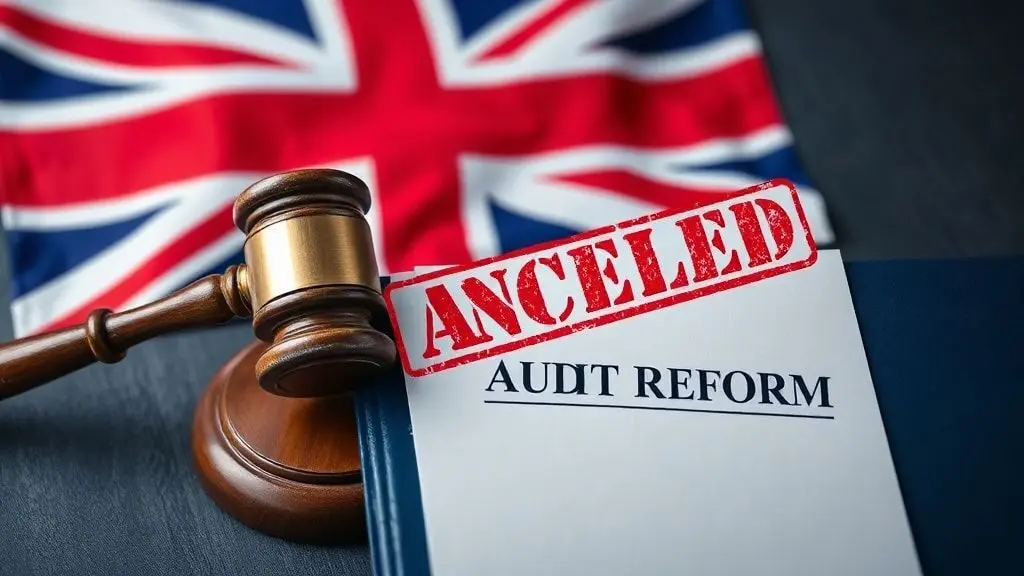
UK Audit Reform Bill scrapped news has sent ripples through the City, as the government pivots toward deregulation and cost-saving for major corporations.
By David Goldberg (@DGoldbergNews)
A Billion-Pound Pivot: The Death of the Audit Reform Bill
In a move that has sent shockwaves through the City of London and the global accounting sector, the NewsBurrow Press Team can confirm that the UK Government has officially pulled the plug on the long-anticipated Audit Reform and Corporate Governance Bill. This massive U-turn, announced on January 20, 2026, marks the end of a legislative journey that began nearly eight years ago in the wreckage of the Carillion collapse. While the government frames this as a “pro-growth” strike against red tape, critics are already calling it a dangerous gamble with the nation’s economic stability.
The decision to scrap the Bill was not merely a administrative adjustment; it was a wholesale rejection of a regime that would have redefined “Public Interest Entities” (PIEs). Under the proposed rules, large unlisted businesses with over 1,000 employees and a turnover exceeding £1 billion would have faced grueling new reporting and audit obligations. By walking away, the Department for Business and Trade (DBT) claims it is protecting these corporate giants from “significant new costs,” estimated to be in the hundreds of millions annually. For the NewsBurrow Network, this represents the most dramatic regulatory retreat in recent memory.
The shock factor here cannot be understated. Just months ago, the Labour administration had championed this Bill in the King’s Speech as the “bedrock of corporate trust.” Now, that bedrock has been replaced by a “growth package” designed to court scale-ups and international investors. The government is effectively betting that a lighter touch will lure more companies to London’s shores, even if it means ignoring the warnings of those who remember the 2018 construction industry meltdown that left 75,000 people in the lurch.
Industry leaders are split. While some boardrooms are breathing a sigh of relief at the avoided compliance fees, the Institute of Chartered Accountants in England and Wales (ICAEW) expressed “deep disappointment.” They argue that the Bill was the final piece of the puzzle to restore global confidence in UK PLC. Without it, the Financial Reporting Council (FRC) remains a regulator without its full arsenal of weapons, a situation one insider described as “trying to police a motorway with a bicycle.”
The Pro-Growth Gambit: Slashing the Costs of Compliance
Secretary of State for Business and Trade, Peter Kyle, hasn’t minced words about the new directive. The NewsBurrow Press Team has reviewed the latest strategy, which aims to cut the administrative costs of regulation by a staggering 25%. This isn’t just about saving money; it’s about saving time. The government believes that for too long, the UK’s most promising companies have looked abroad because they were drowning in “cluttered, compliance-driven documents” that offered little value to actual investors.
To replace the heavy hand of the Reform Bill, the DBT is pivoting toward a “Modernisation of Corporate Reporting” program. This initiative aims to be the most streamlined in the world. Rather than adding more layers of oversight, the government is looking to strip away the redundant parts of the Directors’ Report and the Strategic Report. For medium-sized businesses, this could mean an end to narrative reporting that feels “disproportionate to their scale,” allowing them to focus on the business of making money rather than the business of filing paperwork.
Below is a breakdown of the estimated annual savings and the scope of these reporting exemptions as reported to the NewsBurrow Network:
| Reform Initiative | Impacted Companies | Estimated Annual Savings |
|---|---|---|
| Removal of Directors’ Report | 440,000 Companies | £150 Million |
| Strategic Report Exemption (Medium Firms) | 44,000 Companies | £60 Million |
| Subsidiary Reporting Simplification | 7,000 Companies | £20 Million |
| Total Projected Benefit | ~491,000 Entities | £230 Million+ |
This “slash and burn” approach to regulation is a clear signal that London is open for business, but at what cost? By prioritizing “decision-relevant information” over comprehensive disclosure, the government is walking a tightrope. If another Carillion-style collapse occurs, the “red tape” they are cutting today will be remembered as the safety net that was thrown away. It’s a high-stakes play that suggests the UK is ready to trade a bit of transparency for a lot of agility.
Digital Democracy: The Rise of the Virtual-Only AGM
While the Audit Reform Bill may be dead, the digital revolution in corporate governance is very much alive. The NewsBurrow Press Team has noted that the government is pressing ahead with legislative changes to the Companies Act 2006 to clarify that a “place” of meeting can include an electronic platform. This marks the formal end of the “physical-only” era for Annual General Meetings (AGMs). For many firms, the traditional town hall meeting is becoming a relic of the past, replaced by high-definition Zoom galleries and secure digital voting portals.
This move isn’t just about convenience; it’s about accessibility and cost. Physical AGMs, especially for the FTSE 350, are expensive logistical nightmares involving venue hire, security, and travel. However, the transition isn’t without its detractors. Proxy advisors like ISS remain cautious, warning that virtual-only meetings could be used by boards to “shield themselves” from direct, in-person questioning by activist shareholders. The NewsBurrow Network suggests that companies looking to go virtual should consider a “hybrid” approach first to gauge shareholder sentiment before shutting the physical doors for good.
To visualize the current shift in AGM formats across the UK market, consider the following trend description:
UK AGM FORMAT TRENDS (2024-2026 Forecast)
[Market Share %]100% | * | * 75% | * Physical (72% in '25, falling to 60% by '27)
| * 50% | *
| * 25% | * * Hybrid (Rising toward 30%)
| * * * Virtual-Only (Currently 1%, surging as law clarifies)
0% |----------------------------------------------------
2024    2025    2026    2027
The government’s commitment to “digitally-enabled” meetings is part of a broader push to make the UK the most tech-friendly listing venue in Europe. By removing the legal hurdles for virtual AGMs, the NewsBurrow Press Team believes the government is attempting to appease tech scale-ups that find traditional corporate rituals archaic. Yet, the pressure remains on boards to prove that a digital meeting doesn’t mean a less accountable one.
The POAT Revolution: Rewriting the Rules of Capital Raising
As of January 19, 2026, the old EU-era Prospectus Regulation is officially history. Replacing it is the new Public Offers and Admissions to Trading (POAT) regime. This is arguably the most significant change for business attorneys since the 2024 Listing Rules overhaul. The NewsBurrow Press Team has analyzed the new PRM Sourcebook and found that the “dual trigger” regime is gone. Now, public offers are prohibited unless they fall under a specific, expanded list of exemptions—a complete reversal of the previous legal philosophy.
The headline-grabbing change is the massive jump in the threshold for requiring a prospectus for secondary fundraisings. Previously, a company could only issue 20% of its share capital within 12 months before a prospectus was mandatory. That limit has now been rocketed to 75%. This is a game-changer for listed companies needing quick infusions of capital. They can now tap the markets with unprecedented speed and minimal red tape, significantly reducing the “frictional costs” of being a public company.
Furthermore, the introduction of Public Offer Platforms (POPs) allows companies to raise over £5 million from retail investors “off-market” without a full prospectus. This is a direct attempt to democratize investment and keep smaller firms from fleeing to the US for funding. By empowering POP operators to conduct their own due diligence, the FCA is shifting the burden of trust from a heavy regulatory document to the platforms themselves. It’s a bold experiment in market-led regulation that the NewsBurrow Network will be watching closely.
The FRC’s New Reality: Power Without a Name Change
For years, the plan was to kill the Financial Reporting Council (FRC) and replace it with the Audit, Reporting and Governance Authority (ARGA)—a regulator with “teeth.” With the Bill scrapped, ARGA is no longer happening. However, NewsBurrow Press Team sources indicate that the FRC isn’t just going back to sleep. The government still intends to put the FRC on a full statutory footing as soon as “parliamentary time allows,” effectively giving it the powers of ARGA without the rebranding exercise.
This “statutory footing” means the FRC will finally have the gaps in its information-gathering powers closed, bringing it into line with other major economic regulators like the FCA. FRC CEO Richard Moriarty has welcomed this news, noting that the regulator “has not been standing still.” Even without the full legislative package, the FRC has been quietly improving audit quality across the sector. Since 2018, the watchdog has reported significant strides in the “consistency and rigor” of major audits, a fact the government used to justify why the full Bill was no longer “pressing.”
But can a regulator be truly effective without the full suite of powers originally envisioned? Many business attorneys on NewsBurrow.com are skeptical. Without the ability to hold directors directly accountable for reporting failures (one of the scrapped provisions), the FRC may still find itself fighting with one hand tied behind its back. The “shadow of ARGA” will likely continue to hang over the FRC as it tries to prove that “proportionate regulation” doesn’t mean “weak regulation.”
Sustainability Standards: Preparation Meets Delay
In another pragmatic twist, the Department for Business and Trade has confirmed a delay in the UK Sustainability Reporting Standards (SRS). While these standards are still set for publication in early 2026, the NewsBurrow Press Team has learned that specific “time references” for transitional reliefs have been removed. This means businesses will have significantly more breathing room to align their systems with the most challenging environmental and social disclosure requirements.
Stakeholder feedback was clear: the industry isn’t ready for a “big bang” approach to sustainability. By allowing entities more time to prepare, the government is trying to avoid another compliance “bottleneck.” However, this creates a confusing landscape for business attorneys. On one hand, the High Court is issuing warnings about the risks of AI and emerging tech liabilities, while on the other, the government is pushing back the very standards meant to manage these risks. It is a “wait and see” environment that requires constant vigilance from legal departments.
For firms operating across borders, this delay is a double-edged sword. While it saves costs in the short term, it risks creating a “divergence gap” with the EU’s stricter Corporate Sustainability Reporting Directive (CSRD). Companies on NewsBurrow.com are already asking: is the UK becoming a “green-safe” haven, or is it just falling behind the curve? The answer will likely depend on how quickly the FCA moves to adopt these standards for listed entities later this year.
Navigating the New Corporate Roadmap
As we navigate this “brave new world” of 2026, the role of the Business Attorney has never been more critical. The NewsBurrow Network encourages all legal professionals to stay ahead of the “Horizon Scanning” themes—Crisis Management, Energy Transition, and Capital Flows are no longer just buzzwords; they are the new front lines of corporate risk. With the Audit Reform Bill gone, the focus shifts to internal material controls (Provision 29 of the UK Corporate Governance Code) and the proper utilization of the new POAT exemptions.
The scrapping of the Bill is a moment of profound transformation. It tells us that for the current government, the trauma of Carillion has been superseded by the fear of economic stagnation. It is a bold, controversial, and perhaps even dangerous pivot toward a deregulated future. Whether this leads to a “golden age” of UK scale-ups or the next great corporate scandal remains to be seen. One thing is certain: the rules have changed, and the “red tape” is being cut in ways we never thought possible.
What is your take on the government’s U-turn? Is this a vital boost for British business or a recipe for the next corporate disaster? Join the conversation on NewsBurrow.com and share your insights. The NewsBurrow Press Team will be here, tracking every move as the UK attempts to reinvent itself as the world’s most agile financial hub.
The abrupt cancellation of the Audit Reform Bill has fundamentally altered the compliance landscape for the UK’s largest corporate entities. For business attorneys and legal departments, this regulatory shift creates a critical need for precision and up-to-date guidance as EU-era rules are rapidly replaced by bespoke British frameworks. Navigating these changes without an authoritative reference tool increases the risk of oversight in a year where the Financial Reporting Council is asserting its new statutory powers.
Professional legal teams are now prioritizing resources that provide granular detail on the new POAT regime and the modernization of corporate reporting. With secondary fundraisings and virtual AGM regulations evolving in real-time, having a foundational text on your desk is no longer a luxury but a strategic necessity. These resources bridge the gap between high-level policy shifts and the daily practicalities of corporate governance and share issuance.
To ensure your firm remains at the forefront of these 2026 developments, we have identified the essential tools that successful practitioners are adding to their libraries this quarter. We invite you to join the conversation in our comments section and subscribe to the NewsBurrow newsletter for exclusive regulatory deep-dives. Explore our curated selection of professional resources to strengthen your practice against the volatility of the new corporate roadmap.
Shop Products On Amazon
Shop Products on Ebay
Trending Similar Stories in the News
Trending Videos of Uk Audit Reform Bill Scrapped


GIPHY App Key not set. Please check settings