

 Aisha Khan
Table of Contents
Extreme Weather Events 2026
State of the Planet 2026: Why Extreme Weather is Shattering Every Global Record Right Now
Extreme weather events 2026 have already shattered global records, serving as a stark reminder of the escalating volatility of our planet’s climate.
By Aisha Khan
Environmental Correspondent, NewsBurrow News Network
Twitter: @AishaKNews
The Great Climate Divergence: 2026’s Chaotic Start
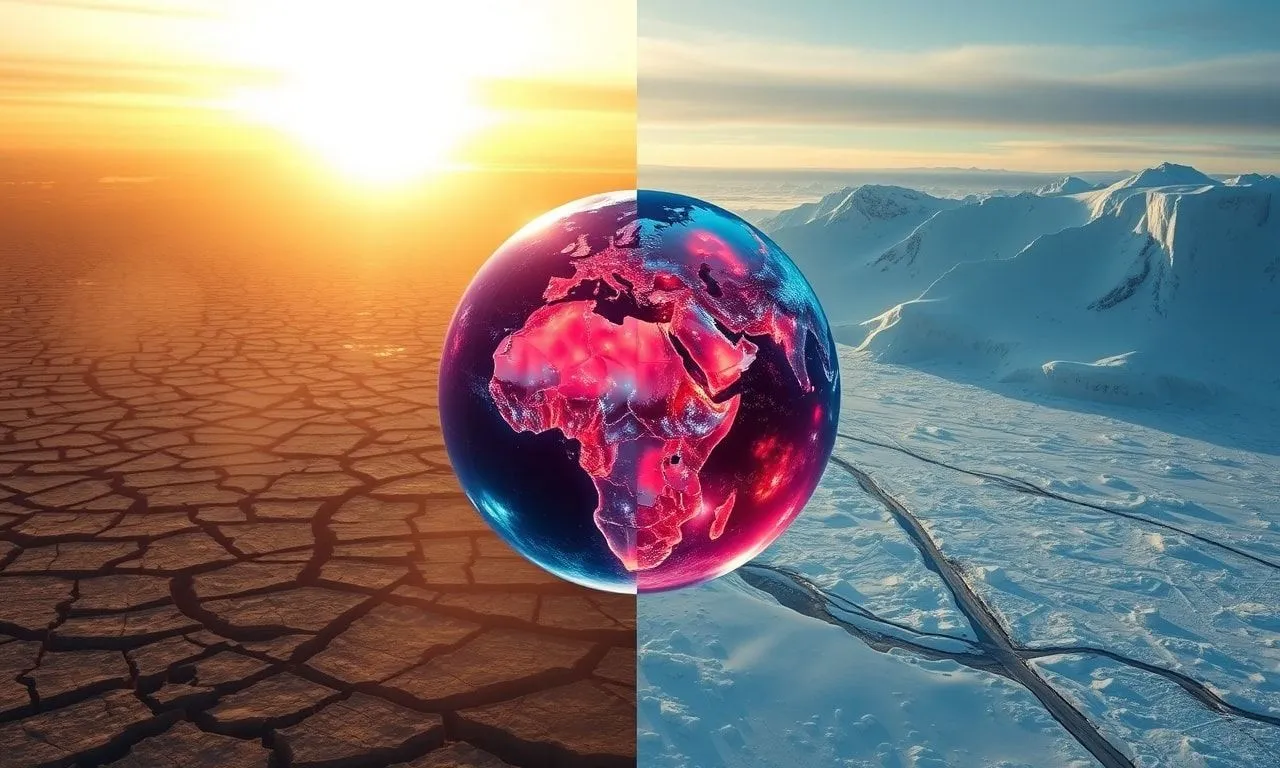
The dawn of 2026 has brought with it a meteorological paradox that has left even seasoned climatologists at the World Meteorological Organization (WMO) reaching for new adjectives. While the calendar barely turned its first few pages, the planet decided to showcase its most violent mood swings. We are currently witnessing what experts call a “Great Climate Divergence”—a period where the traditional rules of seasonal expectation have been shredded. In one hemisphere, the earth is literally baking under a sun that feels closer than ever, while in the other, a shattered polar vortex has unleashed an atmospheric ghost that refuses to leave.
Data recently released by the Copernicus Climate Change Service (C3S) confirms that January 2026 was the fifth warmest January on record globally. This statistic is particularly chilling because it occurred during a weak La Niña phase—a phenomenon that is traditionally supposed to cool the planet. Instead, the background noise of human-induced warming has become so loud that it has effectively drowned out Nature’s own air conditioning. We are no longer just watching a trend; we are living in a permanent state of atmospheric emergency.
This isn’t just a story about numbers on a digital thermometer; it’s a narrative of survival. From the flooded streets of Mozambique to the ice-crusted highways of the American Midwest, the first quarter of 2026 has served as a brutal “State of the Planet” address. The message is clear: the climate system is not just warming—it is destabilizing. As we peel back the layers of these records, the “shock factor” lies in the realization that these extremes are no longer outliers. They are the new baseline for a world that has pushed past its comfortable limits.
Australia on Fire: The 49.5°C Reality of Ceduna
On January 26, 2026, while many Australians were celebrating their national holiday, the coastal town of Ceduna became the epicenter of a planetary furnace. The mercury didn’t just rise; it exploded to an agonizing 49.5°C (121.1°F). This wasn’t a dry desert outpost—it was a seaside community. The sheer heat was so intense that the “silent killer,” as the Australian Bureau of Meteorology calls it, forced residents indoors while gusty winds turned the surrounding landscape into a tinderbox. The heat didn’t just break a record; it broke the spirit of regional normalcy.
The fire weather conditions were rated from “High” to “Extreme,” and for good reason. In South Australia, north-west Victoria, and inland New South Wales, the heat dome was so persistent that vegetation was essentially pre-cooked before the first spark even landed. Fire crews described a “wall of heat” that preceded the actual flames, a phenomenon rarely seen outside of the most catastrophic bushfire seasons. The human impact was immediate: hospitals reported a surge in heat-related distress, and the agricultural sector braced for a devastating blow to livestock and crops.
The shock to the system in Ceduna is a microcosm of a broader Southern Hemisphere crisis. When a coastal town hits nearly 50 degrees, the traditional cooling effect of the ocean has effectively been neutralized. This is the “furnace effect” in full swing. Below is a look at the extreme temperature spikes recorded during this unprecedented January window:
| Location | Recorded Temp (°C) | Historical Average (°C) | Deviation |
|---|---|---|---|
| Ceduna, SA | 49.5 | 29.1 | +20.4 |
| Oodnadatta, SA | 48.5 | 37.8 | +10.7 |
| Mildura, VIC | 47.2 | 32.4 | +14.8 |
| Adelaide, SA | 44.7 | 28.6 | +16.1 |
The Polar Vortex Collapse: Why the Northern Hemisphere is Shivering
While Australia burned, the Northern Hemisphere found itself trapped in an icy grip that felt like a relic from a previous century. A massive disruption in the stratosphere caused the Polar Vortex to split, effectively spilling Arctic air into mid-latitudes like a broken freezer door. From the Canadian Prairies to the streets of Dublin, temperatures plummeted to depths not seen in decades. This wasn’t just a cold snap; it was a sustained atmospheric invasion that turned January 2026 into a test of infrastructure endurance.
The World Meteorological Organization warned of “the longest duration of cold in several decades,” and the reality lived up to the dire forecast. In parts of North America, wind chills hit a bone-shattering -43°F, turning simple outdoor tasks into life-threatening gambles. The disruption wasn’t just in the temperature, but in the moisture. Massive snowfall events buried cities in Japan and the U.S. Northeast, while freezing rain in Ontario turned power lines into glass sculptures before they inevitably snapped under the weight.
The irony of this “deep freeze” is that it is actually a symptom of a warming Arctic. As the North Pole warms at three times the global average, the jet stream—which usually keeps the cold air penned in—becomes “wavy” and sluggish. This allows the cold to migrate south and stay there. It is a terrifying paradox: a hotter world creates a more chaotic, and occasionally much colder, winter for those living in the North. The “ghost of winters past” has returned, but with a modern, climate-driven vengeance.
WMO Analysis: The 2026 ‘State of the Planet’ Brief
The World Meteorological Organization’s mid-February brief reads more like a casualty report than a scientific summary. Secretary-General Celeste Saulo highlighted that extreme weather now consistently ranks as the top global risk in economic forums. The WMO’s data points to a disturbing trend: the number of people affected by climate-related disasters is rising exponentially every year. In 2026, the complexity of these events is what stands out—we are seeing “compound disasters” where heatwaves are immediately followed by catastrophic floods.
One of the most vital insights from the WMO report is the role of National Meteorological Services. In 2026, the difference between life and death has often come down to a 48-hour early warning window. Countries with robust early warning systems have seen disaster-related deaths six times lower than those without. This has prompted a global push for the “Early Warnings for All” initiative, as the unpredictability of the 2026 patterns leaves no room for error or delay.
- Thermal Volatility: Simultaneous record heat (South) and record cold (North) in the same 24-hour cycle.
- Hydrological Intensity: Every 1°C of warming increases rainfall intensity by roughly 7%.
- Economic Erosion: African nations are now losing up to 5% of their GDP annually to climate response.
- Oceanic Overheat: Sea surface temperatures in the North Atlantic are at their highest in recorded history for February.
La Niña’s Failure: Why Natural Cooling Couldn’t Stop the Heat
For years, La Niña was the planet’s reliable “cool phase,” often providing a temporary reprieve from the steady climb of global temperatures. But in late 2025 and early 2026, La Niña failed to show up in any meaningful way. Despite the presence of these cooling Pacific currents, the sheer volume of greenhouse gases in the atmosphere acted as a thermal blanket that La Niña simply couldn’t penetrate. This is perhaps the most frightening takeaway for 2026: our “natural cooling” systems are being overwhelmed by human activity.
Scientists from Imperial College London have noted that human-driven climate change now “overshadows” natural fluctuations. If we are breaking records during a cooling phase, what happens when we shift back into an El Niño—the “global furnace”—later this year? The fear among the scientific community is that 2026 is merely the launchpad for a 2027 that could shatter the 1.5°C Paris Agreement threshold not just temporarily, but as a sustained new reality.
The “Global Air Conditioning” is broken. We have reached a point where the background warming of 1.4°C above pre-industrial levels provides such a high floor that even a “cool” year is hotter than the hottest years of the 1990s. This isn’t a cycle anymore; it’s a climb. The following ASCII art illustrates the “Staircase of Heat” we’ve climbed, where even the “dips” (La Niña) are higher than the previous “peaks” (El Niño).
Global Temperature Trend (1850 - 2026)
Temp (°C)
^
1.5|               _ [2024 Record]
|            _ / \ _ [2026 La Niña "Dip"]
1.0|          _ /
|       _ /
0.5|    _ /
| _ /
0.0|________________________> Time
1850        1990    2026
Southern Africa Under Water: The Mozambique Flood Crisis
While the world watched the thermometers in Australia, Mozambique was drowning. In the final week of January 2026, Southern Africa was hit by a deluge that displaced hundreds of thousands of people. The intensity of these downpours has increased by an estimated 40% since the pre-industrial era. Why? Because a warmer atmosphere holds more water—roughly 7% more for every degree of warming. When that moisture finally releases, it doesn’t just rain; it deluges.
The World Weather Attribution study on the Mozambique floods provides a stark critical analysis: this wasn’t just bad luck. It was a direct consequence of a “loaded climate dice.” The flooding destroyed critical infrastructure and decimated the livelihoods of subsistence farmers who were already reeling from previous storms. The humanitarian cost is a grim reminder that while developed nations debate policy, developing nations are paying the bill in human lives.
The devastation in Mozambique and South Africa highlights the “compound” nature of 2026’s weather. Often, these regions move directly from severe drought to catastrophic flooding with no transition period. This “weather whiplash” makes agricultural planning impossible and leaves soil unable to absorb the sudden influx of water, leading to the deadly landslides we saw in early February. It is a cycle of destruction that is becoming the standard operating procedure for the Southern African climate.
Patagonia and Chile: The Destruction of Ancient Forests
In the high-altitude reaches of Patagonia and the coastal towns of Chile, a different kind of tragedy unfolded this January. Prolonged drought combined with an unprecedented heatwave turned ancient forests into high-octane fuel. In Chile alone, wildfires claimed 21 lives in a single week, as flames moved with a speed that outpaced evacuation efforts. These aren’t just seasonal fires anymore; they are “mega-fires” that create their own weather systems, including fire-induced thunderstorms known as pyrocumulonimbus clouds.
The “shock factor” here is the location. Regions like Patagonia, traditionally known for their cold, windswept landscapes and glaciers, are now becoming fire zones. The encroachment of extreme heat into these ecological refuges is a sign that no corner of the planet is safe. The loss of these forests isn’t just a local disaster; it’s a global one, as these carbon sinks are transformed into carbon sources, further accelerating the very warming that ignited them.
The sheer scale of the burn in 2026 has already surpassed the totals of the last three years combined for the region. As we look at the data, the trend is undeniable: the “fire season” is becoming a “fire year.” The resilience of these ecosystems is being tested to the breaking point, and in many cases, they are failing to recover, leading to permanent shifts in the landscape—from forest to scrubland.
Survival and Adaptation: Living in the Era of Extremes
As we navigate this turbulent 2026, the conversation must shift from “if” this will happen to “how” we will survive it. The WMO and IPCC have both made it clear: even if we stopped all emissions tomorrow, the warming already “baked in” to the system will continue to drive extremes for decades. Adaptation is no longer a luxury; it is a necessity for national security and economic stability. From redesigning power grids to withstand -40°F to building “sponge cities” that can absorb a month’s worth of rain in a day, the blueprint for the future is being drawn in the mud and ashes of 2026.
We encourage our readers at NewsBurrow to join this conversation. How is your local community adapting to these “unpredictable” patterns? Have you noticed the “skipping of spring” in your region, as reported in places like India this February? The climate crisis is the story of our lifetime, and 2026 is proving to be its most dramatic chapter yet. Every fraction of a degree matters, and every voice in this discussion brings us closer to the collective action required to stabilize our wobbling world.
The “State of the Planet” is fragile, but not yet hopeless. By investing in early warning systems and shifting rapidly away from the fossil fuels that “turbo-charge” our weather, we can still influence the severity of the chapters yet to be written. But make no mistake—the records shattered in 2026 are a warning shot. The planet is speaking; it’s time we finally listened.
Would you like me to analyze the potential for a 2027 El Niño surge or provide a localized survival guide for the upcoming spring weather anomalies? Join the conversation in the comments below!
The intensifying volatility of our global climate means that the window for preparation is closing faster than ever before. As we have seen in the early weeks of 2026, disaster does not provide a courtesy call; it arrives with the fury of a 49°C heatwave or the bone-chilling silence of a collapsed polar vortex. In this new era of atmospheric unpredictability, the line between safety and catastrophe is often drawn by the tools you have within arm’s reach when the grid goes dark or the evacuation sirens wail.
Relying on traditional emergency services is no longer enough when entire regions are simultaneously paralyzed by “compound disasters.” Professional resilience requires a proactive shift toward personal readiness, ensuring that your household is equipped to handle the unique thermal and hydrological threats of the current year. Having a comprehensive, battle-tested set of supplies is not just a safety precaution—it is an essential investment in your family’s survival and peace of mind during the most harrowing hours of a storm.
We have curated a selection of high-performance tools and professional-grade gear specifically designed to meet the demands of the 2026 climate crisis. We invite you to explore these essential resources to ensure your readiness is as robust as the challenges we now face. Join the NewsBurrow community by sharing your own preparation tips in the comments below, and subscribe to our newsletter for the latest life-saving alerts and deep-dive climate analysis.
Shop Products On Amazon
Shop Products on Ebay







Trending Similar Stories in the News
The essential role of conditional attribution in understanding complex extreme weather Nature...
Floods linked to climate change hit nearly 1 million in Southern Africa Mongabay...



GIPHY App Key not set. Please check settings