

 Amara Okoye
Table of Contents
Bill Gates Africa $200bn Donation
Bill Gates Pledges $200 Billion to Africa: How AI Will Transform Rural Healthcare
Bill Gates Africa $200bn donation is set to trigger a technological revolution in rural health clinics across the continent over the next two decades.
By Amara Okoye | @AmaraReports
The $200 Billion Gamble: Bill Gates Redraws the Map of African Survival
In a move that has sent shockwaves from the glass towers of Seattle to the bustling corridors of the African Union in Addis Ababa, Bill Gates has officially declared that the vast majority of his nearly $200 billion fortune is heading to one place: Africa. This isn’t just another charitable donation; it is a seismic reallocation of global wealth. The tech titan is effectively betting the entirety of his legendary legacy on the success of a single continent over the next twenty years.
Standing before African leaders, Gates didn’t just offer money—he offered a deadline. With a clear-eyed focus on December 31, 2045, the date the Bill & Melinda Gates Foundation is set to shutter its doors forever, the mission has shifted from steady support to an all-out sprint. The sheer scale of this commitment is unprecedented, representing a doubling of the foundation’s previous spending pace to tackle the world‘s most stubborn inequalities.
But there is a sharp edge to this generosity. By funneling such an astronomical sum into specific health and education sectors, Gates is doing more than saving lives; he is fundamentally restructuring how African nations prioritize their internal budgets. It is a high-stakes gamble that asks a provocative question: Can a private individual’s vision for the future outpace the traditional, often sluggish, machinery of global diplomacy?
The atmosphere surrounding the announcement is a mix of electric hope and quiet apprehension. As the first tranches of this $200 billion begin to move, the eyes of the world are fixed on Africa, waiting to see if this massive injection of capital will act as a cure-all or if it will create a new kind of dependency that the continent may struggle to break once the Gates Foundation vanishes in 2045.
The Great Dissolution: Why 2045 is the Most Important Date in Philanthropy
The “Spend Down” strategy is perhaps the most radical aspect of this $200 billion pledge. Most multi-billion-dollar foundations aim for “perpetuity”—investing their capital and spending only the interest to last forever. Bill Gates has rejected this immortality. Instead, he is burning the candle at both ends, ensuring that every cent of his wealth is deployed while he is still alive to see the impact, leaving nothing behind but the systems he helped build.
This ticking clock creates a unique sense of urgency. By doubling the pace of giving—aiming to spend what took 25 years to distribute in just the next 20—the foundation is forcing a rapid-fire evolution of healthcare infrastructure. It is a “use it or lose it” scenario for partner governments, who must now prepare for a future where this massive financial pillar will eventually be removed entirely.
Critics argue that this “sprint to the finish” could lead to reckless spending or the creation of systems that cannot be maintained without Gates’ billions. However, the foundation’s leadership insists that the goal is to build “durable resilience.” The objective is to ensure that by 2045, African health systems are so technologically advanced and self-sufficient that they no longer require outside intervention to function.
The strategy is a stark reminder of Gates’ roots as a software engineer: optimize the system, fix the bugs, and then ship the final product. But in the world of human lives and complex geopolitics, “shipping the product” means leaving behind 1.4 billion people who must then navigate the world without their most significant financial backer. The next two decades will be a masterclass in exit-strategy philanthropy.
Silicon Savannah: The AI Revolution Hidden in Rural Health Clinics
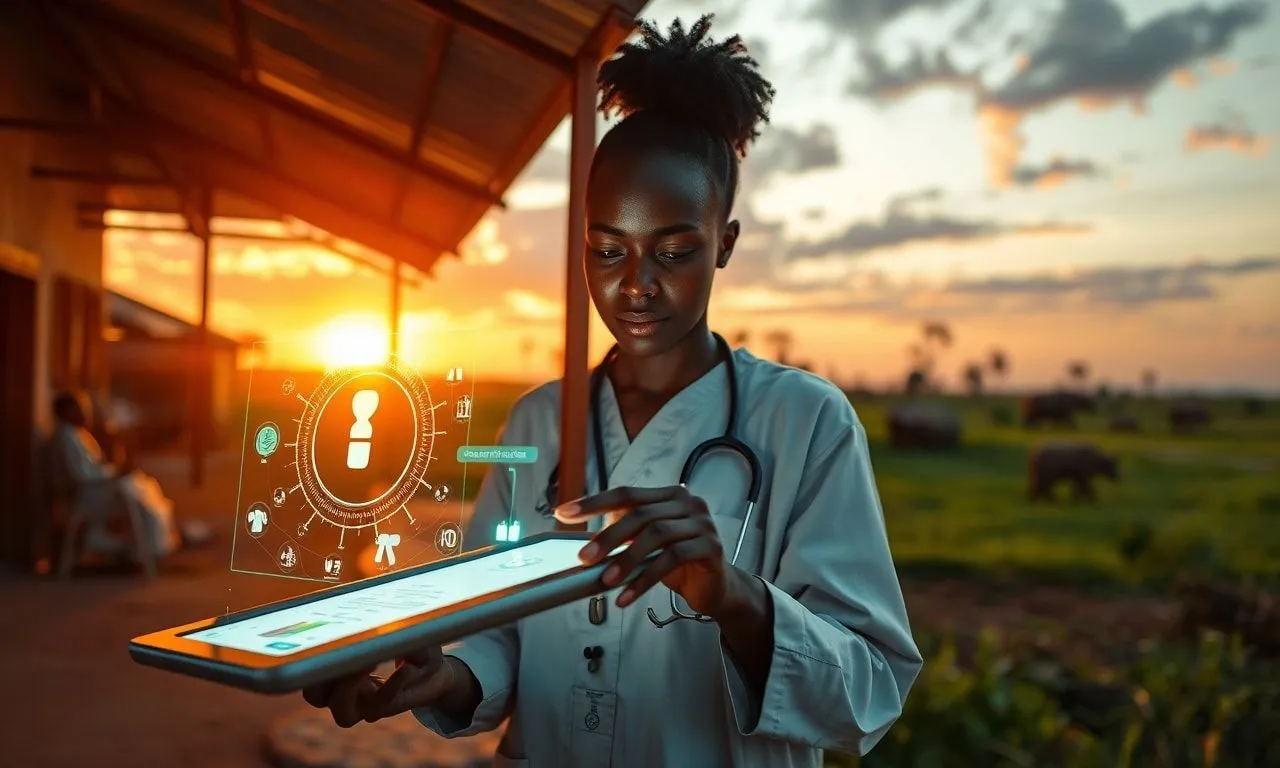
The “shock factor” of this $200 billion donation lies in its delivery mechanism: Artificial Intelligence. Gates isn’t just sending stethoscopes and vaccines; he is sending algorithms. The unique angle of this initiative is the “AI-driven” digital transformation of rural African clinics. Imagine a remote village in the Sahel where a solar-powered tablet, equipped with advanced diagnostic AI, can identify a high-risk pregnancy months before a human doctor could.
This digital leapfrogging is intended to bridge the massive gap in healthcare personnel. With a severe shortage of trained doctors across rural regions, AI tools are being positioned as the “force multipliers” that will allow local nurses and community health workers to perform complex diagnostics. It is a move that turns every rural clinic into a high-tech node in a continental health network.
Below is a breakdown of the projected technological integration in rural African health zones over the next decade:
| Technology Category | Primary Use Case | Projected Impact (2035) |
|---|---|---|
| Diagnostic AI | Early detection of TB and Malaria via mobile imaging | 85% reduction in diagnostic lag time |
| Biometric Health IDs | Tracking vaccination records in nomadic populations | Universal coverage for infant immunizations |
| Cloud-Based Supply Chain | Real-time tracking of vaccine and medicine stock | Zero-waste pharmaceutical distribution |
| Tele-Education Platforms | AI-led teacher training for rural schools | 40% increase in literacy rates in pilot zones |
This tech-heavy approach is not without its detractors. There are valid fears that an over-reliance on AI could lead to a “black box” healthcare system where local practitioners lose their diagnostic intuition, replaced by proprietary software that they do not fully understand or control. Yet, for Gates, the efficiency of AI is the only way to scale healthcare to reach the hundreds of millions currently living below the poverty line.
The War on Mortality: Targeting the Foundations of Human Suffering
At the core of the $200 billion pledge are three non-negotiable priorities: ending preventable deaths of mothers and infants, eradicating infectious diseases, and lifting millions out of extreme poverty. Gates has often said that “the trend lines are better than the headlines,” and he intends to use this capital to ensure those trend lines never falter. The focus is laser-targeted on the first 1,000 days of life, where the most significant gains in human capital are made.
By investing heavily in primary healthcare infrastructure, the foundation is attempting to solve the “last mile” problem. It is one thing to have a vaccine; it is another to ensure that vaccine reaches a child in a conflict-torn region of Sudan or a flooded village in Tanzania. The funding will be used to reinforce these fragile delivery chains, using digital tools to track every vial and every patient.
The scale of the challenge is visually represented in the following progress projection for maternal and infant health across the continent:
Maternal Mortality Rate (Deaths per 100k)
|
| 700+ [########] (Current Average)
| 500  [######  ] (2030 Target)
| 300  [####    ] (2035 Projection)
| 100  [##      ] (2045 Goal)
+---------------------------------------
This isn’t just about medicine; it’s about the economy. Healthy mothers and children are the bedrock of a productive workforce. By focusing on health, Gates is effectively making a $200 billion investment in Africa’s future GDP. If the foundation can successfully lower the mortality rate, the demographic dividend for Africa could be the most significant economic story of the 21st century.
Philanthro-Colonialism? The Rising Voice of African Sovereignty
While the headlines celebrate the $200 billion, a quieter, more skeptical conversation is growing among African intellectuals and civil society. The term “Philanthro-Colonialism” has begun to trend, reflecting a fear that the Gates Foundation’s massive wealth allows it to bypass democratic processes and dictate national policies. When one foundation holds a budget larger than many African nations’ health ministries, who is actually in charge?
Critical voices argue that while the money is welcome, the “donor-driven” agenda can sometimes displace local priorities. If a country wants to focus on cardiovascular health due to a rising middle-class crisis, but Gates’ funding is strictly tied to infectious diseases, the national policy inevitably bends toward the money. It is a soft power that can feel as restrictive as it is supportive.
Gates has attempted to mitigate this by promising a “government-aligned” model. Instead of building parallel systems, the foundation aims to integrate its funding directly into national health plans. However, the sheer gravity of $200 billion makes “alignment” look more like “compliance” to some observers. The debate over transparency and local accountability is set to become the defining conflict of this twenty-year era.
The “shocking” reality is that Africa is becoming the world’s largest laboratory for private-sector governance. As the Gates Foundation expands its coordinating roles in Addis Ababa, Nairobi, and Lagos, it is increasingly acting as a shadow civil service. The challenge for African leaders will be to accept the billions while ensuring their own citizens remain the primary architects of their national destiny.
The Gates Legacy: From Software King to Africa’s Chief Architect
In the end, Bill Gates’ $200 billion donation to Africa is an attempt to rewrite the human story. He is moving away from the “Bill Gates: Tech Mogul” persona and fully embracing the role of “Bill Gates: Global Architect.” By targeting the most vulnerable regions with the most advanced technology, he is trying to prove that poverty is not a permanent condition, but a solvable engineering problem.
The success of this mission will be judged not by the amount of money spent, but by the strength of the systems left standing in 2046. Will there be a “Silicon Savannah” where AI-driven clinics are managed and maintained by African scientists? Or will the departure of the Gates Foundation reveal a hollowed-out infrastructure that cannot sustain itself? The stakes could not be higher.
We invite you to join this conversation. Is this $200 billion pledge the ultimate act of human solidarity, or is it a dangerous precedent for private influence over sovereign nations? How do you feel about AI taking a central role in rural healthcare? Share your thoughts in the comments below and let’s discuss the future of the continent.
- What do you think? Is AI the answer to Africa’s healthcare gap?
- Join the Debate: Can philanthropy truly replace government responsibility?
- Share the News: Help others understand the scale of this historic change.
For more deep-dives into the innovations shaping Africa, stay tuned to NewsBurrow News Network, where we bring you the heart of the story, every time.
As the Gates Foundation accelerates its $200 billion mission, the focus is shifting toward the physical tools required to sustain this digital healthcare leap. For high-tech AI diagnostics to function in the most remote corners of the continent, a stable and independent energy source is no longer a luxury—it is a life-saving necessity. The transition from traditional medicine to a tech-enabled future depends entirely on the ability of local clinics to stay powered regardless of their distance from the national grid.
To meet this urgent demand, specialized equipment designed for durability and portability is becoming the gold standard for frontline health workers. These essential tools allow rural practitioners to maintain cold-chain storage for vaccines and provide continuous power for the mobile diagnostic devices that Bill Gates is betting his fortune on. By equipping these clinics with reliable, self-sustaining energy solutions, the vision of a “Silicon Savannah” becomes a tangible reality for millions of families.
We invite you to explore the latest innovations in field-ready medical technology that are currently empowering communities across the region. Join the conversation in the comments below to share your thoughts on how local infrastructure can best support global philanthropy. Don’t forget to subscribe to the NewsBurrow newsletter for exclusive updates on the tech-driven recovery of African healthcare and more breaking global insights.
Shop Products On Amazon
Shop Products on Ebay




Trending Similar Stories in the News
Bill Gates vows to give most of $200bn fortune to African health and education The Guardian...
Bill Gates to give most of his $200bn fortune to Africa BBC...



GIPHY App Key not set. Please check settings