

 David Goldberg
Table of Contents
Chiefs Kansas Stadium Deal
Chiefs Kansas Stadium Deal Under Fire: $3 Billion Project Faces New Budget Grilling
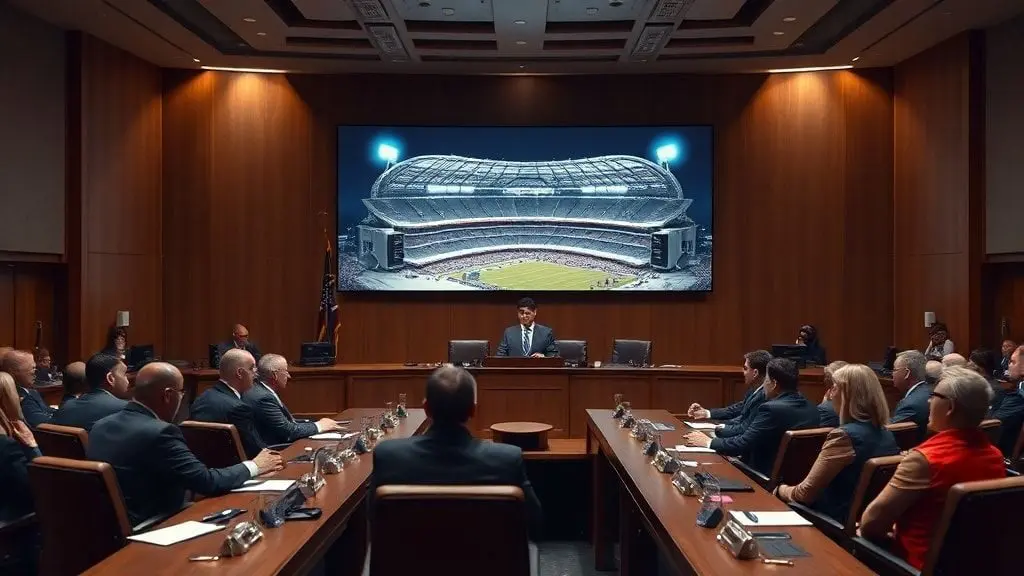
Chiefs Kansas stadium deal discussions reached a fever pitch this week as team attorneys faced intense questioning from state legislators regarding the true cost to taxpayers.
By David Goldberg (@DGoldbergNews)
NewsBurrow Press Team
The 2026 Gridiron Gamble: Kansas Bets Big on the Chiefs
The state of Kansas is no longer just “flyover country”; it is officially the epicenter of a multi-billion dollar tug-of-war. As the sun rose over the Topeka Statehouse this January, the air was thick not just with the winter chill, but with the high-stakes tension of the “Border War” redux. After decades of calling Missouri home, the Kansas City Chiefs are crossing the state line, bringing with them a $3 billion stadium proposal that has sparked a firestorm of legislative debate. This isn’t just a move; it is a massive financial gamble that has lawmakers and taxpayers divided down the middle.
The deal, which was officially inked in late December 2025, promises to transform the Sunflower State into a premier sports destination. However, the sheer scale of the project—a $4 billion total investment including a secondary headquarters—has left many asking if the state is buying a championship legacy or a long-term deficit. For Governor Laura Kelly, the project is a “game-changer,” a lighthouse to attract youth and investment. But for those holding the purse strings in the legislature, the honeymoon phase is over, replaced by a rigorous “budget grilling” that seeks to peel back the layers of this unprecedented public-private partnership.
As the NewsBurrow Press Team observed during the recent hearings, the atmosphere was anything but celebratory. Legislators, armed with spreadsheets and skeptical inquiries, interrogated team representatives about the long-term viability of the financing. This is the story of a team seeking a modern palace and a state seeking an economic engine, but as the details emerge, the question remains: who is really footing the bill for this 2026 gridiron gamble?
Inside the $3 Billion Blueprint: Wyandotte’s New Crown Jewel
At the heart of the controversy is a massive, state-of-the-art domed stadium slated for Wyandotte County. Positioned near the existing Kansas Speedway, this “Crown Jewel” is designed to be more than just a place for Sunday afternoon kickoffs. The blueprint describes a year-round entertainment hub, capable of hosting Super Bowls, Final Fours, and international concerts that currently bypass the region. The vision is grand: a shimmering dome that would dominate the skyline and serve as the anchor for a sprawling mixed-use district filled with high-end hotels and retail outlets.
However, the $3 billion price tag for the stadium alone is enough to make even the most ardent fan pause. The Chiefs have promised to contribute 40% of the costs, leaving a staggering 60% to be covered by the public. NewsBurrow Network sources indicate that the stadium is expected to open its doors for the 2031 NFL season, marking the end of the team’s historic tenure at Arrowhead. The transition from an open-air historic site to a climate-controlled corporate marvel is a significant shift in the team’s identity, one that many critics argue prioritizes luxury boxes over the grit of the traditional fan experience.
To visualize the sheer scale of the investment, consider the following breakdown of projected costs and impacts provided during the January 22, 2026, legislative update:
| Project Component | Estimated Cost | Public Funding (60%) | Private Contribution (40%) |
|---|---|---|---|
| Wyandotte Domed Stadium | $3.0 Billion | $1.8 Billion | $1.2 Billion |
| $300 Million | $180 Million | $120 Million | |
| Ancillary Mixed-Use Development | $700 Million | $0 (Private/TIF) | $700 Million |
| Total Investment | $4.0 Billion | $1.98 Billion | $2.02 Billion |
The Olathe Pivot: More Than Just a Practice Field
While the stadium in Wyandotte grabs the headlines, a secondary front has opened in the city of Olathe. The “Olathe Pivot” represents a $300 million investment in a new team headquarters and training facility located in Johnson County. This move isn’t just about where the players lift weights; it’s a strategic land grab that deepens the Chiefs’ roots in the wealthiest pocket of the state. The proposed facility is expected to be a magnet for further development, including specialized sports medicine clinics and corporate offices that want to be “next door to the champs.”
Yet, the Olathe development has its own set of skeptics. Residents in the Garmin soccer field area have raised concerns about traffic, housing costs, and whether the promised “mixed-use” benefits will actually materialize for the local community. The project is described as an “elite campus,” but for many in Olathe, it feels like an encroachment of professional sports into a residential sanctuary. The NewsBurrow Press Team spoke with local advocates who fear that the $180 million in public incentives for this facility could be better used for schools or local infrastructure.
The Chiefs argue that the Olathe facility is essential for recruiting top-tier talent and maintaining a championship-caliber organization. They point to the 4,000 permanent jobs expected to be generated across both sites. However, the “pivot” to Olathe signifies a broader strategy: the Chiefs are not just a football team anymore; they are a real estate and development firm that happens to play football on the side. This dual-county strategy ensures that if one project faces a hurdle, the other maintains the team’s momentum in the state.
STAR Bonds 101: How a ‘No New Taxes’ Promise Actually Works
To sell this massive project to a tax-averse public, the Kelly administration and the Chiefs have leaned heavily on a complex financial instrument: STAR Bonds (Sales Tax and Revenue Bonds). The pitch is enticing: “No new taxes on Kansans.” In this model, the state issues bonds to pay for construction, and those bonds are repaid using the new sales tax revenue generated within the designated district. Essentially, it’s a bet that the stadium will create so much new economic activity that it will pay for itself over 30 years.
However, the “STAR Bonds 101” reality is more nuanced. Critics point out that these aren’t “free” dollars. By diverting sales tax revenue to pay off stadium debt, that money is effectively siphoned away from the State General Fund for three decades. If a fan buys a $150 jersey at the stadium, the tax on that purchase doesn’t go to fix roads or fund teachers; it goes to pay back the bondholders who funded the billionaire’s stadium. It is a “revenue mirage” where the growth is captured by the project rather than the community at large.
Furthermore, the state must take 100% ownership of the stadium to make this legal. While this allows the bonds to be tax-exempt, it also means the Chiefs don’t pay property taxes on a multi-billion dollar asset. NewsBurrow.com has analyzed the legislative session notes, revealing that the “base value” of the tax district—the amount of tax already being collected before the stadium—could be set as low as zero by the Secretary of Commerce. This would allow the project to capture nearly every penny of sales tax in the area, a move that has fiscal hawks in Topeka sounding the alarm.
The 15-Year Fast Track: Can the Debt Really Be Paid Early?
During the intense hearings on January 22, 2026, Chiefs’ attorney Korb Maxwell dropped a bombshell: the team believes the 30-year debt could be erased in as little as 10 to 15 years. This “15-Year Fast Track” is based on highly optimistic projections of development near the Wyandotte and Olathe sites. The theory is that the “Chiefs Effect” will attract so many ancillary businesses—restaurants, hotels, and retail—that the sales tax revenue will overflow, allowing the state to retire the STAR bonds decades ahead of schedule.
Legislators were quick to grill Maxwell on these numbers. If the projections are wrong, the state is locked into a 30-year diversion of revenue. The “Fast Track” assumes a perfect economic climate and no competition from across the border, a risky assumption given Missouri’s history of retaliatory incentives. “We are seeing unique entertainment opportunities that want to be associated with the NFL and the Chiefs,” Maxwell told the NewsBurrow Press Team, but he stopped short of naming the specific companies ready to sign on the dotted line.
To visualize the projected debt retirement vs. a standard bond, here is an ASCII representation of the “Chiefs Projection” vs. “Skeptics Reality”:
Debt ($B)
^
1.8| **** (Initial Debt)
|     *
1.2|      * (Skeptics' Reality - 30 Year Slope)
|       * . . . . . . . . . . . . . . . .
0.6|        * (Chiefs' "Fast Track" 15 Year Drop)
|         * .
0+---------|---------|---------> Time (Years)
0        15        30
Game-Changer or Budget-Breaker? The Jobs Debate
No stadium deal is complete without the promise of a job’s bonanza. Governor Kelly’s office has touted a staggering 20,000 construction jobs and a $4.4 billion economic impact during the building phase alone. Once the doors open, they project 4,000 permanent positions and $1 billion in annual economic activity. To many, this sounds like an undeniable win for a state looking to shed its “flyover” image and retain its graduating youth. “This is the biggest economic win we’ll ever have in Kansas,” House Speaker Dan Hawkins recently noted.
But the NewsBurrow Press Team’s critical analysis suggests these numbers may be inflated. Economists frequently argue that stadium jobs are often part-time, low-wage seasonal positions (concessions, ticket takers, parking) that don’t support a family. Moreover, there is the “crowding out” effect. If a family spends $500 on a Chiefs game, that is $500 they aren’t spending at their local bowling alley or movie theater. You aren’t creating new wealth; you are simply shifting it from the suburbs to the stadium district.
The “shock factor” here is the potential for a net loss. While 20,000 people may wear hard hats for a few years, the long-term cost to the state budget could exceed the revenue these jobs generate in payroll taxes. The debate isn’t just about whether the Chiefs bring jobs—they certainly do—it’s about whether each of those jobs is costing the Kansas taxpayer more than it’s worth. Is it a game-changer, or is it a budget-breaker disguised in a red jersey?
Economists Sound the Alarm: Why Experts Say the Numbers Don’t Add Up
While politicians and team owners celebrate, the ivory towers are sounding a mournful note. J.C. Bradbury, a noted sports economist, has been vocal in his disdain for the Kansas deal. His upcoming research, “This One Will be Different,” argues that the economic justifications used by the Department of Commerce are fundamentally flawed. Bradbury’s data suggests that professional sports teams rarely, if ever, provide a positive return on public investment. “The magnitude of the effect is small and not statistically significant,” Bradbury noted in a study of similar deals.
The Kansas Policy Institute has echoed these concerns, with Dave Trabert pointing out that the $2 billion in public money won’t “fix” the Kansas economy. Instead, he advocates for broad property tax relief, which would benefit all 3 million Kansans rather than one billionaire family. The “shock” to many fans is learning that the Chiefs—a franchise worth billions with massive TV contracts—are asking for nearly $2 billion in public help while keeping the vast majority of the profits.
According to research gathered by the NewsBurrow Network, here is how the Kansas deal compares to other controversial subsidies:
- Kansas Chiefs Deal: $1.8 Billion public subsidy (approx. 60% of stadium cost)
- Tennessee Titans: $1.2 Billion public subsidy (2023)
- Buffalo Bills: $850 Million public subsidy (2022)
- Washington Commanders: $6 Billion+ in proposed forgone revenue packages
The Kansas deal is setting a new, dangerous precedent for what a small-market state is willing to pay to feel like a “big-league” player.
The ‘Lopsided’ Lease: Who Keeps the Revenue?
Perhaps the most contentious part of the budget grilling involves the revenue streams. Under the current agreement, the state of Kansas owns the stadium, but the Chiefs keep the keys—and the cash. The team will retain 100% of ticket sales, parking fees, and concessions. Crucially, they also keep the revenue from non-NFL events, such as a hypothetical Final Four or a Beyoncé concert. The state, as the owner, is responsible for the long-term “integrity” of the building, which critics fear could mean taxpayers are on the hook for future repairs and upgrades.
This “lopsided” arrangement is a bitter pill for critics who argue that if the public is the majority investor (60%), the public should see a share of the profits. Instead, the public’s “return” is purely indirect—through sales tax on the periphery. If the stadium district underperforms, the Chiefs still walk away with their game-day millions while the state struggles to service the STAR bond debt. It is a classic case of socializing the risk while privatizing the reward.
NewsBurrow Press Team’s investigation into the lease highlights that the Chiefs are also exempt from property taxes. In Wyandotte County, where property taxes are a constant pain point for homeowners, seeing a $3 billion facility pay zero is a “shock factor” that is already sparking local protests. Legislators are now being pressured to revisit these terms, but with the Chiefs holding the threat of moving elsewhere, the state’s leverage is precariously thin.
Neighborly Rivalry: The Missouri vs. Kansas ‘Border War’ Redux
You cannot tell the story of the 2026 Chiefs move without mentioning the “Border War.” For decades, Kansas and Missouri have engaged in a “race to the bottom,” using tax incentives to lure companies a few miles across the state line. This stadium deal is the ultimate victory for Kansas in that skirmish. After Jackson County, Missouri, voters rejected a sales tax extension in 2024, Kansas lawmakers sensed blood in the water and pounced with the “shock and awe” STAR bond proposal.
Missouri leaders are, predictably, “deeply disappointed.” Missouri Governor Mike Kehoe and Jackson County officials have warned that this move doesn’t create “new regional wealth” but simply drains public resources. “Moving a stadium a few miles does not create new regional wealth; it undermines trust in government,” Jackson County Legislature Chairman DaRon McGee told NewsBurrow.com. The tragedy of the Border War is that the only winners are the team owners, who use the two states’ rivalry to bid up the public subsidy.
As the Chiefs prepare to depart the iconic Arrowhead Stadium—a place of immense history and “loudest stadium” records—the fan base is fractured. While Kansas-based fans are ecstatic to have the team in their backyard, Missouri fans feel abandoned. This relocation isn’t just about geography; it’s about the erosion of a community’s “fabric” in favor of the highest bidder. The 2026 season may be played in Missouri, but the heart of the team has already crossed the river.
What’s Next for Chiefs Kingdom? Key Dates for 2026
As we move further into 2026, the “grilling” will continue. The Wyandotte County Commission and the Olathe City Council still have critical votes to cast regarding the local portion of the sales tax diversion. While the state has authorized the STAR bonds, local leaders like KCK Mayor Christal Watson have cautioned that this is “not a done deal.” If local residents fear property tax hikes to cover the increased police and fire needs around the stadium, they may yet block the final approvals.
Fans and taxpayers should keep an eye on the following “Road to 2031” timeline:
- February 2026: Olathe City Council vote on mixed-use district boundaries.
- March 2026: Wyandotte County public hearings on infrastructure requirements.
- Summer 2026: Final issuance of $1.8 billion in STAR bonds.
- Spring 2027: Expected groundbreaking in Wyandotte County.
- August 2031: Inaugural kickoff at the new Kansas Domed Stadium.
The conversation is just beginning. Will this be the “biggest economic win” in Kansas history, or a cautionary tale studied by future generations of economists? The NewsBurrow Network encourages you to join the conversation. Is a $1.8 billion public subsidy worth the prestige of the Chiefs, or have we gone too far? Share your thoughts and help shape the future of the Sunflower State.
What do you think? Is the “no new taxes” promise enough to win your support, or are the “hidden costs” too high? Head over to our social channels and let your voice be heard in this historic debate.
As the debate over the Chiefs Kansas stadium deal continues to echo through the halls of the statehouse, one thing remains certain: the heartbeat of the franchise is fueled by its unwavering fan base. Whether the team takes the field in a legacy open-air stadium or a cutting-edge dome, the connection between the colors on the jersey and the pride of the community remains unbreakable. For many, supporting the team through these transitional times is about more than just politics or economics; it is about preserving a culture of excellence that spans generations.
The intensity of the “Border War” and the looming move have only heightened the desire for fans to solidify their allegiance and stand with the Kingdom. As the blueprint for the 2031 season becomes clearer, the energy surrounding the franchise is reaching a boiling point, proving that no matter where the stadium sits, the spirit of the fans will always be the team’s greatest asset. Now is the perfect time to showcase your loyalty and prepare for the next chapter of this historic journey with the latest authentic team essentials.
We invite you to join the conversation in the comments below—tell us how you feel about the potential move to Wyandotte County. To stay updated on the latest developments in this $3 billion saga and other breaking news, make sure to subscribe to the NewsBurrow Network newsletter for exclusive insights delivered straight to your inbox. Don’t miss out on the chance to gear up and represent the Chiefs as they make history on both sides of the state line.


GIPHY App Key not set. Please check settings