

 Chief Editor
Table of Contents
Rare G4 Geomagnetic Storm Aurora
Rare G4 Geomagnetic Storm Sparks Northern Lights in Unexpected Places: How to View the 2026 Aurora Spectacle
Rare G4 Geomagnetic Storm Aurora displays have transformed the night sky into a vibrant canvas, reaching as far south as Alabama and California in a historic celestial event.
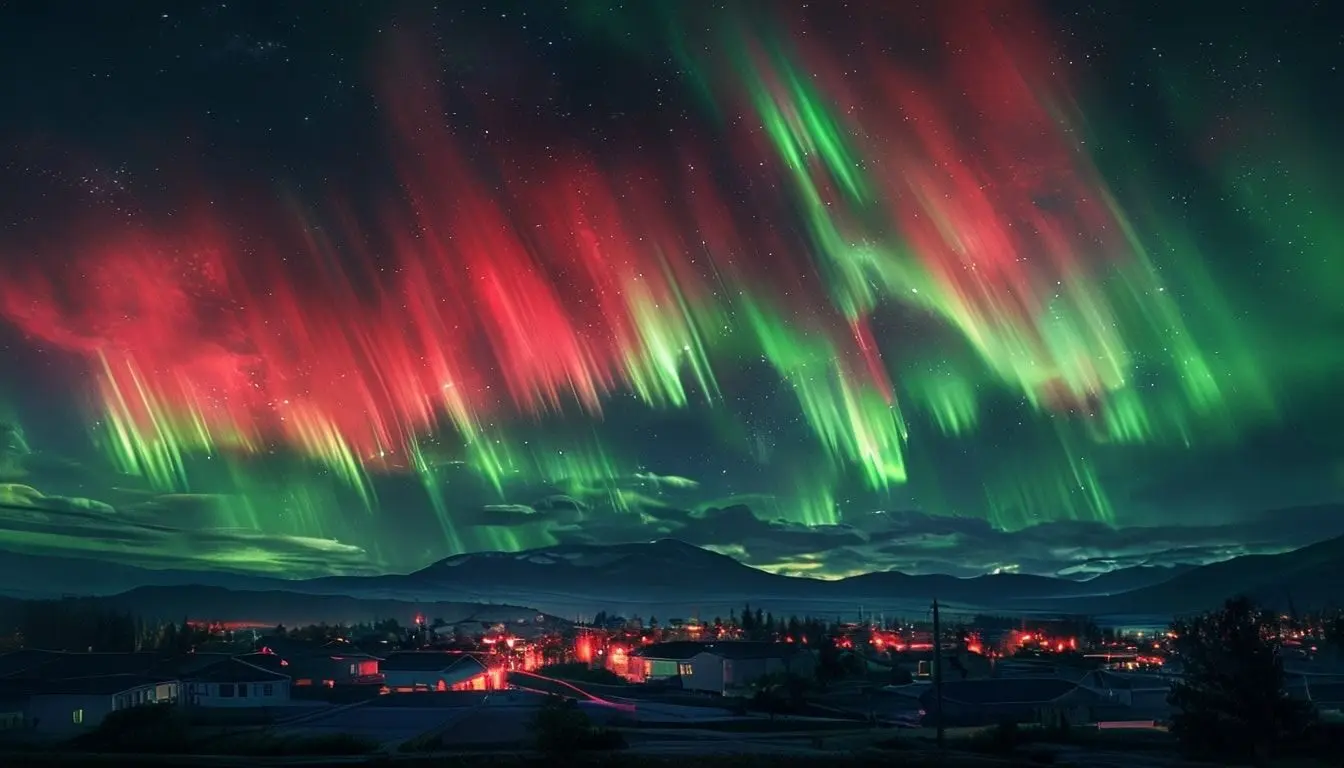
The night sky over the mid-latitudes usually offers nothing more than the reliable twinkle of stars and the occasional passing satellite. But on the evening of January 19, 2026, the atmosphere quite literally ignited. A rare, high-velocity solar shockwave slammed into Earth’s magnetic shield, triggering a G4-class geomagnetic storm so potent it painted the heavens in hues of neon green and blood red as far south as Alabama, Arizona, and Southern California.
At NewsBurrow Network, we’ve been tracking this solar cycle’s erratic behavior, but even veteran astronomers were stunned by the sheer speed of this event. Triggered by a massive X1.9 solar flare just a day prior, the Coronal Mass Ejection (CME) traversed the 93-million-mile void at a staggering 1,900 km/s—nearly 4.2 million miles per hour. This wasn’t just a space weather event; it was a cosmic sprint that broke records held since the early 2000s, proving that our Sun still has plenty of surprises up its sleeve as we navigate the waning phase of Solar Cycle 25.
The 25-Hour Sprint: Anatomy of a Cosmic Collision
Typically, a CME takes three to four days to reach our planet. The January 19 event, however, arrived in a mere 25 hours. This “fast-arrival” phenomenon occurs when a solar eruption is so energetic that it clears its own path through the solar wind, effectively slipstreaming toward Earth. The NewsBurrow Press Team monitored the shock arrival at approximately 19:30 UTC, a moment that sent space weather magnetometers into a frenzy. The sheer density of the plasma—peaking at 28 protons per cubic centimeter—transformed our planet’s magnetosphere into a ringing bell of kinetic energy.
The intensity of this collision reached G4 (Severe) levels, the second-highest tier on the NOAA space weather scale. For context, while a G1 storm might flicker over the Canadian border, a G4 storm physically pushes the auroral oval toward the equator. This expansion meant that for a few glorious hours, the “Northern Lights” were no longer just for the North. People standing on porches in the American Midwest and the plains of Central Europe looked up to see a spectacle that usually requires a plane ticket to the Arctic Circle.
Storm Severity Comparison
| Storm Class | Frequency (Per Cycle) | Visibility Limit (Typical) | Tech Impact |
|---|---|---|---|
| G1 (Minor) | 1,700 events | Maine / Michigan | Minor grid fluctuations |
| G3 (Strong) | 200 events | Pennsylvania / Iowa | Satellite drag, GPS issues |
| G4 (Severe) | 100 events | Alabama / California | Widespread radio blackouts |
| G5 (Extreme) | 4 events | Florida / Texas | Potential grid collapse |
A Dark Canvas: Why the New Moon Was the Silent Hero
In the world of skywatching, timing is everything. Had this storm struck during a Full Moon, much of the delicate red oxygen glow would have been washed out by lunar glare. Instead, the universe aligned perfectly with a New Moon phase. This pitch-black backdrop acted as a high-contrast canvas, allowing the faintest ribbons of light to pop with a saturation rarely seen in urban environments. Even in light-polluted corridors like Aurora, Illinois, the glow was unmistakable to the naked eye.
The “shock factor” for many was the color. While green is the most common auroral hue (caused by oxygen at lower altitudes), this G4 storm pushed particles so deep into the atmosphere that they interacted with high-altitude nitrogen and oxygen, producing rare, towering pillars of crimson. These red auroras are often the only parts visible to those in southern latitudes, appearing like a distant forest fire or a sunset that simply refuses to fade. NewsBurrow.com readers reported these “blood skies” lasting for over two hours before the magnetic field orientation shifted.
Smartphone Sorcery: Capturing Magic Without a DSLR
Gone are the days when you needed five thousand dollars in glass to capture the Aurora. During this event, some of the most viral images came from standard smartphones. The trick, as our tech experts at NewsBurrow Network point out, lies in the “Night Mode” long-exposure algorithms. Because the aurora is moving light, your phone needs to gather photons for 3 to 10 seconds. However, holding a phone by hand for 10 seconds creates a blurry mess—stability is the non-negotiable requirement for success.
- Night Mode is King: Manually slide your exposure time to the “Max” setting (usually 10 or 30 seconds).
- Focus at Infinity: Don’t tap the sky to focus; instead, tap a distant light or use “Pro Mode” to set focus to the mountain icon (infinity).
- Avoid the Zoom: Digital zoom destroys resolution. Stay wide to capture the “curtain” effect of the lights.
- The Tripod Hack: If you don’t have a tripod, prop your phone against a car roof or a rock. Even the slightest tremor will ruin the sharpness of the stars.
The Professional’s Edge: DSLR Settings for 2026 Conditions
For those wielding mirrorless or DSLR cameras, the G4 storm provided a masterclass in high-speed photography. Because the solar wind was moving at 1,900 km/s, the aurora wasn’t just “glowing”—it was dancing. Long exposures of 30 seconds would have turned the sky into a soup of green light. To capture the “ribbons” or “piano keys,” photographers had to shorten their shutter speeds and trust their sensors to handle higher ISO levels.
Our photography desk recommends a “Fast and High” approach for active storms. By opening your aperture to its widest (f/2.8 or lower) and bumping the ISO to 1600 or 3200, you can drop your shutter speed to 2 or 5 seconds. This “freezes” the motion of the light, showing the intricate structure of the magnetic field lines as they interact with our atmosphere. It is the difference between a snapshot and a masterpiece.
The Invisible Danger: S4 Radiation and Global Technology
While we marveled at the beauty, the NewsBurrow Press Team also tracked the “dark side” of the storm. This event was classified as an S4 (Severe) Solar Radiation Storm—the most intense since the legendary “Halloween Storms” of 2003. These are not just light shows; they are bombardments of high-energy protons. For astronauts aboard the International Space Station, this meant retreating to the most shielded modules to avoid increased cancer risks and acute radiation exposure.
On Earth, the impact was felt in the aviation and satellite sectors. Airlines operating polar routes were forced to reroute to lower latitudes to protect crews and passengers from elevated radiation doses. Meanwhile, GNSS systems (GPS) reported “scintillation” errors, where the turbulent ionosphere caused signal delays. For a world increasingly dependent on precise timing—from high-frequency stock trading to autonomous tractors—the January 2026 storm was a sobering reminder that we live in the atmosphere of a volatile star.
The 2026 Outlook: Why the Show Isn’t Over
If you missed this display, do not despair. We are currently in a fascinating phase of Solar Cycle 25. While the official “Solar Maximum” was predicted for late 2025, the waning phase in 2026 is historically when some of the most massive, “complex” sunspots emerge. These “Great Spots” are prone to producing Earth-directed CMEs. The G4 storm of January 19 was likely just the opening act for a year that promises several more high-latitude breakouts.
Stay connected with NewsBurrow.com as we provide real-time alerts. The key to being a successful aurora chaser in 2026 is preparedness. Keep your “Go Bag” ready with warm layers, a portable power bank, and your tripod. Most importantly, keep an eye on the “Bz” orientation of the incoming solar wind—if it points south, the gates of the magnetosphere open, and the sky prepares to dance once more.
Did you catch the lights in an unexpected place? We want to see your photos and hear your story! Join the conversation in the comments below or tag us on social media using #NewsBurrowAurora.
While the naked eye can certainly appreciate the ethereal glow of a G4-class storm, capturing the true majesty of the Aurora Borealis requires more than just being in the right place at the right time. The rapid movement of these geomagnetic ribbons—often dancing at thousands of miles per hour—means that even the slightest hand-shake can turn a potential masterpiece into a blurred streak of light. For residents in the southern US and Central Europe, where the lights appear lower on the horizon, precision is the difference between a grainy memory and a crisp, professional-grade photograph.
To truly freeze these curtains of solar fire in high definition, stability is your most valuable asset. Experts at the NewsBurrow Network emphasize that whether you are using a high-end mirrorless camera or the latest smartphone, a rock-solid foundation is essential to handle the long exposure times required for low-light celestial events. Investing in the right gear not only simplifies the process but ensures that you are ready for the next solar eruption the moment the alerts hit your phone.
Are you ready to transform your night sky observations into stunning visual art before the next wave of solar activity arrives? Below, we have curated a selection of professional-grade tools that are currently favored by our on-the-ground reporting teams for their reliability in extreme conditions. We invite you to share your best shots in the comments below and subscribe to the NewsBurrow newsletter to receive real-time space weather warnings and exclusive photography guides directly in your inbox.


GIPHY App Key not set. Please check settings