

 Chief Editor
Table of Contents
Denver Apartment Fire 2026
Denver Apartment Fire: Largest Blaze in 30 Years Gutted Harker Heights Complex—Arson Suspect Arrested
Denver apartment fire 2026 investigations have taken a dramatic turn as officials link the catastrophic five-alarm blaze to a deliberate act of arson that gutted a multi-million dollar development.
By Aiden Hughes | NewsBurrow Press Team
The Night Denver Stood Still: A 30-Year Record Shattered in Flames
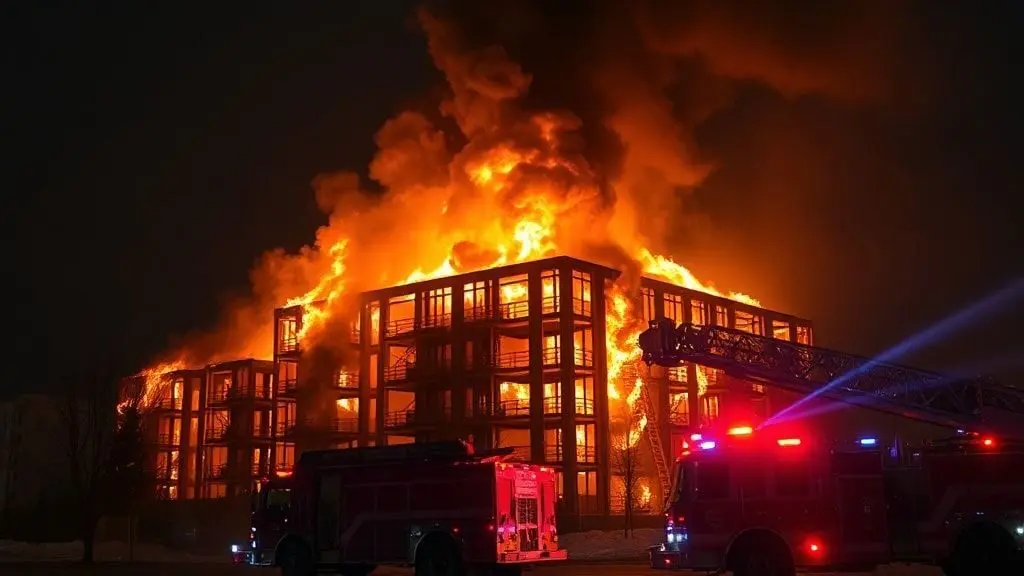
On the biting cold evening of January 2, 2026, the skyline of Southeast Denver was abruptly transformed into a hellish orange landscape. At approximately 6:42 p.m., the first 911 calls flooded the Denver 911 Communications Center, reporting a massive blaze at the Harker Heights apartment complex. What began as a dumpster fire on the west side of the construction site at Leetsdale Drive and South Forest Street quickly mutated, fueled by high winter winds and the exposed wood-frame skeleton of the developing 283-unit structure. Within minutes, the situation escalated from a routine response to a historic catastrophe.
The NewsBurrow Press Team has learned that the fire was so intense it effectively skipped the usual alarm progression, skyrocketing to a five-alarm status—nearly a six-alarm—faster than any incident in recent memory. For the residents of the neighboring Glendale area, the spectacle was as terrifying as it was awe-inspiring. Embers the size of dinner plates were reportedly carried by the wind for over a quarter-mile, raining ash onto suburban roofs and sparking fears of a city-wide conflagration. It was a night where the routine of the city ground to a halt, replaced by the roar of a firestorm that would soon be etched into the record books.
The magnitude of the event was reflected in the sheer scale of the ruins. The Harker Heights complex, which occupied an area roughly the size of four football fields, was reduced to a skeletal remains of charcoal and twisted metal within hours. As the sun rose the following morning, the smoke plumes were visible from miles away, a grim reminder that Denver had just experienced its largest structural fire since the infamous University Hills Mall blaze of 1984. The city didn’t just watch a building burn; it witnessed the destruction of a massive piece of its future residential infrastructure.
| Key Incident Metric | Reported Figure |
|---|---|
| Alarm Level | 5-Alarm (Near 6-Alarm) |
| Firefighter Count | 156 Personnel |
| Water Used | 18 Million Gallons |
| Total Units Destroyed | 283 Apartments |
| Historical Precedent | Largest since 1984 |
A War of Attrition: 156 Heroes and 18 Million Gallons of Water
Fighting a blaze of this magnitude required more than just courage; it required an industrial-scale logistical operation. As the fire took hold of the upper stories, Denver Fire Department officials realized the building’s instability made interior firefighting a suicide mission. Truck 19 was the first to arrive, and their immediate assessment led to a “defensive mode” strategy. This meant crews stayed outside the collapse zone, surrounding the inferno with massive master streams and aerial ladders to douse the flames from above. The sound of the fire was described by witnesses as a continuous low-frequency growl, punctuated by the structural snaps of timber and the hiss of evaporating water.
The sheer volume of water required to tame the Harker Heights fire was staggering. By the time the final hotspots were doused on Monday, the NewsBurrow Network confirmed that approximately 18 million gallons of water had been utilized. This massive draw on the city’s water system was equivalent to filling nearly 30 Olympic-sized swimming pools. Firefighters from Aurora and South Metro Fire Rescue were called in for mutual aid, not just to fight the main body of fire, but to conduct “ember watch” as the wind threatened to ignite the entire neighborhood.
Below is a visual representation of the fire’s growth over the first six hours of the incident:
Fire Intensity (Scale 1-10)
^
10 |             .----.
8 |          .---'    '---.
6 |       .--'             '--.
4 |    .--'
2 | .--'
0 +---------------------------->
6PM   7PM   8PM   9PM  10PM  11PM
(Time of Night)
Despite the apocalyptic conditions, the discipline of the responders resulted in a miracle: only one minor injury was reported. A single firefighter was hospitalized for a shoulder injury sustained during the chaotic early deployment but was released the next morning. No civilians or construction workers were caught in the flames, a testament to the rapid evacuation orders issued by the NewsBurrow Press Team’s contacts in the Denver Police Department. However, the victory was bittersweet, as the fire’s containment required a level of saturation that left the site a soggy, unstable tomb of ash.
The Veteran’s Perspective: Division Chief Robert Murphy’s Toughest Call
In the world of firefighting, thirty years is a lifetime. For Division Chief of Operations Robert Murphy, those three decades had seen it all—until the night of January 2. Standing amidst the smoke at a Saturday morning news conference, Murphy was visibly struck by the scale of the destruction. He noted that in his entire 30-year career with the Denver Fire Department, he had never seen a fire of this magnitude. It wasn’t just the size; it was the ferocity. “It’s major,” Murphy told reporters. “I can’t tell you the last time in Denver we had a fire this big.”
Chief Murphy explained to NewsBurrow.com that the stage of construction was the building’s greatest enemy. Because the Harker Heights complex was in its “mid-stage,” it lacked the critical fire protection systems that save lives and property. There were no working sprinklers, no fire-rated drywall to slow the spread, and no firebreaks. The building was essentially a massive stack of seasoned lumber, wrapped in plastic weather-proofing that acted as an accelerant. It was, as Murphy put it, a fire that was able to “run cleanly” through the structure before the department could even establish a perimeter.
The Chief’s leadership during the crisis was pivotal. By making the call to remain in defensive mode, he ensured that no firefighters were inside when the upper floors inevitably pancaked. His decision-making reflected a career built on understanding the limits of structural integrity. While the building was a total loss, Murphy’s focus remained on the fact that his people were going home. His perspective provided a sobering reality check to the city: as much as we build upward with wood-frame designs, they remain incredibly vulnerable until the very last nail is driven and the last sprinkler head is activated.
The Arson Investigation: From Gasoline to Facial Recognition
While the smoke was still rising, a shadow team of investigators from the Denver Fire Department and the U.S. Bureau of Alcohol, Tobacco, Firearms and Explosives (ATF) was already working the periphery. This wasn’t just a tragic accident; it was a crime scene. Using advanced facial recognition technology and a trail of digital breadcrumbs, investigators pieced together a chilling timeline. The breakthrough came from surveillance footage at a nearby gas station, where a man was seen filling a container with gasoline just an hour before the first 911 call.
The suspect, later identified as 38-year-old Tony Becerra, unwittingly led investigators through the city’s transit system. Cameras captured him boarding a bus on Colfax, transferring at Colorado Boulevard, and finally walking toward the Harker Heights site. Most damning was the footage from the “Taste of India” restaurant. Becerra allegedly entered the establishment shortly after the fire began, went into the restroom to change his shirt, and then smiled directly into a security camera. That smile would be his undoing, as NewsBurrow.com confirmed that investigators used that very image to run a facial recognition match against CBI records.
The investigation revealed a clinical level of preparation followed by an eerie calmness. Becerra reportedly called 911 himself to report the fire, but he allegedly gave a false description, identifying himself as a homeless person who saw someone else start the blaze. This “hiding in plain sight” tactic failed under the scrutiny of the ATF’s National Response Team. By January 13, the manhunt ended at Becerra’s home in Aurora, where he was taken into custody without incident, facing multiple counts of first-degree arson.
Profile of the Suspect: The Man Known as ‘Psycho’
Who is Tony Becerra? As the NewsBurrow Press Team dug into the suspect’s background, a troubling portrait emerged of a man known by the street names “Skitzo” and “Psycho.” Becerra’s criminal history in Colorado is extensive, dating back to 2003. His rap sheet includes at least 10 major arrests for violent crimes, including assault, domestic violence, and felony assault causing serious bodily injury. In 2011, he was sentenced to four years in the Department of Corrections. Yet, despite a history of violence and instability, he was back on the streets of the Denver metro area.
The “shock factor” for the public lies in the reports from Becerra’s own family. In a 2020 police report, his sister told Aurora officers that Tony “sees and hears things” and suffers from a severe mental condition. She warned then that her brother would not stop his erratic behavior “until police kill him.” Just a year before the Harker Heights fire, Becerra was hospitalized for what first responders called “psych issues” after a shoplifting incident. This raises a haunting question for the Denver community: how did a man with a documented history of mental instability and the nickname “Psycho” slip through the cracks of the system to allegedly commit the city’s largest act of arson in decades?
Further analysis by NewsBurrow Network suggests that Becerra’s nomadic lifestyle contributed to the difficulty in tracking him earlier. While he had an address in Aurora, he was often characterized by police as “transient” or homeless. The intersection of mental health crises and criminal history is at the heart of this case. As he sits in the Denver jail without bond, the city is left to grapple with the reality that one of its most ambitious housing projects may have been destroyed by a man whose cries for help—or warnings of violence—had been documented for years.
Harker Heights: A $23 Million Dream Reduced to Ash
The loss of the Harker Heights complex is not just a statistical anomaly; it is an economic gut-punch to Denver’s housing market. The project, developed with the architectural expertise of RiNo-based firm KEPHART, was set to open its doors in May 2026. It promised 283 modern apartment units in a city desperate for inventory. With amenities ranging from a yoga studio and fitness center to co-working spaces and a rooftop pool, it was designed to be a crown jewel of the Leetsdale corridor. Now, all that remains is a $23 million insurance claim and a massive cleanup bill.
The ripple effect on the local economy is profound. Beyond the loss of housing, the construction delay impacts hundreds of contractors and workers who were counting on the final phase of the project for their livelihoods. NewsBurrow.com spoke with local real estate analysts who suggest that a loss of this scale can actually drive up neighboring rents in the short term, as the 283 units that were supposed to ease demand are now non-existent. The “Harker Heights Gap” will be felt in the Leetsdale market for years to come as the developer decides whether to rebuild from the foundation up.
- Lost Housing: 283 units removed from the 2026 market.
- Infrastructure Loss: Complete destruction of plumbing, electrical, and HVAC systems already installed.
- Amenity Loss: High-end fitness, yoga, and co-working spaces intended for community growth.
- Demolition Costs: Millions required just to clear the unstable charcoal skeleton.
The Firestorm Recipe: Why Wood Frames Burn Faster
To understand why the Harker Heights fire was so unstoppable, one must look at the science of modern construction. The complex utilized a “stick-frame” or wood-frame design, which is the industry standard for multi-family residential buildings due to its cost-effectiveness. However, during the construction phase, these buildings are essentially giant piles of kiln-dried kindling. Without the protection of fire-rated gypsum board (drywall) or a pressurized sprinkler system, a small flame can become a five-alarm inferno in under ten minutes.
An additional factor in the rapid spread was the plastic weather-wrapping used to protect the wood from Denver’s winter elements. This plastic acts like a candle wick, allowing fire to run vertically and horizontally across the exterior of the building with terrifying speed. When combined with the high winds of January 2, the building became a literal furnace. The NewsBurrow Press Team observed that the lack of “firebreaks”—the vertical walls designed to stop fire from moving between sections—was inevitable at this stage of construction, leaving the building defenseless.
This incident has sparked a renewed debate among urban planners and fire safety experts. Is it time for Denver to mandate more stringent fire watches or temporary sprinkler systems for large-scale wood-frame projects? While wood is a sustainable and affordable material, the Harker Heights disaster proves that the “vulnerability window” during construction is a significant public safety risk that requires more than just a single security guard to monitor.
Glendale’s Dark Weekend: Collateral Damage and Power Outages
The residents of Glendale and Southeast Denver didn’t just watch the fire; they felt it. The heat radiating from the Harker Heights complex was so intense that Denver Police were forced to issue mandatory evacuation orders for 10 to 15 homes on the adjacent hill. Families were plucked from their Friday night routines as officers hammered on doors, warning of the risk that the radiating heat could spontaneously ignite their own properties. It was a race against the elements as the retaining wall along the hill became the final line of defense for a dozens of residential homes.
Perhaps the most widespread impact was the “Glendale Blackout.” The fire damaged critical high-voltage lines, plunging thousands into darkness during one of the coldest months of the year. Xcel Energy worked alongside the NewsBurrow Press Team’s emergency contacts to restore power, but for many, the outages lasted into the weekend. The Glendale Event Center was transformed into a temporary overnight shelter, providing warmth and food for those displaced by the evacuations or the loss of heat in their own apartments.
The road closures on Leetsdale Drive between South Forest and South Holly Streets created a traffic nightmare that lasted for days. As one of the city’s primary east-west arteries, the closure forced thousands of commuters onto side streets, clogging the residential heart of Glendale. The smoke intrusion was so severe that the nearby Jewish Community Center had to close its facilities for deep cleaning. This was not just a fire at a construction site; it was a localized disaster that strained every facet of Glendale’s municipal infrastructure.
Secondary Ignitions and the Sherwin-Williams Close Call
In the chaos of the main blaze, a second disaster was narrowly averted. As the fire jumped across the site, it ignited a secondary fire at the adjacent Sherwin-Williams paint store. This was the nightmare scenario for Chief Murphy: a chemical-fueled inferno added to an already unmanageable wood-frame fire. Paint, thinners, and industrial solvents are highly flammable and produce toxic fumes that could have forced a much larger evacuation of the Glendale area.
Firefighters, showing incredible situational awareness, diverted a portion of their master streams to protect the Sherwin-Williams building. They fought a “fire within a fire,” successfully extinguishing the secondary ignition before it could reach the store’s primary chemical storage. The NewsBurrow Network highlights this as a pivotal moment in the night. Had the paint store fully ignited, the smoke would have transitioned from “nuisance ash” to “toxic plume,” potentially changing the entire health profile of the incident for the surrounding community.
This secondary threat underscores the danger of high-density construction in urban corridors. When massive projects like Harker Heights go up in flames, every neighboring business becomes a potential casualty. The Sherwin-Williams incident will likely lead to calls for greater “buffer zones” or enhanced fire suppression requirements for businesses located adjacent to major construction sites. For now, the owners of the paint store are counting their lucky stars and praising the quick thinking of the crews on the ground.
The Road to Demolition: A Legal and Physical Cleanup
As of late January, the skeletal remains of Harker Heights are being assessed for demolition. The building is a “total loss” in every sense of the word. Chief Murphy noted that even the portions of the foundation that didn’t burn may be compromised by the extreme heat and the 18 million gallons of water that saturated the soil. The cleanup is expected to take months, requiring heavy machinery and specialized crews to navigate the unstable, charred remains of the 283-unit dream.
On the legal front, the wheels of justice are turning rapidly. The Denver District Attorney’s office is currently conferring with the United States Attorney regarding a “federal adoption” of the charges. Because the ATF was so heavily involved and the scale of the arson is so historic, Tony Becerra could face federal arson charges, which carry significantly heavier sentencing guidelines. Becerra remains in the Denver jail without bond, while his legal team explores the potential for a mental health defense based on his documented history of psychological issues.
The public conversation has already shifted to accountability. How was Becerra able to access the site so easily? While a security guard was on-site, they were reportedly on the other side of the massive complex when the fire was set. This incident is forcing a hard look at the “Good Neighbor Agreements” and security protocols that developers use. For the residents of Leetsdale Drive, the physical ruins of the fire will eventually be cleared, but the legal and emotional fallout of this arson will linger for years.
Rising from the Ashes: A Call for Urban Vigilance
The Harker Heights fire is a wake-up call for the city of Denver. It highlights the delicate balance between the need for rapid housing development and the imperative of public safety. While we cannot stop building the homes that our growing population needs, we must become more vigilant in protecting these sites during their most vulnerable stages. This is not just a problem for developers; it is a community-wide issue that involves mental health support, criminal justice reform, and construction safety innovation.
NewsBurrow Network encourages you to join this conversation. Was this a failure of the mental health system, or a lapse in construction site security? Should Denver reconsider the prevalence of wood-frame “stick” buildings in high-density corridors? The ashes of January 2 have much to teach us if we are willing to listen. As the city clears the rubble and prepares for the next chapter, one thing is certain: Denver will never look at its construction sites—or its fire safety protocols—the same way again.
What are your thoughts on the safety of massive wood-frame developments in our neighborhoods? Share your opinions in the comments below or join the discussion on social media with #DenverFire2026.
The devastating scale of the Harker Heights inferno serves as a grim reminder that a five-alarm blaze can transform a modern residence into a skeletal ruin in mere hours. For apartment dwellers and homeowners alike, the speed of this fire highlights a critical window of vulnerability that exists between the first spark and the arrival of emergency crews. While the Denver Fire Department’s defensive tactics prevented loss of life on the front lines, the event has sparked an urgent conversation among urban residents about personal preparedness and the tools necessary to navigate a high-density emergency.
Safety experts at the NewsBurrow Network emphasize that while structural fire suppression is the responsibility of developers and the city, immediate evacuation capability rests in your hands. In multi-story buildings, traditional exit routes can become impassable due to smoke or structural instability, making secondary escape options a vital component of any household safety plan. Taking proactive steps today can mean the difference between being trapped by a fast-moving fire and reaching safety with your family.
We want to hear from you—has this record-breaking fire changed how you view your own home’s safety features? Share your thoughts in the comments below and subscribe to the NewsBurrow newsletter for the latest regional safety updates and investigative reporting delivered straight to your inbox. To help you fortify your own emergency readiness, we have curated a selection of essential gear designed to provide reliable escape routes when every second counts.
Shop Products On Amazon
Shop Products on Ebay
Trending Similar Stories in the News
Trending Videos of Denver Apartment Fire 2026


GIPHY App Key not set. Please check settings