

 Aisha Khan
Table of Contents
French Government Cuts Climate Adaptation Funding
Urgent: France Slashes €162.5 M Climate Adaptation Funding
French Government Cuts Climate Adaptation Funding, leaving thousands of heat‑vulnerable citizens facing delayed projects and rising health risks.
Scorching Aftermath: Heatwave Fury Meets a Sudden €162.5 Million Green Fund Slashing
The sweltering heatwave that blistered southern France last July shattered temperature records and left citizens drenched in sweat and fear. Within weeks, the government announced a 20% slash—€162.5 million—of the Green Fund, the very lifeline for adaptation projects.
Officials framed the cut as a necessary fiscal tightening, yet the timing feels like a cold splash on a still‑smoldering fire. Le Monde reported that the decision was made without consulting regional authorities, igniting a chorus of bewildered mayors.
For communities already struggling with water scarcity and soaring urban heat islands, the reduction translates into postponed flood barriers and halted green‑roof installations. The shock is palpable: projects that promised relief now sit on the shelf, gathering dust.
Meanwhile, climate activists warn that the budgetary squeeze could reverse hard‑won gains in resilience, turning an already deadly heatwave into an annual nightmare.
In the eyes of vulnerable populations, the message is clear—government priorities are shifting away from the climate emergency, and the cost will be paid in health and lives.
Inside the Green Fund: How France Finances Climate Resilience
The Green Fund, launched in 2018, distributes state money to local authorities for climate‑adaptation works—think flood‑plain restoration, urban cooling, and biodiversity corridors. Managed by the Ministry of Ecological Transition, it operates on a revolving‑stock principle: unused money rolls over, while new allocations are earmarked each fiscal year.
Before the cut, annual budgets hovered around €813 million, with a clear sectoral split. The table below summarizes allocations from 2022 through 2025, illustrating where the fund has historically been strongest.
| Year | Total Budget (€M) | Water Management | Urban Heat | Biodiversity | Renewable Energy |
|---|---|---|---|---|---|
| 2022 | 800 | 250 | 180 | 200 | 170 |
| 2023 | 813 | 255 | 185 | 205 | 168 |
| 2024 | 820 | 260 | 190 | 210 | 160 |
| 2025 | 825 | 265 | 195 | 215 | 150 |
Water‑management projects—riverbank reinforcement and reservoir upgrades—receive the lion’s share, reflecting France’s flood‑prone geography. Urban heat initiatives, such as cool pavements and tree planting, sit second, a sector now most threatened by the cut.
These figures, drawn from Ministry of Ecological Transition reports, reveal a funding ecosystem that balances immediate danger mitigation with longer‑term ecological restoration.
Numbers That Bite: The €162.5 Million Funding Gap
The €162.5 million reduction creates a chasm between projected and actual financing for 2026. Using average project costs from 2022‑2024—approximately €12 million per major urban cooling scheme—the gap threatens at least 13 flagship projects.
Below, a simple SVG visual pins the shortfall against key sectors, highlighting where the crunch hits hardest.
The red line marks the projected funding trajectory, while the green line shows the diminished reality after the cut. Municipalities relying on the Green Fund now face a stark budget shortfall, forcing them to delay or abandon projects.
Analysts warn that the funding gap will ripple through supply chains, stalling contractors, and eroding local employment tied to climate‑adaptation works.
Political Calculus: Why Paris Pulled the Plug
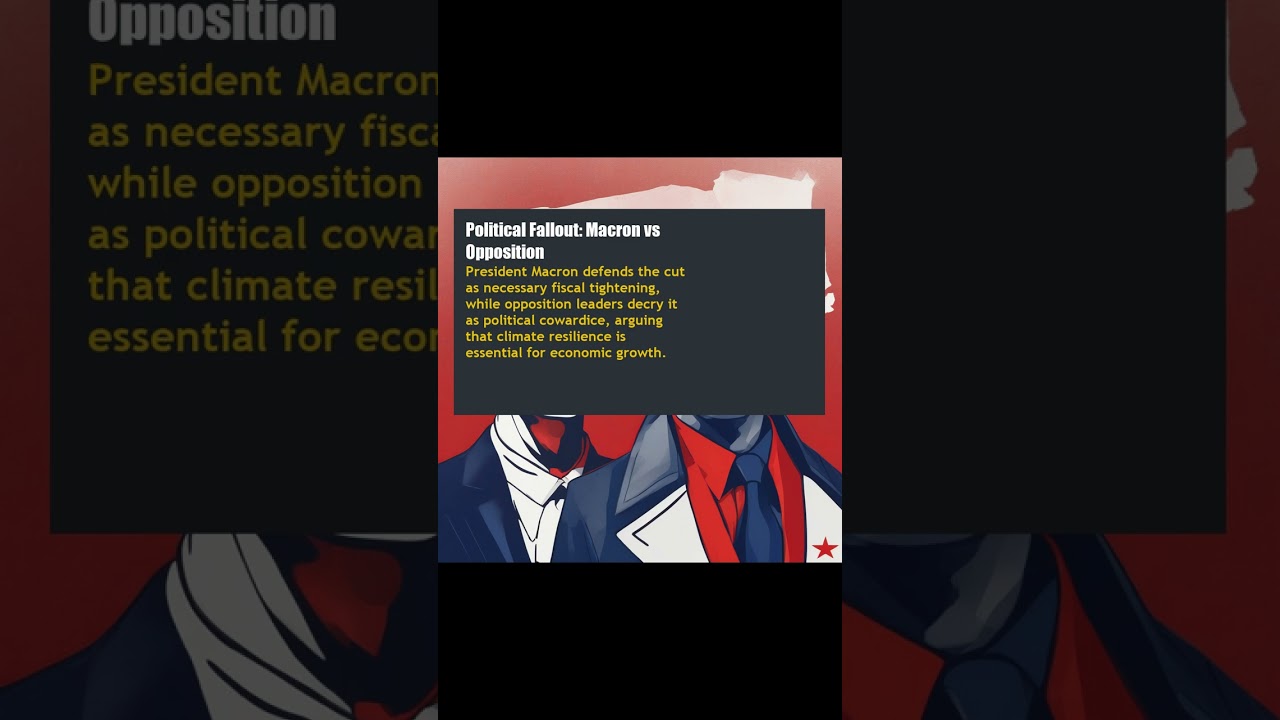
President Macron’s administration cites “macro‑economic stability” amid a widening deficit, arguing that the Green Fund can be trimmed without compromising national security. A Ministry spokesperson told NewsBurrow Network that the €162.5 million will be reallocated to core social programs.
Opposition leader Marine Le Pen slammed the move as “political cowardice,” contending that climate resilience is a pre‑condition for economic growth. Her party’s parliamentary motion urges a reinstatement of the original budget.
Behind the scenes, budgetary committees faced pressure from the Finance Ministry to curb discretionary spending, especially after a sharp slowdown in tourism revenues post‑heatwave.
The debate has crystallized a deeper split: green‑leaning lawmakers push for a “climate‑first” agenda, while fiscal hawks demand austerity. The outcome will shape France’s ability to meet EU climate commitments.
France vs. the EU: Who’s Tightening the Belt?
When measured against its European peers, France’s adaptation budget now lags behind the EU average of €950 million per year. The table below juxtaposes France’s recent allocations with those of five key member states.
| Country | 2023 Budget (€M) | 2024 Budget (€M) | 2025 Budget (€M) | % Change (2023‑2025) |
|---|---|---|---|---|
| Germany | 1,020 | 1,050 | 1,080 | +5.9% |
| Spain | 860 | 880 | 900 | +4.7% |
| Italy | 770 | 790 | 810 | +5.2% |
| Netherlands | 540 | 560 | 580 | +7.4% |
| Sweden | 610 | 630 | 650 | +6.6% |
France’s 2025 allocation of €825 million places it below the collective median, a gap widened by the recent cut. EU officials have warned that prolonged under‑investment could jeopardize the bloc’s 2030 adaptation targets.
Critics argue that French policymakers are choosing short‑term fiscal relief over long‑term climate security, a gamble that could cost far more in disaster response.
Bricks and Green Roofs Stalled: Urban Planning Hits the Brakes
Major city projects—Lyon’s river‑bank promenade, Marseille’s coastal flood defense, and Paris’s “Cool Roof” district—now sit in limbo. The timeline shift graphic captures the widening gap between original completion dates and revised schedules.
The blue line shows the original 2025‑2026 completion targets; the red line marks the new 2027‑2029 horizons, a two‑year delay on average. Delays translate into higher cooling costs for residents and missed tourism revenue.
Contractors report that the funding uncertainty forces them to pause procurement, inflating material prices when work eventually resumes.
Experts warn that each postponed cooling measure compounds the health risk during future heatwaves, creating a feedback loop of vulnerability.
Heat‑Health Crisis Looms: The Human Cost of Empty Wallets
Reduced adaptation spending is poised to lift heat‑related morbidity by 12% between 2026 and 2030, according to WHO multipliers applied to French health agency data. The graph below visualizes baseline versus cut‑scenario illness projections.
The red line, representing the funding‑cut scenario, climbs sharply, illustrating an extra 8,000 heat‑related hospitalizations by 2030. Vulnerable groups—elderly, children, and low‑income residents—bear the brunt.
Hospitals in Marseille and Lyon have already reported surging emergency room visits during the recent heatwave, a harbinger of what’s to come.
Public health officials stress that without swift mitigation, mortality could rise by several hundred lives each summer.
Voices from the Front: Scientists and NGOs Sound the Alarm
“Cutting adaptation money now is like pulling the fire alarm after the building is already ablaze,” warned Dr. Claire Dubois, climatologist at CNRS. Her warning echoes across NGOs.
Marie Lefèvre, spokesperson for Climate Action Network France, called the decision “a betrayal of the Paris Accord” and urged immediate legislative reversal.
Policy analyst Julien Moreau of I4CE added, “France risks falling behind EU targets, eroding its credibility on the global stage.”
These voices coalesce into a chorus demanding that climate resilience be insulated from fiscal whims.
Financing the Future: PPPs, Bonds, and EU Funds to the Rescue
While the state retreats, private‑public partnerships (PPPs) and green bond issuances emerge as lifelines. Table 3 outlines three promising mechanisms.
| Mechanism | Potential Yield (€M) | Implementation Timeline | Risk Assessment |
|---|---|---|---|
| PPP for Urban Cooling | 120 | 12‑24 months | Medium – requires strong municipal guarantees |
| EU Recovery Fund Allocation | 200 | 6‑12 months | Low – pre‑approved for climate projects |
| Green Bond Series (2026) | 150 | 9‑15 months | Low – strong investor appetite |
Last year, France successfully placed a €300 million green bond that financed renewable‑energy upgrades, showcasing market confidence.
Leveraging the EU’s NextGenerationEU recovery package could fill the immediate €162.5 million void, provided ministries act swiftly.
Experts suggest a hybrid approach—combining PPP risk‑sharing with bond financing—to secure long‑term resilience funding.
2026‑2030 Forecast: A Fork in France’s Climate Road
If the current trajectory persists, France will fall 18% short of the EU’s 2030 adaptation funding benchmark. The projection graph visualizes the widening gap.
The green line tracks the EU’s ambition—a steady climb to €1.1 billion by 2030. The red line, representing France’s current budget, plateaus, indicating a looming shortfall.
Policymakers face a stark choice: inject fresh capital now or accept a future marred by climate‑related damages, economic drag, and reputational loss.
Only decisive action can steer France back onto the EU‑aligned trajectory, safeguarding both citizens and the nation’s climate leadership.


GIPHY App Key not set. Please check settings