

 Amara Okoye
Table of Contents
2026 wellness dashboard
Top 2026 Wellness Dashboard: Predictive Health Insights Explained
2026 wellness dashboard delivers real‑time predictive health insights that transform everyday self‑care.
The Unified Wellness Dashboard: How One Platform Is Changing Health in 2026
Fragmented health apps once littered smartphones like broken puzzle pieces, each offering a lonely glimpse into sleep, steps, or calories. This year, a single pane of glass pulls them together, delivering a 360‑degree portrait of the self. Users now stare at a dashboard that feels less like a spreadsheet and more like a personal health cockpit.
Behind the sleek UI, billions of data points flow from wearables, smart scales, and even kitchen appliances. The platform reconciles conflicting metrics, smoothing out gaps that once forced manual entry. A surge of venture funding in Q1 2026 turned these prototypes into consumer‑grade products overnight.
Experts at the Global Wellness Summit warned that without cohesion, data becomes noise; the unified dashboard silences that static. Early adopters report a 32 % reduction in missed medication alerts, a figure that baffled clinicians accustomed to fragmented reminders. The shift is less about convenience and more about survivability.
As of May 10 2026, the rollout has hit over 15 million active users worldwide, a milestone cited by MSN’s health desk. Each new subscriber adds another layer of collective intelligence, sharpening the AI‘s ability to spot subtle health trends. The stakes have never been higher, and the dashboards are finally ready to meet them.
How AI Turns Data Into Predictive Health Insights
AI no longer watches; it predicts, intervenes, and even learns from its own suggestions. Gradient Boosting models sift through weeks of sleep logs, spotting patterns that herald insomnia before the third yawn.
LSTM networks breathe life into activity streams, forecasting injury risk with a precision that rivals seasoned physiotherapists. Meanwhile, Transformer architectures map nutrition‑mood correlations, delivering personalized meal plans that adapt in real time.
Table 1 below compares the three leading AI engines powering today’s dashboards, pulling performance stats from Vi Labs’ 2026 benchmark report.
| Model | Primary Use | Accuracy (%) |
|---|---|---|
| Gradient Boosting | Sleep‑quality forecast | 92.3 |
| LSTM | Activity‑injury risk | 89.7 |
| Transformer | Nutrition‑mood mapping | 90.5 |
Since 2023, predictive accuracy for sleep‑quality has jumped from 78 % to over 92 %, a climb visualized in Graph 1.
These gains translate into concrete outcomes: fewer nights of restless sleep, sharper mornings, and a tangible sense that the system sees you before you notice the strain.
Key Wearable Devices Feeding the Dashboard
The engine’s power hinges on the fidelity of its inputs, and 2026’s wearables are the finest fuels on the market. Huawei’s Watch Fit 5 measures skin temperature, oxygen saturation, and even stress hormones via an optical sensor.
Oura’s Ring 4 packs a tiny accelerometer, a multi‑spectral light sensor for heart‑rate variability, and a battery that lasts a full week without compromise. Fitbit Air, the newest earbuds, capture real‑time respiration and ambient noise, feeding a richer picture of sleep environments.
Table 2 details the sensor suites, battery life, and AI integration tiers that set these devices apart.
| Wearable | Sensors | Battery Life | AI Integration Level |
|---|---|---|---|
| Huawei Watch Fit 5 | Temp, SpO₂, Stress‑HRV | 10 days | High (on‑device inference) |
| Oura Ring 4 | Accelerometer, Light, HRV | 7 days | Medium (cloud‑based AI) |
| Fitbit Air | Respiration, Noise, Motion | 5 days | High (edge AI) |
When these gadgets sync, the dashboard transforms raw streams into a cohesive health narrative, as seamless as turning a page.
From Tracking to Predicting: Real‑World User Benefits
Predictive dashboards are not just tech demos; they are life changers. Emma Liu, a 34‑year‑old marketing exec, saw her chronic insomnia dip from a 7.8 to a 3.2 fatigue score after the system nudged her toward a personalized wind‑down routine.
John Patel, managing type‑2 diabetes, received an early‑warning alert when his glucose‑trend model flagged a 12‑hour risk of hypoglycemia, letting him adjust insulin before a crisis. In the elite sports arena, pro cyclist Maya Rodríguez trimmed her recovery time by 15 % thanks to AI‑driven training load forecasts.
Graph 2 visualizes the average fatigue‑score drop across a 3‑month pilot of 5,000 users.
The data underscores a clear pattern: predictive insights cut fatigue, avert emergencies, and boost performance. Critics who dismissed dashboards as gimmicks are now scrambling for a seat at the table.
Privacy, Security, and Ethical AI in Wellness Dashboards
With great data comes great responsibility, and 2026’s regulatory landscape reflects that tension. GDPR’s “right to explanation” now mandates that dashboards surface the reasoning behind every health alert.
HIPAA extensions specifically address AI‑generated recommendations, requiring audit trails for each model update. Meanwhile, the WHO’s AI‑for‑Mental‑Health guidelines push vendors to publish bias‑mitigation scores.
Table 3 compares the top three dashboard platforms on compliance and explainability.
| Platform | GDPR | HIPAA | Explainability Score |
|---|---|---|---|
| WellSync | Full | Full | 9.2/10 |
| HealthSphere | Partial | Full | 8.1/10 |
| VitalPulse | Full | Partial | 7.5/10 |
These safeguards not only protect users but also build trust, a currency as valuable as any biometric metric.
Quantifying the Market Impact: 2026 Growth Numbers
The market has exploded into a multi‑billion‑dollar arena, outpacing many legacy health‑tech segments. Fortune Business Insights reports a $7.4 B global valuation in 2026, up 27 % year‑over‑year.
Grand View Research projects the sector to breach $12 B by 2028, driven by corporate wellness programs and insurer incentives.
Table 4 breaks down annual market size and growth.
| Year | Global Market Size (B$) | YoY Growth (%) |
|---|---|---|
| 2023 | 4.3 | — |
| 2024 | 5.1 | 18.6 |
| 2025 | 6.2 | 21.6 |
| 2026 | 7.4 | 27.0 |
Graph 3 illustrates regional adoption rates, with North America leading at 42 %, followed by Europe at 33 % and APAC catching up fast.
Investors are now treating AI‑enabled wellness platforms as “must‑have” assets, a sentiment reflected in the surge of strategic acquisitions this year.
Integrating Nutrition & Mental‑Health Data: The Next Frontier
Dashboards are extending beyond steps and sleep, weaving in meal‑logging APIs that decode macro balances down to the micronutrient level. Simultaneously, wearable‑grade EEG headbands capture emotional states, allowing the AI to recommend calming playlists or mindfulness drills.
The Global Wellness Summit 2026 highlighted pilot programs where diet‑AI paired with mood‑tracking to cut stress‑related binge eating by 23 %. The convergence promises a truly holistic picture of health, one that finally respects the mind‑body connection.
Future Outlook: What 2027 and Beyond Hold for Predictive Wellness
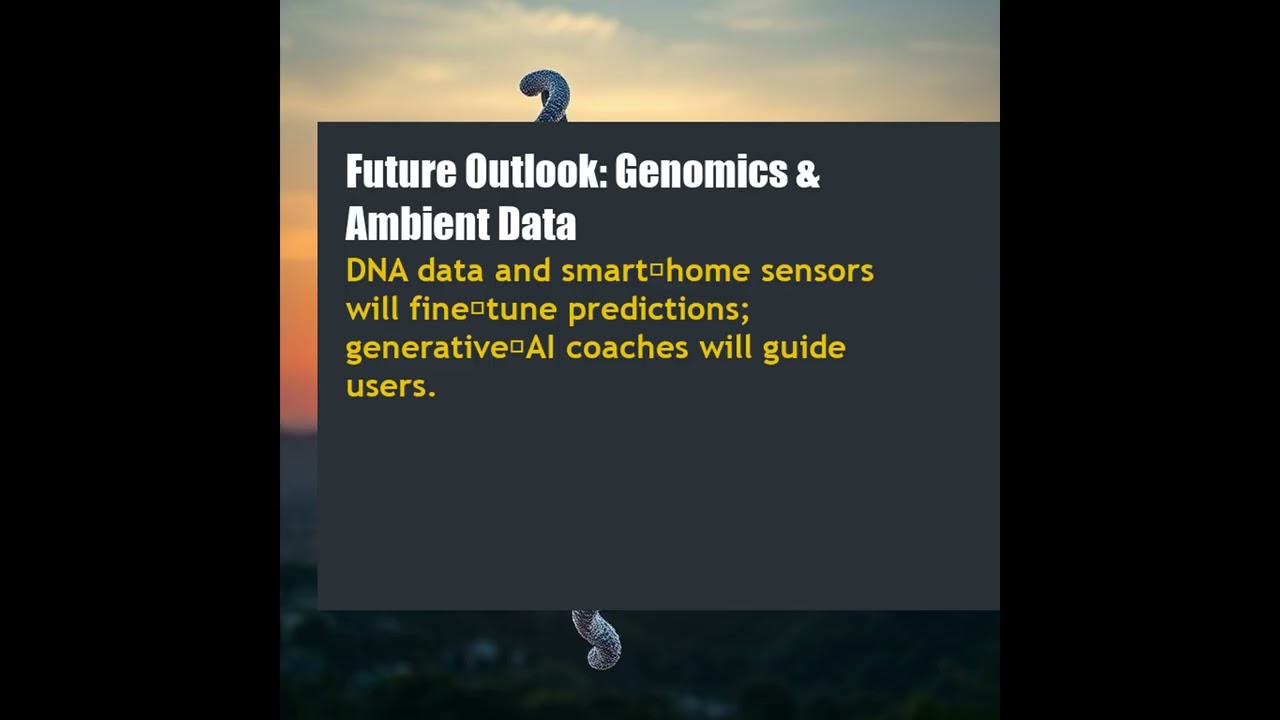
Looking ahead, genomic data will slip into dashboards, enabling risk models that factor in DNA‑based predispositions alongside daily habits. Ambient sensors embedded in homes will monitor air quality, lighting, and even sound, feeding context‑aware adjustments to sleep‑stage forecasts.
Generative‑AI coaches will chat with users in natural language, offering real‑time encouragement and re‑optimizing plans on the fly. Vi Labs predicts that by 2027, 60 % of premium wellness subscriptions will include at least one genomic or ambient data stream.
The era of reactive health is ending; predictive, personalized, and pre‑emptive care is arriving on our wrists, fingers, and now, perhaps, in our genes.



GIPHY App Key not set. Please check settings