

 Ryan Chen
Table of Contents
asteroid 2024 yr4
Ultimate Look: asteroid 2024 yr4 From City‑Killer Panic to Zero Risk
asteroid 2024 yr4 sparked worldwide panic, but precise science proved the threat was vanishingly small.
The ‘City‑Killer’ Buzz: Why the World Went on Edge
When early calculations hinted that asteroid 2024 YR4 could slam into Earth, social media ignited like a powder keg. Headlines shouted “city‑killer” while families huddled around televisions, eyes wide with dread. The panic was not just media‑driven; satellite‑track alerts pinged phones worldwide, turning scientists into reluctant celebrities. In the frenzy, skeptics warned of hype, yet the visceral fear of a cosmic punch‑in‑the‑face proved irresistible.
Public reaction rippled from online forums to town‑hall meetings, where residents demanded emergency plans. Even ticket sales for apocalypse documentaries spiked, a testament to how quickly uncertainty translates into economic buzz. Yet behind the roar, a small cadre of astronomers quietly sifted through noisy data, preparing to separate fact from fear.
The drama underscored a deeper truth: modern society is hyper‑connected, and a distant rock can dominate headlines in minutes. This episode reminded us that the line between legitimate hazard and sensationalism is razor‑thin, and that line is where the story truly unfolded.
As the world braced, the astronomical community raced against the clock, knowing that precise measurements could either vindicate the panic or restore calm.
Discovery and the Early Terror: From First Glimpse to Torino Level‑3
Late December 2024, a modest ground‑based telescope in Chile logged a moving dot that would soon become a headline monster. Initial orbit calculations placed 2024 YR4 on a trajectory intersecting Earth’s orbit within a decade, earning it a Level‑3 rating on the Torino Impact Hazard Scale.
The raw numbers were unsettling: a semi‑major axis barely larger than Earth’s, a modest eccentricity, and a low inclination that aligned the path directly with our planet’s orbital plane. Astronomers worldwide scrambled to refine the orbit, aware that each new data point could swing the risk dramatically.
Public agencies issued provisional alerts, and the C Alerts and Warnings channel on NewsBurrow lit up with live updates. The tension was palpable—every new observation felt like a roll of the dice.
| Parameter | Value |
|---|---|
| Semi‑major axis (AU) | 1.02 |
| Eccentricity | 0.15 |
| Inclination (°) | 3.2 |
| Torino Scale | Level 3 (initial) |
The early alarm, while later proven excessive, highlighted how quickly uncertainties can balloon into global concern.
Trajectory Re‑calibrated: How the Threat Vanished
By March 2025, a cascade of radar ranging and optical measurements sharpened the asteroid’s path. The refined models pushed the impact corridor millions of kilometers away, slashing the probability to less than 0.01 %.
That statistical drop demoted 2024 YR4 to a Torino Level 0, essentially declaring it a non‑threat. Yet the journey from doom to safety was not just numbers; it was a showcase of international data sharing and rapid computational advances.
The graphic illustrates the steep decline, a visual reassurance that the cosmos, while unpredictable, is also increasingly observable.
JWST’s Close‑up: The Decisive Proof That 2024 YR4 Won’t Hit
In April 2025, the James Webb Space Telescope trained its NIRCam on the wandering rock, delivering high‑resolution infrared images. The instrument measured a diameter of roughly 60 meters, a size far too small to cause global catastrophe even if it struck the Moon.
NASA’s Dr. Elena Martínez declared, “JWST’s data conclusively eliminates any 2032 lunar impact scenario, putting the city‑killer myth to rest.” ESA’s counterpart echoed the sentiment, noting the importance of precise sizing for impact probability algorithms.
Beyond quelling fear, the observations refined the asteroid’s albedo, mass estimate, and spin rate—critical parameters for any future deflection mission.
If the Moon Were Hit: Six‑Million‑Ton Fireball and Crater Chaos
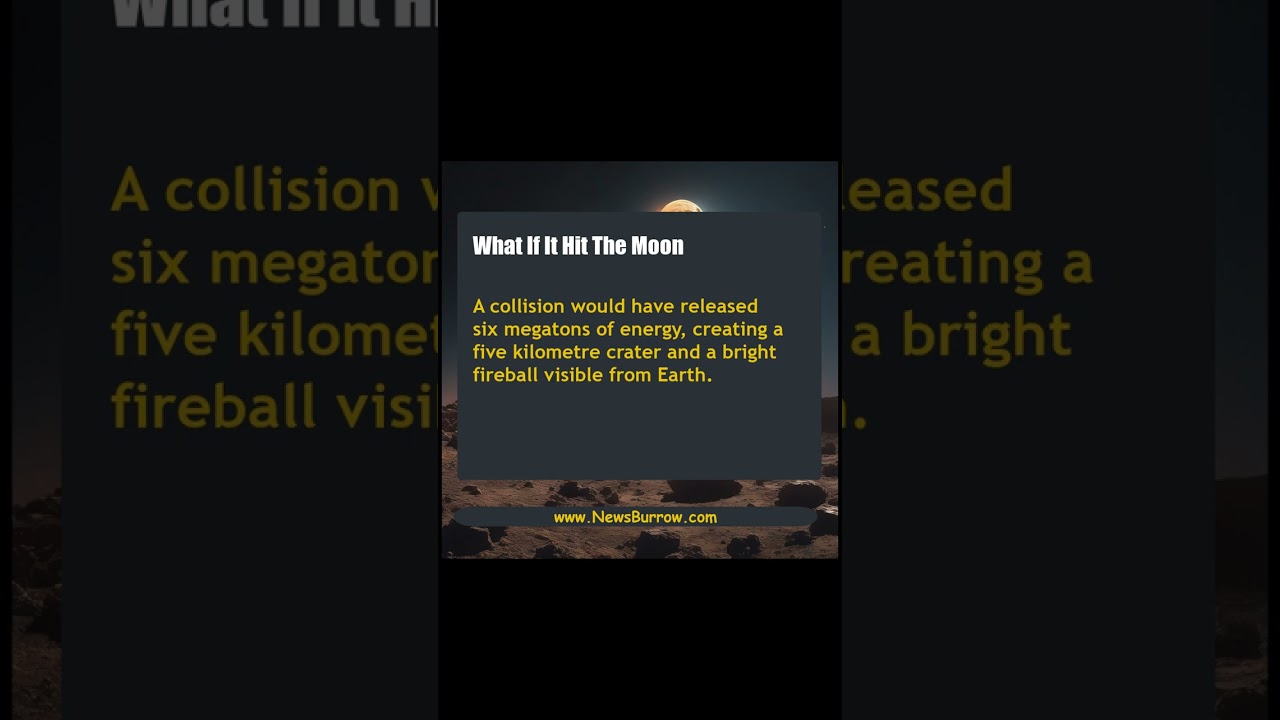
Had 2024 YR4 collided with the lunar surface, the energy release would have rivaled a 6‑megaton TNT blast—a force comparable to 120 times the Hiroshima bomb.
The impact would have carved a crater about five kilometers wide, ejecting material that would produce a luminous fireball visible from Earth, especially on the night side of the Moon.
| Metric | 2024 YR4 | Comparison |
|---|---|---|
| Impact Energy | 6 Mt TNT | Tsar Bomba: 50 Mt TNT |
| Crater Diameter | ~5 km | Meteor Crater: 1.2 km |
While dramatic, the actual risk remained nil, yet the hypothetical scenario underscored why even small bodies deserve careful scrutiny.
Science Goldmine: What a Lunar Flyby Could Reveal
A near‑miss with the Moon would have offered a unique laboratory for studying lunar regolith response to high‑velocity impacts. Dust plumes and ejecta trajectories could refine models of surface cohesion.
Moreover, spectroscopic data from the flyby would decode the asteroid’s composition, hinting at its origin—whether a fragment of a larger parent body or a primitive carbonaceous relic.
Such insights could seed future sample‑return missions, leveraging a natural “free‑flyby” to gather material without the expense of a dedicated launcher.
Planetary Defense Lessons: Speed, Collaboration, and Flexibility
The 2024 YR4 episode showcased the power of early detection paired with rapid international coordination. Within weeks, NASA, ESA, and independent observatories exchanged data, iterating models in near real‑time.
CISA’s chief of space security remarked, “Our ability to downgrade the risk so swiftly demonstrates that the planetary defense network is maturing faster than any asteroid threat.” The incident proved that flexible mitigation planning—ready to shift from evacuation prep to scientific observation—can save resources and nerves.
Future protocols will likely embed automated alert pipelines, ensuring that the world never again watches a “city‑killer” story unfold in the dark.
History Repeats? Comparing 2024 YR4 with Past Near‑Earth Misses
Asteroid 2024 YR4 is not the first rock to ignite global alarm. In 1998, 1998 SF36 sparked a brief media frenzy before calculations relegated it to a harmless pass‑by. Likewise, 2013 TX68 briefly flirted with a Level‑2 rating before being demoted.
| Object | Discovery Date | Max Torino Level | Final Outcome |
|---|---|---|---|
| 2024 YR4 | Dec 2024 | 3 → 0 | No impact |
| 1998 SF36 | Apr 1998 | 2 → 0 | No impact |
| 2013 TX68 | Aug 2013 | 2 → 0 | No impact |
Each case reveals a pattern: initial uncertainty inflates risk perception, but as observation arcs lengthen, probabilities plummet.
The historical lens reminds policymakers that vigilance must be matched with patience, lest fear outpace facts.
Visual Dashboard: Timeline and Probability at a Glance
The dashboard compresses years of data into a single glance, letting readers see how the probability gauge nosedived as observations improved.
Looking Ahead: Ongoing Monitoring and Real‑Time Alerts
Even with 2024 YR4 safely receded, the sky remains crowded with objects of unknown intent. NewsBurrow Network has pledged to issue live alerts via its C Alerts and Warnings channel, ensuring the public never stalls in the dark again.
Future plans include deploying a constellation of small infrared satellites to capture asteroids earlier, shaving weeks off detection times. Combined with AI‑driven orbit prediction, the system aims to turn panic into informed readiness.
As humanity watches the heavens, the lesson rings clear: transparency, speed, and scientific rigor are the trinity that will keep our cities safe.



GIPHY App Key not set. Please check settings