

 David Goldberg
Table of Contents
extreme weather financial risk
Urgent Alert: Extreme Weather Financial Risk Hits $898B Exposure
Extreme weather financial risk is reshaping boardroom priorities as CEOs confront a looming $898 billion exposure by 2026.
The Trillion-Dollar Storm: Why Boards Can’t Ignore the Weather
Yesterday’s flood in Europe erased $2.6 billion from corporate balance sheets; tomorrow’s heatwave could scorch assets worth trillions. The narrative has shifted from distant climate talk to an urgent, boardroom‑level alarm bell.
Investors now demand that CEOs treat extreme weather as a material risk, not a peripheral footnote. When a hurricane stalls a refinery for weeks, the ripple hits stock prices, credit ratings, and shareholder confidence.
Financial models are being rewritten to embed climate variables alongside traditional market drivers. The old assumption that nature is a background player is rapidly eroding.
Stakeholders—shareholders, regulators, insurers—are watching closely, ready to punish any firm that sidelines weather‑related exposure.
Quantifying the Threat: The $898 Billion Forecast That Keeps Sleepers Awake
According to the latest CDP analysis, corporations collectively face a looming $898 billion exposure by 2026 if current trends persist. That figure dwarfs the $3 billion recorded losses of 2025, a stark reminder that the storm is only gathering strength.
The graph below visualizes the chasm between today’s realized losses and tomorrow’s projected threat.
The 2025 bar represents actual losses—modest in the grand scheme but a warning sign. The 2026 bar, soaring to $898 billion, is a projection that could cripple any unprepared balance sheet.
Analysts argue that the gap reflects not just climate escalation but also inadequate corporate disclosure and risk modeling.
If the trajectory isn’t altered, the next decade could witness a cascade of bankruptcies, credit downgrades, and market turmoil.
The Awareness Gap: Why Boards Still Underestimate the Storm
Only 35% of Fortune‑500 firms now flag extreme weather as a material financial risk. The remaining 65%—often the most exposed—treat it as a peripheral concern.
This blind spot stems from legacy risk frameworks that prioritize market volatility over physical threats. Traditional risk committees lack the climate expertise needed to read the warning signs.
When boardroom conversations sideline weather, the company forfeits early mitigation opportunities, paying a premium later.
Research shows that firms that acknowledge the risk early can shave up to 13% off future mitigation costs.
Cascading Effects: How Floods, Heatwaves, and Cyclones Cripple Assets and Supply Chains
Physical climate events strike at the heart of operational continuity, turning assets into liabilities overnight.
| Weather Event | Primary Financial Impact on Assets |
|---|---|
| Floods | Infrastructure damage, inventory loss, production downtime |
| Heatwaves | Equipment overheating, increased cooling costs, labor productivity drop |
| Cyclones | Structural destruction, logistics disruption, insurance claim spikes |
When a flood inundates a manufacturing hub, factories halt, orders slip, and revenue evaporates in days.
Heatwaves elevate energy bills and force shutdowns of temperature‑sensitive equipment, eroding margins.
Cyclones shred transport networks, forcing firms to reroute goods at premium rates, exposing them to contractual penalties.
The combined effect ripples through supply chains, turning a single event into a global cascade of financial loss.
The Uninsured Burden: When Insurance Fails to Shield Corporations
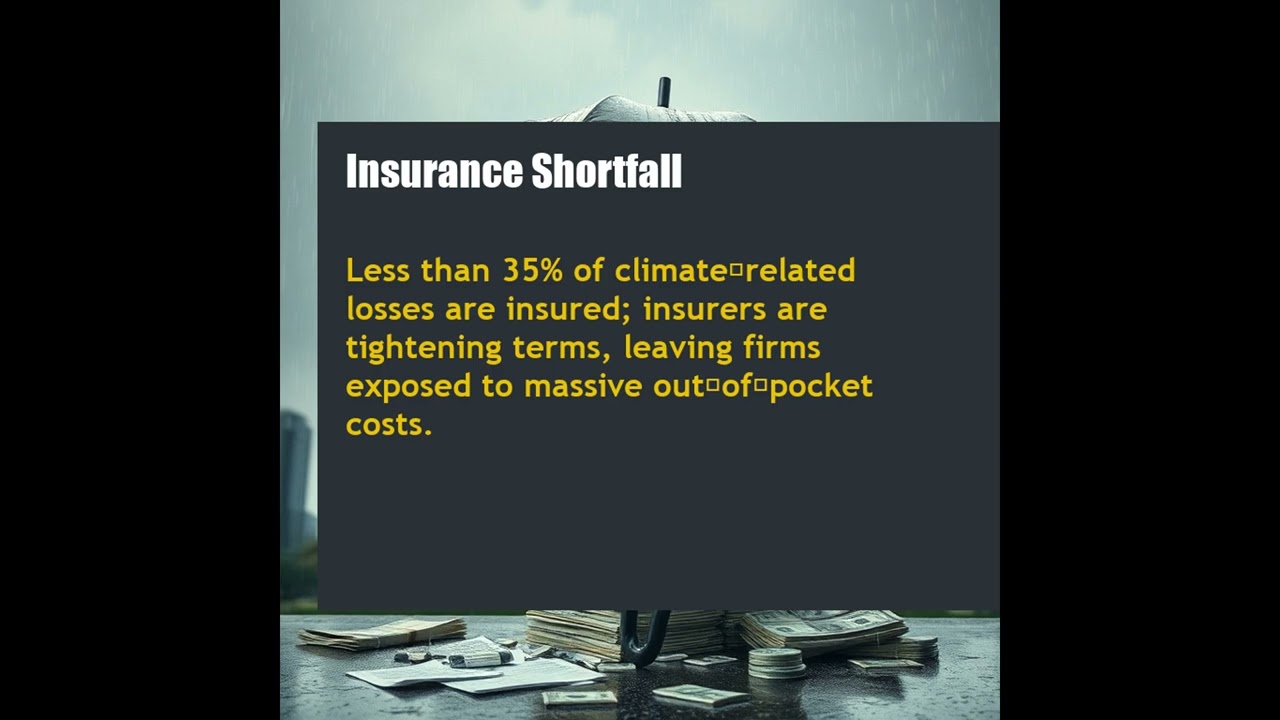
Less than 35% of climate‑related losses are currently covered by insurance, leaving a massive exposure gap.
Insurers are tightening underwriting standards, hiking premiums, and in some cases withdrawing coverage entirely for high‑risk zones.
Uninsured firms are forced to dip into reserves, raise capital, or default, passing the cost onto taxpayers and shareholders.
The fiscal shock reverberates across economies, amplifying the urgency for proactive risk transfer strategies.
The Global Divide: Emerging Markets Bear the Heaviest Climate Costs
Developing economies confront steeper borrowing costs and thinner balance sheets, magnifying weather‑driven financial shocks.
A cyclone in Southeast Asia can double a nation’s external debt service burden within months, straining fiscal stability.
Limited access to sophisticated insurance products forces many firms to self‑fund reconstruction, stunting growth prospects.
International investors are beginning to price climate resilience into sovereign risk assessments, reshaping capital flows.
Investing in Resilience: The Business Case for Proactive Mitigation
Data reveals that proactive mitigation spending is nearly 13 times cheaper than the cumulative cost of reactive disaster response.
Installing flood barriers, retrofitting facilities for heat tolerance, and diversifying supply routes deliver high ROI while safeguarding earnings.
Companies that embed climate‑resilient designs report steadier cash flows and lower cost‑of‑capital ratios.
Boardroom strategies that prioritize resilience are emerging as decisive competitive differentiators.
Mandating Transparency: New Regulations Force Climate Disclosure
Regulators across Europe, North America, and Asia are tightening mandates on climate‑related financial reporting.
The latest frameworks require firms to audit physical risks, quantify potential losses, and disclose mitigation plans to investors.
Non‑compliance now risks fines, litigation, and loss of market access, turning transparency into a strategic imperative.
Transparent reporting also unlocks capital from ESG‑focused funds, aligning financial incentives with climate stewardship.
Beyond Recovery: Building a Resilient Future Economy
The next decade will reward firms that embed resilience at the core of their financial architecture.
Executives must recalibrate risk models, allocate capital to climate‑hardening projects, and embed adaptive governance structures.
Policymakers should incentivize private investment in resilient infrastructure through tax credits and guarantee schemes.
Only a coordinated, forward‑looking approach will prevent extreme weather from becoming the next systemic financial crisis.



GIPHY App Key not set. Please check settings